FMCSA's carrier census lists 12,311 active carriers based in the Miami area — 11,807 with one to nine trucks, 385 operators running 10 to 49, and 97 with 50 or more — roughly 62,473 power units between them. 1
Freight comes into South Florida through three gates: the container berths at PortMiami, the tanker and container docks at Port Everglades, and the cargo ramps at Miami International. Almost all of it lands full, and most of what leaves goes north light. That one fact shapes the math for every carrier based between Homestead and Riviera Beach. A drayage tractor working out of Medley, a fuel hauler loading on Eller Drive in Fort Lauderdale, and a reefer running produce up the Turnpike are three different jobs, and they attract three different kinds of driver.
Pay-per-driver recruiting means we get paid when a driver you approved actually starts in your truck, and not before. For a carrier in Hialeah or Doral that means no retainer, no job-board subscription you forget to cancel, and no invoice for a stack of applications from people who have never sat in the morning stack on I-95. We screen in English and Spanish. We ask about your outbound lane before we talk about the inbound one, because the drivers will. And we tell drivers the truth about where the freight goes once it clears the port gate.
In Miami the driver is doing backhaul math on the first call while you are still reading him the sign-on bonus.
Freight in Miami: what moves, and where
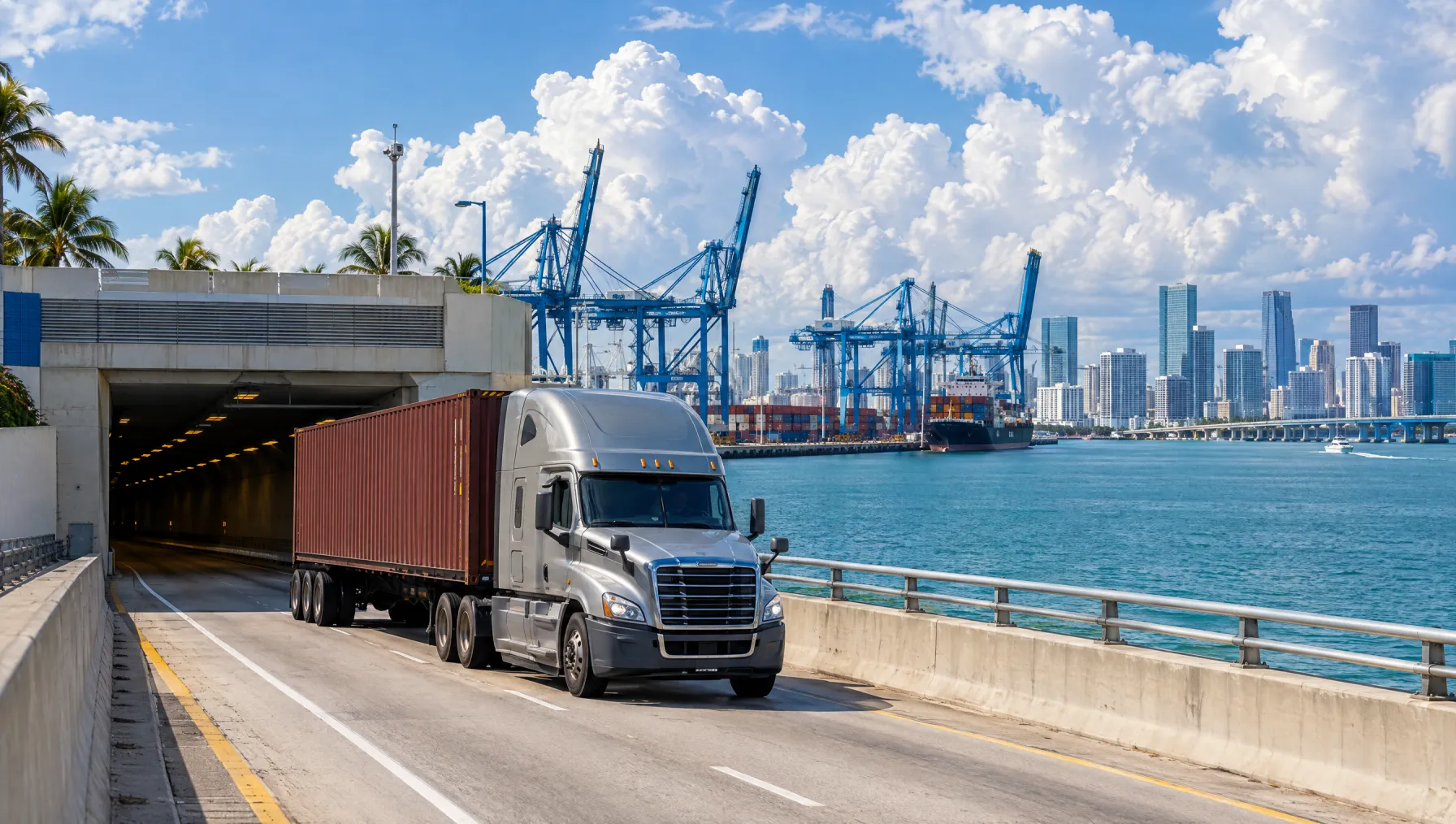
Start at the water. PortMiami handled 1,115,058 TEUs in 2025 and works through three terminal operators: POMTOC, South Florida Container Terminal and Seaboard Marine. Trucks reach the island through the PortMiami Tunnel, a toll-free 4,200-foot tube under the ship channel that connects the terminals to the MacArthur Causeway, with cargo in the right lane at 35 miles an hour. The county says the tunnel takes about 80 percent of port traffic off downtown streets, and that trucks make up 28 percent of the nearly 16,000 vehicle trips to and from the port each weekday. Florida East Coast Railway is the exclusive rail provider at PortMiami, Port Everglades and the Port of Palm Beach, and it owns the 351-mile mainline up to Jacksonville, so a box that does not go on a truck in Miami goes on a train north.
Up I-95 in Fort Lauderdale, Port Everglades moved more than a million TEUs in fiscal 2024 on 26 container services, most of them north-south trade with the Caribbean and Latin America, and it has FEC's near-dock Intermodal Container Transfer Facility beside the terminals. The port is also South Florida's fuel farm. Seventeen petroleum terminals and pipeline companies operate within the port's jurisdiction, more than 15 million gallons of energy products arrive by tank ship and barge each day, and tanker trucks carrying roughly 8,000 to 12,000 gallons leave for gas stations in 12 counties. Broward County says about one-third of Florida's energy requirements are stored and distributed by companies located there. Those fuel seats are a market of their own, with tanker and hazmat endorsements, a lot of night loading, and drivers who rarely leave once they are in.
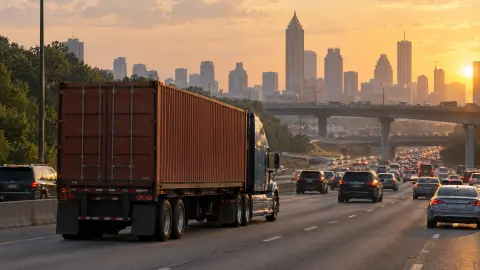
Inland, the fleets cluster west of the airport. The 33166 and 33178 ZIPs, the Medley and Doral side of the airport, hold 51 and 34 fleet families with ten or more trucks, the thickest concentration in the metro. Pompano Beach's 33069 has 23, the 33142 ZIP on Miami's industrial west side has 19, and 33186 out in Kendall has 15. Miami International Airport sits in the middle of that cluster. It moved 3,405,322 U.S. tons of freight in 2025, 85 percent of it international, and it is the country's number one airport for international freight, with cut flowers, fish and fresh fruit and vegetables among its top imports. Flowers and fish go into reefers within hours of landing, which is why so many small reefer fleets park within a few miles of the cargo ramps. South of all this, Miami-Dade's farms sold $1.14 billion of product in the 2022 agricultural census, second in Florida only to Palm Beach County, and that Homestead harvest moves north on trucks. Ryder System, the fleet-leasing and dedicated-transportation company, lists its business address in Miami, which puts a national fleet operator in the same labor pool as the one-truck owner-operators of Hialeah.
- I-95
- The spine of the coast from Miami through Fort Lauderdale to West Palm Beach, and a Strategic Intermodal System highway in FDOT's Broward and Palm Beach freight plans. Port Everglades fuel and container traffic, airport freight and every retail delivery share it, the morning stack builds before sunrise, and FL511 posts truck parking availability along it.
- Florida's Turnpike
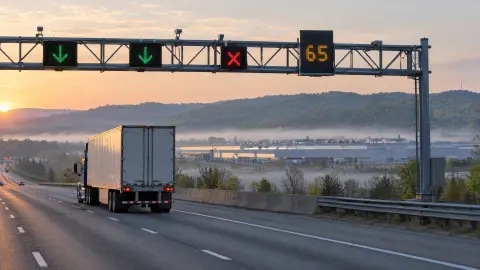
- The tolled inland route out of the metro toward Orlando and the rest of the state. Every truck needs SunPass or Toll-by-Plate, so carriers either budget the tolls or send drivers up US-27 and accept the slower run.
- I-75 / Alligator Alley
- A 78-mile, limited-access tolled stretch of I-75 across the Everglades in Broward and Collier counties, with mainline toll plazas at each end and two toll-free interchanges in between. It links the Naples and Fort Myers side of the state to Broward and Miami-Dade, and FDOT counts it as part of the Strategic Intermodal System.
- US-27
- The inland highway north through western Broward and Palm Beach counties toward Lake Okeechobee, listed by FDOT as a Strategic Intermodal System highway in both counties. Carriers that want to stay off Turnpike tolls run it, and a lot of agricultural loads take it down into Medley.
- PortMiami Tunnel / MacArthur Causeway
- A toll-free 4,200-foot tunnel from the MacArthur Causeway onto the port, cargo in the right lane at 35 mph. It keeps drayage off downtown streets, but every driver learns the gate rhythm the hard way.
Where the 10-plus-truck fleets sit, by ZIP: 33166 (51), 33178 (34), 33069 (23), 33142 (19), 33186 (15).
Hiring drivers in Miami: what we actually see
The driver pool here is bilingual and settled. Many drivers in Hialeah, Medley and Opa-locka trained in Spanish, interview in Spanish, and switch to English for a roadside inspection and back again for dispatch. A recruiter who screens only in English hears from a fraction of the market and then wonders why the phone is quiet. The other thing about this pool is that it does not want to leave. Drivers own homes in Hialeah, Miramar and Homestead, their families are here, and the first question on nearly every screen is some version of how many nights a week am I home. Port drayage and fuel work answer that question well. Regional reefer to Atlanta or Charlotte answers it badly unless the carrier is honest about a Tuesday-out, Friday-home pattern.
Commute geography is harsher than the map suggests. A driver in Homestead will not take a seat that starts in Pompano Beach, because that is a long run up the Turnpike or I-95 before the shift even begins, and the same is true in reverse. We draw the circle tight: Medley and Doral yards pull from Hialeah, Miami Gardens and west Kendall; Pompano and Deerfield yards pull from Broward and the south end of Palm Beach County. Seats that fill fast here are local drayage for a driver who already holds a TWIC, city routes that end at the same yard every night, and dedicated retail runs with a fixed schedule. Seats that fill slowly are hazmat tanker, which needs the endorsements and a clean record, and anything that asks a Miami driver to stay out two weeks at a time.
What carriers get wrong is the pitch. They lead with cents per mile when the driver is doing math on backhaul: if the outbound load off the peninsula is light or missing, the week's miles collapse and so does the check. They skip the TWIC question until orientation and then lose a week waiting on a card. And too many post an English-only, Midwest-style over-the-road job description for a yard in Medley where every other conversation on the lot is in Spanish. We fix those three things on the intake call before we make a single phone call to a driver.
What drivers in Miami are paid
BLS puts the median annual wage for heavy and tractor-trailer truck drivers in the Miami-Fort Lauderdale-West Palm Beach, FL metro area at $51,580, with a mean of $56,080 (Occupational Employment and Wage Statistics, May 2025).
The Bureau of Labor Statistics puts the 2025 median for heavy and tractor-trailer truck drivers in the Miami-Fort Lauderdale-West Palm Beach metro at $51,580 a year, with a mean of $56,080. The gap between the two numbers tells you the mix. A large share of local port, city and retail seats sit near the median, and a smaller group of fuel haulers, dedicated regional drivers and company drivers on long lanes pull the mean up.
The median is a local number for a local market. Many of the seats we fill here are home nightly, and a local seat does not produce the long miles that push an over-the-road check higher. When a Medley or Doral carrier writes a job ad, publish the real weekly gross for that seat and the home time next to it, not a cents-per-mile figure that assumes miles the peninsula does not produce.
A driver who sees a number above $51,580 with nightly home time will call. A driver who sees a mileage rate with no outbound lane behind it will not.
- $51,580
- median annual wage, Miami-Fort Lauderdale-West Palm Beach metro
- $56,080
- mean annual wage, May 2025 (BLS OEWS 53-3032)
Rules that shape Miami seats
TWIC for unescorted access at the seaports
Port Everglades states that federal law requires anyone seeking unescorted access to a seaport facility to hold a Transportation Worker Identification Credential. TWIC holders are issued a green Business Purpose Card for designated restricted and secure areas. A drayage driver without the card waits for an escort or does not get the load, so ask about it on the first call. source ↗
Florida weight limits: 80,000 pounds on the interstates
Florida Statute 316.535 caps gross weight on the Interstate System at 80,000 pounds including all enforcement tolerances, with 20,000 pounds on any single axle. Heavy export boxes and loaded fuel tankers run close to those numbers, and the scale is where a Medley carrier learns whether its container weights were honest. source ↗
Hurricane season, June 1 to November 30
The National Hurricane Center defines the Atlantic season as June 1 through November 30, with the statistical peak on September 10 and most activity between mid-August and mid-October. A dispatcher here plans fuel, port closures and driver availability around the cone, and a driver placed in August needs to hear that on the screen. source ↗
Tolled corridors and evacuation toll suspensions
Alligator Alley in Collier and Broward counties and the Turnpike mainline are tolled facilities. Ahead of Hurricane Milton in October 2024, FDOT suspended tolls for seven days on Alligator Alley, the Turnpike mainline and other facilities to keep evacuation traffic moving. Carriers should budget tolls in normal weeks and expect routing changes when a storm is forecast. source ↗
Heat index alerts for outdoor work
The Weather Service office in Miami issues heat alerts when the heat index is expected to exceed 105 to 110 degrees for at least two consecutive days, and notes that full sun can add up to 15 degrees to the felt value. Drivers chaining containers or hooking tanker hoses on a July afternoon work under that number. source ↗
PortMiami Tunnel lane and speed rules
Miami-Dade County assigns cargo traffic to the right lane and cruise traffic to the left lane inside the 4,200-foot PortMiami Tunnel, and enforces a 35 mph limit. The tunnel is toll-free and links the port directly to the MacArthur Causeway, which is how drayage avoids downtown streets. source ↗
The Miami calendar
Hurricane season runs June 1 through November 30, with the peak around September 10, and from mid-August to mid-October every dispatcher in Doral is watching the cone. A storm threat empties the fuel racks at Port Everglades and can bring toll suspensions for evacuations, as it did in October 2024 when FDOT lifted tolls on Alligator Alley and the Turnpike mainline for seven days ahead of Hurricane Milton. Once the roads reopen there is a surge of inbound relief and rebuild freight.
Driver supply tightens in the weeks after a storm because drivers are dealing with their own roofs and their own families. The cooler months are the other season that matters. 14 billion farm sector ships its harvest north while Florida vegetables are in season: the state agriculture department lists tomatoes and sweet corn from October through June, squash from October through May and snap beans from November through May.
In our experience the reefer seats near the airport and in Medley open up over that same stretch, when flower, fish and produce imports through MIA land on top of the Homestead harvest. Late spring and early summer are the quietest stretch, and the easiest time to fill a seat with a driver who is ready to move.
How pay-per-driver works for a Miami carrier
An intake call maps your lanes, equipment, pay and home time for Miami; if we can't guarantee you enough driver volume, we say so on that call. Our recruiters interview every driver by phone and verify CDL, endorsements, experience and work history against your requirements, then send complete submission packets through Onboard, our own placement platform. You pay per placed driver — half when the driver starts, half after the first 14 days — and recruiting for Miami runs from our North Miami, FL office, 10 miles away. The model in full is on Pay Per Driver; why the first 48 hours decide most hires is on speed to hire.
Who this fits in Miami — and who it doesn't
The census counts 385 operators running 10 to 49 trucks in the Miami area and 97 with 50 or more.
This works for the 385 fleet families in the 10-to-49-truck band and the 97 at 50 trucks and up, because those are the carriers with a yard address, a dispatcher who answers the phone, and enough freight to keep a new driver busy in week one. A Medley drayage outfit with 15 tractors and a TWIC requirement, a Pompano fuel hauler with tanker endorsements and night shifts, a Doral reefer carrier running flowers and fish off the MIA ramps, a Hialeah carrier with dedicated retail routes across three counties. Each of those has a clear seat, a clear schedule and a clear answer to the home-time question, and that is what a driver here needs to hear before he says yes.
We also work with carriers in the 1-to-9 band when the owner is the dispatcher and knows exactly which lane the second truck will run.
Who we turn down: We turn down carriers who cannot describe the outbound lane. If a Miami fleet is hauling inbound port freight and hoping a load board fills the trip north, the driver's miles will collapse by week three and he will leave, and we will have placed him into a seat that was never real. We also turn down carriers who want English-only recruiting for a Hialeah yard, carriers that will not say whether a TWIC is required, and anyone who wants to post a cents-per-mile number without a weekly gross next to it. Those are not picky rules. They are the three things that end a Miami placement inside 90 days.
How we think about drivers who stay: why drivers quit, and how to fix each reason. Selling to trucking companies rather than hiring drivers? That's a different service — Marketing for Trucking.
Our numbers
No third party audited these. They're our own operating numbers — the claims we make publicly about our own shop, and the standard you should hold us to on a call.
- 100+
- drivers our operation places per month
- 3,000+
- lifetime CDL hires
- 50+
- carrier partners
- 24 hrs
- to first drivers for a new carrier
More carrier feedback, in the carriers' own words: results.
Questions Miami carriers ask us
Staffing and recruiting are not the same purchase — ask any agency these, then compare who does the work and when the money changes hands.
What does it cost a Medley drayage carrier to hire a driver through CDL Agency?
You pay per driver who actually starts in your truck, nothing up front. We split the fee in two: half when the driver starts, and the other half once he clears the 14-day retention term. If he leaves in those first two weeks, the second half is never billed and we recruit the replacement. There is no retainer, no monthly subscription and no charge for applications that never turned into a hire. For a 15-truck drayage fleet in Medley this means the recruiting bill lines up with the days a tractor was actually earning, which is the only way we think it should work on a peninsula where freight margins are decided by the backhaul.
Where are your recruiters, and do you know the yards in Hialeah and Doral?
Our South Florida office is in North Miami, about 10 miles from downtown Miami, and it is one of four offices we run, alongside Mundelein and Romeoville in Illinois and Lancaster in the Dallas area. That puts our recruiters inside the market: the same I-95 traffic, the same airport-side yards in Medley and Doral, the same conversations in Spanish at the counter. We screen drivers by phone and video from that office, and when a carrier wants a face-to-face at the yard before an orientation class, we can be in Medley or Hialeah the same day. We do not run a walk-in hiring hall there, and we would rather be honest about that than pretend.
Do seats running out of Port Everglades or PortMiami need winter or chain prep at all?
Not for the local work. A drayage or fuel driver whose world is the tunnel, Eller Drive and the I-95 corridor will never touch a chain. The weather prep that matters here is hurricane season, June 1 through November 30 with the peak around September 10, and summer heat, where the Weather Service office in Miami issues alerts when the heat index is expected to exceed 105 to 110 degrees for two days running. For regional seats that run north from Medley to Atlanta, Nashville or the Carolinas, the picture changes between December and March. Drivers who have spent their whole career in Dade or Broward may have never driven on ice, and we ask about that directly before we send someone to a carrier whose lanes cross the Tennessee mountains in January.
What does a Doral or Hialeah carrier need ready on the intake call to get drivers fast?
Six things, and the carriers who have them hire in days instead of weeks. The yard address, so we can draw the commute circle. Whether the seat needs a TWIC, tanker or hazmat endorsement, because that decides which drivers we even call. The schedule stated as home time, not as a mileage range. The weekly gross a driver can actually expect in the first month, with the outbound lane explained so the backhaul question has an answer. Whether your dispatcher speaks Spanish, because many of your applicants will ask. And your next orientation date, since a driver who says yes on a Tuesday and hears nothing until the following week takes another job on Thursday. Carriers near the MIA cargo ramps that bring all six to the call are the ones whose seats we fill fastest.
Why do drivers in Miami quit in the first 90 days, and how does your 14-day retention term work?
In this market the first-90-day exit is almost always a math problem or a geography problem. The math problem is backhaul: the driver was told a mileage rate, the outbound loads off the peninsula were thin, and his check came in short twice in a row. The geography problem is the commute: a Homestead driver took a Pompano Beach seat because the pay looked good, and after three weeks of the Turnpike he stopped showing up. Our 14-day retention term covers the first two weeks. If the driver leaves in that window, you are not billed the second half of the fee and we start again at no charge. Beyond that, we reduce 90-day exits by refusing to recruit for seats that cannot state the outbound lane and the real weekly gross up front.
When is it hardest and easiest to hire drivers in South Florida, and why?
The hardest stretch is the weeks around a storm. From mid-August to mid-October, when hurricane activity peaks, carriers hiring for the fuel racks at Port Everglades or for relief freight into Miami are competing for drivers who are also boarding up their own homes, and a direct hit takes some drivers out of the market for weeks. The second hard stretch is the start of the cooler months, when the reefer seats around the MIA cargo ramps and in Medley open up at the same time Miami-Dade's vegetable harvest starts moving north, so every carrier with a reefer wants the same experienced drivers. The easiest window is late spring into early summer, before the season starts: freight is steadier, fewer carriers are adding trucks, and a driver who wants a change can make it without a storm or a holiday in the way.
Drivers in Miami: browse current CDL-A jobs or get matched to a carrier — free for drivers.
Sources
- PortMiami cargo statistics and terminal operators (Miami-Dade County)
- PortMiami Tunnel (Miami-Dade County)
- Port Everglades cargo overview (Broward County)
- Port Everglades energy and petroleum (Broward County)
- Port Everglades fuel distribution, tanker to gas tank (Broward County)
- Port Everglades ID badges and TWIC (Broward County)
- Port Everglades about and address (Broward County)
- TSA Transportation Worker Identification Credential
- Florida East Coast Railway network and port service
- Miami International Airport facts and 2025 cargo tonnage
- Miami International Airport cargo overview
- Ryder System, Inc. SEC EDGAR filing index (business address)
- Florida Statute 316.535, maximum weights
- National Hurricane Center, tropical cyclone climatology
- FDOT, tolls suspended for Hurricane Milton evacuations (Oct 7, 2024)
- Florida's Turnpike, SunPass and Toll-by-Plate
- Florida's Turnpike Enterprise, FY2017 Department-Owned Facilities report (Alligator Alley)
- FDOT, Broward County Freight and Logistics Overview (SIS highways)
- FDOT, Palm Beach County Freight and Logistics Overview (SIS highways)
- FL511, FDOT real-time traffic and truck parking
- FDACS, Florida agriculture overview and county statistics
- FDACS, Florida crops in season
- NWS Miami, heat page
1 FMCSA Company Census (2026-09-26): active carriers based in Miami, Hialeah, Medley, Doral, Miami Gardens, Opa-locka, North Miami, Fort Lauderdale, Pompano Beach, Davie, Hollywood, Miramar, Pembroke Pines, Deerfield Beach, Boca Raton, West Palm Beach, Riviera Beach, Homestead; MCS-150 filed in the last 24 months; 1–20,000 trucks; fewer than 10 buses. 10+ truck counts merge registrations sharing an address or D-U-N-S number. Totals and the 1–9 band count active USDOT registrations; fleet sizes are self-reported on the MCS-150, so read them as a scale, not a headcount.
Wages: U.S. Bureau of Labor Statistics, OEWS May 2025, occupation 53-3032, series OEUM003310000000053303213 (median) and OEUM003310000000053303204 (mean).
Written by
Andrius Pletniovas — Founder, CDL Agency
Andrius Pletniovas (Andrius Digital) is the founder of CDL Agency, a truck-driver recruiting and marketing company that has placed 3,000+ CDL drivers for 50+ carriers across the U.S. He writes about driver recruiting, retention, and the trucking market from running the agency every day.
More about Andrius →Official personal website →