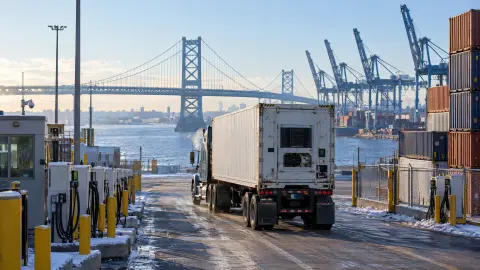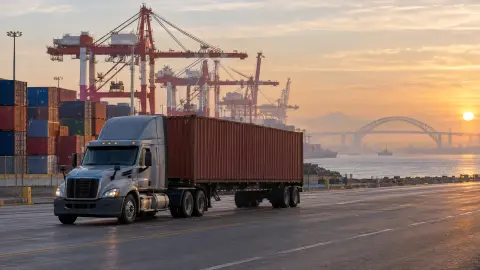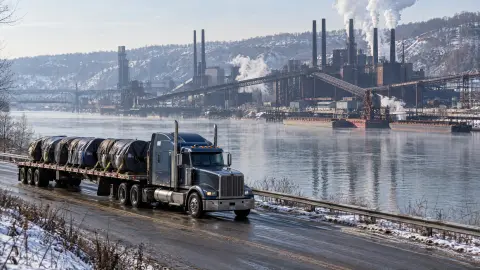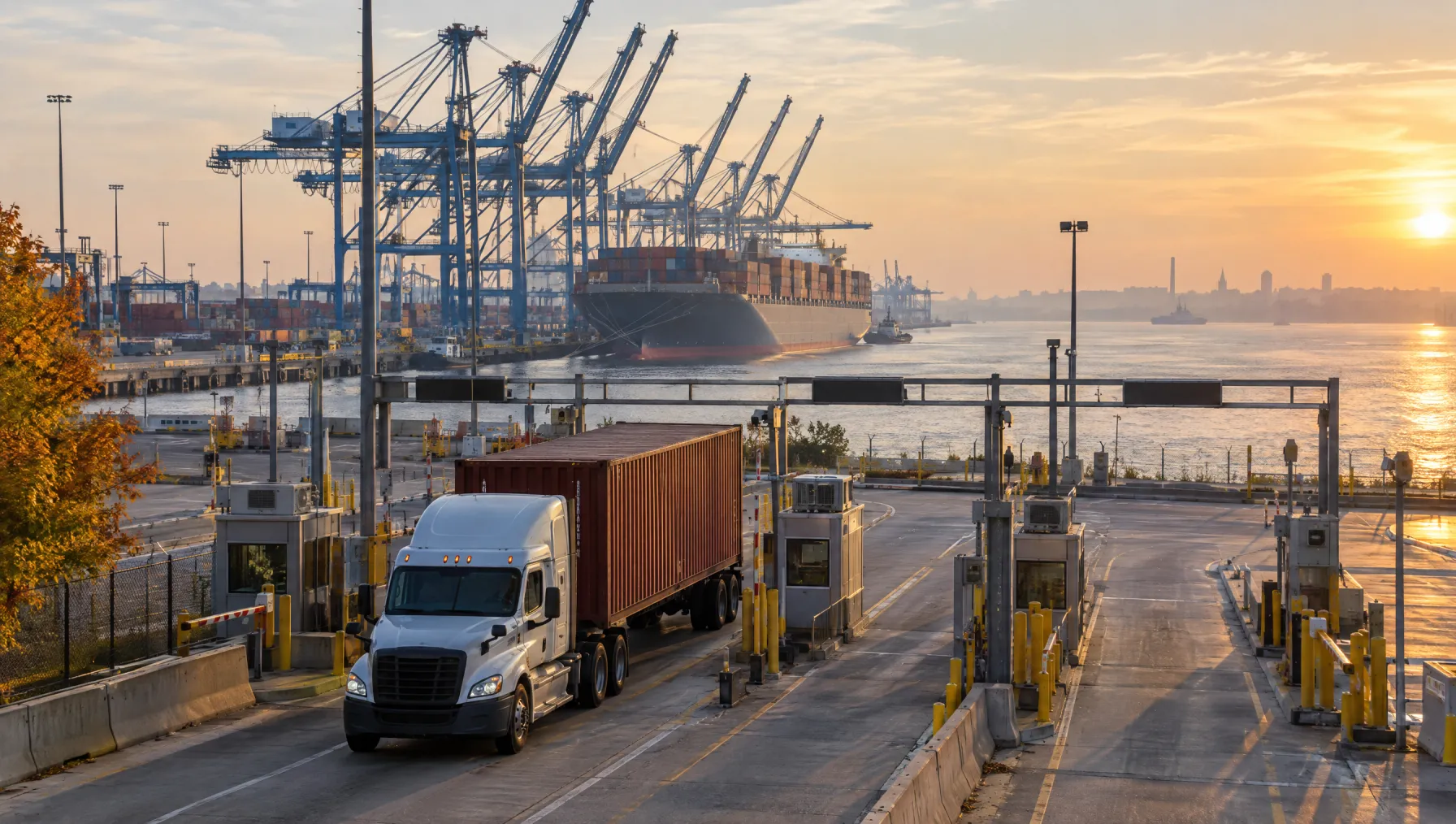
FMCSA's carrier census lists 3,826 active carriers based in the Baltimore area — 3,448 with one to nine trucks, 309 operators running 10 to 49, and 60 with 50 or more — roughly 44,714 power units between them. 1
Every container that comes off a ship at Seagirt and every car that rolls off at Dundalk or Fairfield leaves on a truck or a railcar, and the trucks leave through two tunnels that ban hazmat, one of which will not take a double trailer or anything over 13 feet 6 inches. Since the Key Bridge came down, the beltway no longer closes around the harbor. A driver who used to loop I-695 from Sparrows Point to Glen Burnie now sits in the Fort McHenry or Harbor Tunnel line with everyone else. Baltimore freight is port freight first, then the warehouse belt down I-95 and US 1 toward Hanover and Jessup that serves Washington as much as this city.
Pay-per-driver recruiting means a carrier here pays us for a driver who starts, not for ads, not for a stack of leads, not for a monthly retainer. We find, screen and submit drivers for one specific seat, and you pay a flat fee per placement. For a Dundalk drayage fleet or a Hanover regional outfit that needs three trucks seated before the fall import push, that is a cost you can put against a load, which is how most owners here already think.
A Baltimore driver already knows which tunnel refuses his load and which dock will hold him three hours; the recruiter who pretends otherwise loses him by Friday.
Freight in Baltimore: what moves, and where
The Port of Baltimore is the center of gravity. Dundalk Marine Terminal covers 570 acres with 13 berths and handles containers, automobiles, farm and construction roll-on roll-off equipment, wood pulp, breakbulk and project cargo, 2.5 miles from I-95 and 1.5 miles from I-695, with more than eight miles of rail inside the fence. Norfolk Southern provides the direct rail service there and CSX reaches it through a local interchange. Next door, Seagirt is the container terminal, 320 acres run by Ports America Chesapeake under a 50-year partnership signed in 2010, with 50-foot berths, Neo-Panamax cranes and a rated capacity of 1.5 million TEU a year. The 68-acre CSX intermodal yard sits beside Seagirt, less than a mile and two traffic signals from I-95, and loads six trains a day toward the Southeast and Midwest with gates open from 4 a.m. to midnight on weekdays. Fairfield Marine Terminal is 150 acres, 61 of them built out as an auto terminal, handling automobiles, light trucks, tractors, agricultural vehicles and wheeled cranes, and the MPA calls Baltimore the number one U.S. port for roll-on roll-off cargo. Every one of these gates requires a TWIC and an eModal registration under the carrier's SCAC, or the driver does not get in.
Sparrows Point is the second engine. Tradepoint Atlantic has turned the old steel mill site into a 3,300-acre logistics center with its own deepwater port on the 50-foot channel and onsite rail that connects directly to CSX and Norfolk Southern, and its site lists Amazon, Under Armour, Home Depot, FedEx, Volkswagen, BMW and McCormick among the companies there. On May 1, 2026, Tradepoint and Terminal Investment Limited broke ground on the Sparrows Point Container Terminal, 330 acres split between a 168-acre terminal with an intermodal yard and 162 acres of support land, built to add container capacity on the east side of the harbor. All of it sits on the far side of where the Francis Scott Key Bridge used to be. The MDTA's stated goal is to open the new cable-stayed bridge by 2030, foundation piles will be driven through spring 2027, and the state dashboard announced on October 1, 2026 put the permanent supports at 55 percent done at the south tower and 26 percent at the north. Until then, Sparrows Point trucks headed for Glen Burnie, Curtis Bay or BWI go through the tunnels or around the west side of the beltway.
The FMCSA data shows where the fleets park. The ZIP with the most carrier families is 20794, Jessup, with 28, then 21224 in east Baltimore near the Dundalk gates with 27, 21226 in Curtis Bay with 26, 21076 in Hanover with 21 and 21220 in Middle River with 21. That is the map: port drayage on the east and south sides of the harbor, and the warehouse belt southwest along I-95 and US 1 toward BWI, where the airport's 395,000-square-foot Air Cargo Center and its DHL, FedEx and UPS operations average 1.4 million pounds of cargo a day. Commercial vehicles are prohibited on the Baltimore-Washington Parkway, so freight between the Jessup and Laurel belt and Washington rides I-95 and US 1. North on I-95, Middle River's 21220 is the fifth ZIP on that list, White Marsh sits beside it at the top of the Express Toll Lanes, and Aberdeen and Edgewood sit beside Aberdeen Proving Ground, the Army post that houses DEVCOM, CECOM and the Army Test and Evaluation Command.
- I-95 (Fort McHenry Tunnel and JFK Highway)
- The spine of the market. Through the eight-lane Fort McHenry Tunnel under the harbor, nearly 1.4 miles of tube, then north on the JFK Memorial Highway 50 miles from the city line to Delaware, with the northbound-only toll plaza a mile past the Susquehanna and the MDTA Police weigh station on the way. Hazmat loads cannot use the tunnel.
- I-695 Baltimore Beltway
- Without the Key Bridge the beltway is a horseshoe, not a loop. A Sparrows Point to Glen Burnie run that was a straight shot across the Patapsco now means a tunnel line or the long way around the west side past I-70 and I-83.
- I-895 Baltimore Harbor Tunnel
- The older four-lane tunnel, 1.4 miles, opened in 1957 and used by drayage between Dundalk, Canton and Curtis Bay. No double trailers, nothing over 13 feet 6 inches tall or 96 inches wide, and the same hazmat ban as Fort McHenry. Local drivers price the delay into their day.
- I-95 Express Toll Lanes
- Eight miles of lanes, seven of them tolled, all-electronic, between I-895 and just north of MD 43 at White Marsh. Carriers running White Marsh and Middle River freight decide whether the toll buys enough time to be worth it, and drivers ask who pays it.
- US 1 and the Jessup-Laurel belt
- Because commercial vehicles are barred from the Baltimore-Washington Parkway, US 1 and I-95 carry the warehouse freight between Jessup, Laurel, Elkridge and the Washington market. It is stoplight driving with heavy local turnover at the docks.
Where the 10-plus-truck fleets sit, by ZIP: 20794 (28), 21224 (27), 21226 (26), 21076 (21), 21220 (21).
Hiring drivers in Baltimore: what we actually see
Baltimore drivers are port drivers or they are not, and that is the first thing to settle. A TWIC holder who has run Seagirt and Dundalk for years knows the gate rhythm, the eModal system and which terminal lines move after lunch. He will not take a regional seat out of Hanover unless the hourly math is plainly better, and he asks about it in the first two minutes. The regional driver is a different person. He lives in Glen Burnie, Essex, Rosedale or Laurel, runs Philadelphia, Richmond or North Jersey, wants his own bed most nights, and his questions are about dock schedules, tunnel tolls and whether the truck is assigned. The two groups overlap less than carriers assume, and a job ad that tries to speak to both speaks to neither.
Commute geography matters more here than in most metros because the harbor splits the market. A driver in Dundalk or Middle River will not report to a yard in Curtis Bay or Jessup if it means a tunnel both ways on his own time. With the Key Bridge gone, the east-side driver and the south-side yard are further apart than the map suggests, and we screen for that before we submit a name. Drayage seats that pay by the hour with a set shift fill fastest. Regional seats with real home time fill next. The slow ones call themselves regional but run three nights out, or bury tolls and chassis delays in a percentage split.
What carriers get wrong here is reputation. Drivers compare notes in the terminal queue, and a bad dock or a slow settlement travels from Canton to Hanover by the weekend. We tell the driver exactly what the seat is, hourly or per-move, which gates, which lanes, who pays the Fort McHenry toll and whether TWIC renewal is reimbursed, because a driver who was told regional and got drayage is gone inside a month and nobody gets paid for that.
What drivers in Baltimore are paid
BLS puts the median annual wage for heavy and tractor-trailer truck drivers in the Baltimore-Columbia-Towson, MD metro area at $59,460, with a mean of $60,770 (Occupational Employment and Wage Statistics, May 2025).
The BLS puts the 2025 median for heavy and tractor-trailer drivers in the Baltimore-Columbia-Towson metro at $59,460 a year, with a mean of $60,770. The mean sitting a little above the median tells you there is a tail of drivers earning past the middle, which in this market is usually port drayage paid by the hour with overtime, or regional work with steady weekly miles. The figure is a blend of local, drayage and regional seats, so a carrier should not treat it as the number to beat.
It is the number the driver already has in his head. What a Baltimore carrier should publish is the real structure: an hourly rate or a per-move rate for drayage, a stated weekly figure for regional, who pays the tunnel and Express Toll Lane charges, whether TWIC fees are reimbursed and what the schedule is. Drivers here convert everything to an hour because the tunnel line and the terminal queue eat hours, and a carrier that states pay that way gets taken seriously.
- $59,460
- median annual wage, Baltimore-Columbia-Towson metro
- $60,770
- mean annual wage, May 2025 (BLS OEWS 53-3032)
Rules that shape Baltimore seats
Hazmat is banned in both harbor tunnels
The Fort McHenry Tunnel on I-95 and the Baltimore Harbor Tunnel on I-895 prohibit bulk gasoline, flammable liquids, explosives, significant amounts of radioactive materials, other hazardous materials and bottled propane over 10 pounds per container, with a maximum of ten containers. With the Key Bridge down there is no hazmat crossing of the harbor, so those loads go around the west side of the beltway. source ↗
No doubles or tall loads in the Harbor Tunnel
The I-895 Baltimore Harbor Tunnel bars all double trailers and any vehicle taller than 13 feet 6 inches or wider than 96 inches. Drayage drivers moving between Dundalk, Canton and Curtis Bay plan around this, and oversize loads use Fort McHenry or go around. source ↗
TWIC and eModal registration at every MPA gate
Truck drivers need a TWIC for unescorted access to Maryland Port Administration terminals, and the carrier must be registered in eModal under its SCAC with the driver enrolled in Trucker Check. The MPA states that a driver who is not registered and current in eModal, or who lacks acceptable credentials, is denied entry at the gate. source ↗
Maryland five-minute idling limit
Maryland Transportation Article 22-402 says a motor vehicle engine may not run more than five consecutive minutes while the vehicle is not in motion, with exceptions for traffic or mechanical trouble outside the driver's control, warming to the manufacturer's operating temperature, running necessary heating, cooling or auxiliary equipment, and accomplishing the intended use of the vehicle. Dock waits in Jessup and terminal queues at Dundalk test this rule every day. source ↗
Oversize permits must be rerouted off the Key Bridge
MDOT SHA Commercial Vehicle Operations states that the Francis Scott Key Bridge is closed and any hauling permit that used that route must be rerouted through the Maryland One permit system. Overheight loads above 14 feet 6 inches also require a height clearance route survey certification with the permit application. source ↗
Commercial vehicles are prohibited on the Baltimore-Washington Parkway
The National Park Service states plainly that commercial vehicles are prohibited on the Baltimore-Washington Parkway. Trucks running between the Jessup, Laurel and Hanover warehouse belt and Washington use I-95 or US 1 instead, and a new driver from out of state learns this the expensive way. source ↗
The Baltimore calendar
The port keeps the market moving all year. In our experience the auto and roll-on roll-off work out of Dundalk and Fairfield follows the vessel schedule more than the retail calendar, while container drayage at Seagirt and the Sparrows Point distribution centers builds toward the late summer and fall import push for holiday retail. That is when Sparrows Point and Jessup carriers come to us short of seats, and when a drayage driver with a current TWIC has the most choices.
Winter is the other pressure point. Snow and ice on the I-95 approaches and the tunnel lines slow everything. MDOT SHA runs the plows and salt that keep the corridor open and publishes emergency truck parking locations where commercial drivers can wait out storms that drop six inches or more.
We see applications pick up in January, when drivers who put up with a bad seat through the holidays start looking. Summer is thin, so a carrier that waits until August to fill a fall seat is already late.
How pay-per-driver works for a Baltimore carrier
An intake call maps your lanes, equipment, pay and home time for Baltimore; if we can't guarantee you enough driver volume, we say so on that call. Our recruiters interview every driver by phone and verify CDL, endorsements, experience and work history against your requirements, then send complete submission packets through Onboard, our own placement platform. You pay per placed driver — half when the driver starts, half after the first 14 days — and recruiting for Baltimore runs from our Mundelein, IL office, 720 miles away. The model in full is on Pay Per Driver; why the first 48 hours decide most hires is on speed to hire.
Who this fits in Baltimore — and who it doesn't
The census counts 309 operators running 10 to 49 trucks in the Baltimore area and 60 with 50 or more.
Our model fits the middle of the Baltimore market. The FMCSA census shows 3,448 registrations with one to nine trucks, 309 carrier families with 10 to 49 and 60 families with 50 or more. The 10-to-49 carrier in Hanover, Jessup, Curtis Bay or Dundalk, running drayage or mid-Atlantic regional with a dispatcher who knows every driver by name, is who we do the most for.
That owner cannot carry a full-time recruiter, cannot justify a monthly retainer that does not produce, and cannot leave a truck parked through the fall import season. The smaller 50-plus families work too, when they have a defined seat, an hourly or per-move pay sheet and a yard a driver can reach without a tunnel both ways.
Who we turn down: We turn down carriers that describe the job as regional when it is drayage, or that pay by a percentage with tolls, chassis waits and tunnel time buried inside it, because the driver figures it out at the first settlement and leaves. We turn down anyone who wants drivers tomorrow for a seat they have not defined. We turn down lease-purchase programs dressed as company jobs. And we do not take port work from a carrier that will not say who pays TWIC renewal, because in Baltimore that question comes up on every single call.
How we think about drivers who stay: why drivers quit, and how to fix each reason. Selling to trucking companies rather than hiring drivers? That's a different service — Marketing for Trucking.
Our numbers
No third party audited these. They're our own operating numbers — the claims we make publicly about our own shop, and the standard you should hold us to on a call.
- 100+
- drivers our operation places per month
- 3,000+
- lifetime CDL hires
- 50+
- carrier partners
- 24 hrs
- to first drivers for a new carrier
More carrier feedback, in the carriers' own words: results.
Questions Baltimore carriers ask us
Staffing and recruiting are not the same purchase — ask any agency these, then compare who does the work and when the money changes hands.
What does CDL Agency charge to fill a drayage or regional seat for a Baltimore carrier?
A flat fee per placed driver, agreed before we start, and nothing before that. You pay half when you accept the driver and half when the driver starts. There is no retainer, no ad spend passed through, no charge for leads that never call back. For a Dundalk drayage fleet or a Hanover regional carrier, that puts recruiting on the same footing as fuel or tolls: a cost tied to a truck that is actually moving, not a monthly bill for activity.
Where are your recruiters, and do you have an office near the Port of Baltimore?
No. Our nearest office is our headquarters in Mundelein, Illinois, at 1280 Townline Road, about 720 miles from Baltimore. We also have offices in Romeoville, Illinois, Lancaster, Texas and North Miami, Florida, but none in Maryland. Baltimore recruiting runs by phone, text and video from Mundelein. That works because the drivers we are calling are already here, in Dundalk, Glen Burnie, Essex and Jessup, and because we learn the local facts, the tunnel bans, the TWIC gates and the Key Bridge detours, before we make a single call on your behalf.
How do you handle the drug test, Clearinghouse query and paperwork for a driver who lives in Dundalk or Glen Burnie?
We run the FMCSA Drug and Alcohol Clearinghouse pre-employment query with the driver's consent before we submit him, and we collect the application, MVR authorization, medical card, TWIC if the seat is port work and employment history up front. The pre-employment drug screen is scheduled at a collection site near the driver, on the east side for a Dundalk or Essex driver and near Glen Burnie or Hanover for a south-side driver, so he is not crossing the harbor on his own time for a drug screen. We send you a complete file, not a name and a phone number, and we chase the previous-employer verifications ourselves.
What home time can I honestly promise a driver running Philadelphia, Richmond or North Jersey out of Jessup or Sparrows Point?
Promise what the lane actually does. Mid-Atlantic regional from the Jessup and Sparrows Point warehouse belts can be home most nights if the dock appointments cooperate and the dispatcher plans the tunnel and the I-95 toll plaza into the day, but a North Jersey turn with a bad receiver becomes a night out. We tell the driver which runs are day turns and which ones sometimes are not, and we tell him who decides. Baltimore drivers have heard every version of home daily, so a carrier that says most nights, with an honest count of nights out per month, gets the driver and keeps him.
Can you recruit Spanish-speaking drivers for a Baltimore carrier, and does it matter here?
Yes. We recruit and screen in Spanish and English, and we keep the Spanish-speaking driver's file in the language he gave it to us so nothing is lost between the first call and your orientation. In the Baltimore market this matters most in the drayage and warehouse-belt seats around Curtis Bay, Jessup and Hanover, where a bilingual driver who can handle a terminal clerk in English and a yard crew in Spanish is worth more than his CDL alone suggests. If your dispatch is English only, we tell the driver that too, so there is no surprise on day one.
How many Baltimore carriers am I competing against for the same TWIC drayage driver, and what does that mean for my offer?
The FMCSA census for the Baltimore metro counts 3,826 active carrier registrations running 44,714 trucks. Of those, 3,448 are fleets of one to nine trucks, 309 carrier families run 10 to 49 and 60 families run 50 or more. The five ZIP codes with the most carrier families are Jessup, east Baltimore, Curtis Bay, Hanover and Middle River, which is the same ground the drayage and warehouse-belt yards sit on. That means the driver you want has an offer from a yard he can see from yours. You win on the things that are hard to copy: a stated hourly rate, assigned equipment, who pays the tunnel toll and a dispatcher who answers the phone.
Drivers in Baltimore: browse current CDL-A jobs or get matched to a carrier — free for drivers.
Sources
- MDTA Harbor Crossings: tunnel hazmat and size restrictions
- MDTA Baltimore Harbor Tunnel (I-895)
- MDTA Fort McHenry Tunnel (I-95)
- MDTA JFK Memorial Highway and I-95 Express Toll Lanes
- Key Bridge Rebuild FAQ (MDTA): goal to open by 2030, cable-stayed design
- Key Bridge Rebuild construction schedule (MDTA): piles through spring 2027
- Governor of Maryland, Oct 1 2026: Key Bridge rebuild progress dashboard
- Maryland Port Administration: Dundalk Marine Terminal
- Maryland Port Administration: Seagirt Marine Terminal
- Maryland Port Administration: Fairfield Marine Terminal
- Maryland Port Administration: Intermodal Container Transfer Facility
- Maryland Port Administration: Trucker information (TWIC, eModal)
- Maryland Port Administration home: #1 U.S. port for roll-on/roll-off
- Tradepoint Atlantic: 3,300-acre Sparrows Point logistics center and companies on site
- Sparrows Point Container Terminal (Tradepoint Atlantic and Terminal Investment Limited)
- TSA: Transportation Worker Identification Credential
- Maryland Transportation Article 22-402: five-minute idling limit
- MDOT SHA Commercial Vehicle Operations: Key Bridge permit rerouting, truckers map
- MDOT SHA Hauling Permits: overheight route survey requirement
- MDOT SHA Snow and Ice (winter operations, emergency truck parking)
- National Park Service: commercial vehicles prohibited on the Baltimore-Washington Parkway
- BWI Marshall Airport facts and figures: air cargo
- U.S. Army Aberdeen Proving Ground
1 FMCSA Company Census (2026-09-26): active carriers based in Baltimore, Dundalk, Sparrows Point, Essex, Rosedale, White Marsh, Middle River, Curtis Bay, Glen Burnie, Hanover, Linthicum, Elkridge, Jessup, Columbia, Laurel, Halethorpe, Arbutus, Aberdeen, Belcamp, Edgewood; MCS-150 filed in the last 24 months; 1–20,000 trucks; fewer than 10 buses. 10+ truck counts merge registrations sharing an address or D-U-N-S number. Totals and the 1–9 band count active USDOT registrations; fleet sizes are self-reported on the MCS-150, so read them as a scale, not a headcount.
Wages: U.S. Bureau of Labor Statistics, OEWS May 2025, occupation 53-3032, series OEUM001258000000053303213 (median) and OEUM001258000000053303204 (mean).
Written by
Andrius Pletniovas — Founder, CDL Agency
Andrius Pletniovas (Andrius Digital) is the founder of CDL Agency, a truck-driver recruiting and marketing company that has placed 3,000+ CDL drivers for 50+ carriers across the U.S. He writes about driver recruiting, retention, and the trucking market from running the agency every day.
More about Andrius →Official personal website →