FMCSA's carrier census lists 4,641 active carriers based in the Newark area — 4,267 with one to nine trucks, 291 operators running 10 to 49, and 72 with 50 or more — roughly 42,504 power units between them. 1
A Newark day starts at a gate. Drayage drivers line up at APM, Maher, PNCT or GCT Bayonne with a TWIC in one pocket and a SeaLink card in the other, hoping the chassis they were promised is actually sitting in the pool. Down the Turnpike at Exit 8A, the warehouse belt around Cranbury runs on a different clock: dock appointments, regional dry van, home most nights. Those are two different driver pools living inside one metro, and most carriers here hire from both without saying which one they mean.
Pay-per-driver recruiting means we are paid when a driver you approved starts and stays, not for ads, not for a monthly retainer. For a carrier in Newark that matters because this market burns recruiting budgets fast. A good driver here gets several offers a week, and the one he takes usually has the better parking, not the better cents per mile. So we screen for the things that keep a driver in a seat in this specific market: where the truck sleeps, which gates he already knows, and whether the lane he is being sold actually exists on your dispatch board.
In Newark a driver will leave a higher-paying seat for one with a gate, a light and a legal place to park, and the recruiter who skips that question loses him by day ten.
Freight in Newark: what moves, and where
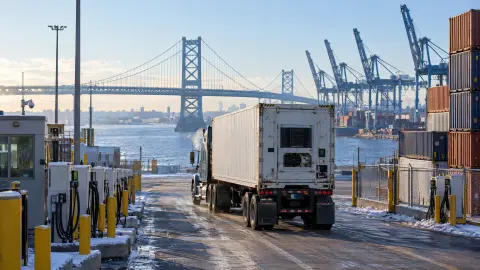
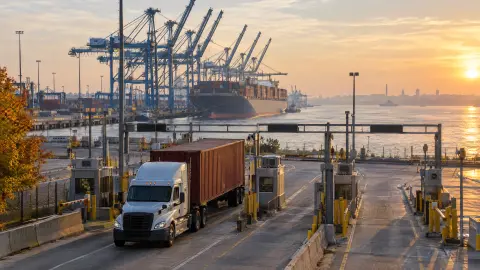
The port is the reason this market exists. The Port of New York and New Jersey moved 5,955,798 loaded TEUs in 2025, and the Port Authority's annual report calls it the second-busiest port in the nation for loaded TEUs. The boxes land with six terminal operators: APM Terminals and Maher Terminals in Elizabeth, Port Newark Container Terminal on the Newark side, GCT Bayonne on the Port Jersey peninsula, GCT New York at Howland Hook on Staten Island, and Red Hook in Brooklyn. Every Class 8 truck entering a terminal must be registered in the Drayage Truck Registry with a valid RFID tag, and every driver needs a TWIC and a SeaLink card. The Truck Service Center that issues SeaLink cards sits at 1160 McLester Street in Elizabeth. Chassis come from pools such as DCLI, TRAC and Flexi-Van, dispatched out of depots the Port Authority lists in its trucker guide: Ironbound's Doremus and Hyatt yards in the 07105 part of Newark, Columbia's depots on South Bay Avenue in Elizabeth and at the Military Ocean Terminal in Bayonne, and the Marsh Street depot in Newark. The same guide warns that Millennium Marine Rail in Port Elizabeth has no chassis on site, so a driver sent there for a pickup must already be sitting on one. That sentence explains half the arguments a Newark dispatcher has in a week.
Rail is bigger here than outsiders expect. ExpressRail puts on-dock or near-dock tracks at each major terminal: ExpressRail Elizabeth for Maher and APM, ExpressRail Newark for PNCT, ExpressRail Port Jersey for GCT Bayonne, and ExpressRail Staten Island for GCT New York. CSX and Norfolk Southern both serve the system, and the Port Authority puts its capacity at 1.5 million lifts a year. The Port Authority's intermodal map also shows the Croxton terminal and Norfolk Southern's E-Rail yard just north of the port, around Kearny and Jersey City, which is one reason so many fleets register out of 07032 in Kearny and 07105 on the Doremus Avenue side of Newark. Those two ZIP codes, plus 07114 by the airport, hold the densest cluster of ten-truck-and-up carriers in this market: 44 families in 07105, 32 in 07032, 28 in 07114. Parking is the quiet constraint. The secured lots the Port Authority lists are on Delancey Street and Doremus Avenue in 07105, on Hackensack Avenue in Kearny, and on Pulaski Street in Bayonne, and the Pilot at 400 Doremus Avenue has 33 truck spaces. That is the legal overnight inventory a drayage recruiter can point to inside the port zone.
South of Linden the freight changes shape. NJDOT's 2017 statewide freight plan says the areas around Turnpike Interchanges 10, 8A, 7A and 6 host millions of square feet of new warehousing and distribution space, with Interchange 12 and the urban counties to the north drawing same-day e-commerce and refrigerated food distribution. The Southern Middlesex County freight study describes Cranbury, Monroe, South Brunswick and Jamesburg as a hub built around Interchange 8A, fed by the Turnpike, US 1 and US 130, with Amazon, Costco, Wayfair, Home Depot and Petco distribution centers near the interchange and UPS and FedEx warehouses in the area. Edison's 08817 and South Plainfield's 07080 sit between the two worlds, which is why they rank among the five densest carrier ZIPs: a fleet there can run port turns in the morning and 8A dock appointments in the afternoon. One more number matters for anyone pricing drayage. Inside the port, the Port Authority's terminal highways and the Doremus Avenue Overweight Route allow marine containers at a gross vehicle weight up to 128,000 pounds within equipment limits. Once the box leaves port property, the state's annual ocean-borne container permit caps the combination at 90,000 pounds, and anything heavier needs a single-trip permit.
- I-95 / New Jersey Turnpike
- The spine of every Newark driver's day. Interchange 14 ties the Turnpike to I-78 and US 1&9 beside Port Newark, and NJDOT's freight plan lists Interchanges 13 and 14 among the state's heaviest truck crash clusters. Exit 8A feeds the Cranbury warehouse belt, and the Turnpike stayed open to trucks in both of this winter's NJDOT commercial vehicle bans.
- I-78
- The east-west lane out of the port, running across the state to the I-78 toll bridge into Pennsylvania. NJDOT's freight plan calls it one of New Jersey's highest-volume freight corridors, and it closed to tractor-trailers in both the December 2025 and February 2026 winter orders.
- I-287
- The bypass that ties I-78 at Bedminster, I-80 at Parsippany and the Turnpike at Edison together, so a Somerset or Piscataway fleet can reach all three without touching the city. It also closes to tractor-trailers under NJDOT's winter travel orders, which strands anyone who planned a storm-day run around it.
- Doremus Avenue and the Port Newark approaches
- The Port Authority's overweight corridor, with the Ironbound chassis yards, the empty-return depots, the Columbia secured lot at 252 Doremus Avenue and the Pilot truck stop all in the 07105 strip. A drayage driver's whole shift can happen on this one road.
- Exit 8A / Route 130 / County Route 535
- The ramp cluster at Cranbury that every regional dry-van driver in Middlesex knows by heart. The county freight study recommends reconfiguring the CR 535 and Route 32 interchange to handle queuing and reduce turn conflicts, and wants trucks signed toward US 130, so plan dock appointments around it.
Where the 10-plus-truck fleets sit, by ZIP: 07105 (44), 07032 (32), 07114 (28), 08817 (25), 07080 (23).
Hiring drivers in Newark: what we actually see
The first question we ask a Newark carrier is not how much the job pays. It is where the truck is parked at 7 p.m. If the honest answer is a lot the company leases in Kearny or Bayonne, we can recruit for that fleet all day. If drivers find their own spot, we tell the carrier to fix that first, because the driver pool here already knows the game. Many have been ticketed on a residential street or towed off a dead end in the meadows, and they will take a lower-paying seat with a gate and a light over it. The second question is which pool the carrier is hiring from. Port drayage drivers hold a TWIC and a SeaLink card and drive a truck that clears the Drayage Truck Registry's engine rules. They count turns, not miles, and they know which terminal's appointment system gives them a two-hour window. Regional drivers out of Edison, Piscataway and the 8A belt want a dock schedule, a Thursday night at home and a lane that does not end in Manhattan, where the Holland Tunnel does not take a tractor-trailer at all.
Seats fill in a predictable order. Day-cab port work with a legal parking spot and a compliant truck fills fast, because the credentialed drivers are already here and they talk to each other. Regional dry van out of Cranbury or South Plainfield fills next, as long as the home time is real. The slow seats are the ones carriers misdescribe: a drayage job that is really three days a week of rail-ramp returns to Croxton or E-Rail, or a regional job whose freight spends every Tuesday in a Bronx grocery warehouse. Drivers find out on day two and leave on day ten, and then the carrier calls us about turnover. Our fix is unglamorous. We ask for the lane history from the last thirty days, we read the driver the chassis and gate situation out loud, and we warn him if the first check will be short because of orientation. Drivers who hear the bad parts first stay longer, and in Newark that is the whole business.
What drivers in Newark are paid
BLS puts the median annual wage for heavy and tractor-trailer truck drivers in the New York-Newark-Jersey City, NY-NJ metro area at $65,040, with a mean of $69,020 (Occupational Employment and Wage Statistics, May 2025).
The federal wage survey for the New York-Newark-Jersey City metro puts the 2025 median for heavy and tractor-trailer drivers at $65,040 a year, with a mean of $69,020. Read those as a floor for this market, not a target. The median blends in local and LTL dock work that a port driver would not take, and the mean is pulled up by drayage drivers who run four turns a day in summer and two in February.
Drivers here tell us rent and tolls eat most of a raise, but we have not found a public source we trust enough to put a number on it, so we do not. What we tell a carrier to publish is simple: an honest weekly gross for a typical week, the parking arrangement, and the pay basis in plain words, whether per move, per mile or hourly. A Newark driver comparing three ads skips the one that hides the week behind an annual range.
If your real number lands near the metro median, say so and sell the parking and the home time. If it lands above the mean, say that too, and be ready to show settlement sheets, because drivers here will ask.
- $65,040
- median annual wage, New York-Newark-Jersey City metro
- $69,020
- mean annual wage, May 2025 (BLS OEWS 53-3032)
Rules that shape Newark seats
Port gate credentials and engine model-year cutoffs
Every Class 8 truck entering a Port Authority marine terminal must be registered in the Drayage Truck Registry with a valid RFID tag, and the driver needs a TWIC and a SeaLink card. Under the Port Authority's marine terminal tariff effective May 1, 2026, trucks registering since July 2, 2023 need an engine meeting EPA 2014 model-year standards, trucks with 1998 or older engines are already barred, 1999 engines lose terminal access May 1, 2027, and 2000 engines on May 1, 2028. source ↗
Hudson crossings: no tractor-trailers in the Holland Tunnel
The Port Authority's traffic rules, revised January 2026, bar all combination vehicles and any vehicle with four or more axles from the Holland Tunnel, and bar all trucks from the lower level of the George Washington Bridge. The Lincoln Tunnel allows a tractor and semitrailer up to 85 feet overall with a 45-foot trailer, under a 13-foot height limit. Hazardous materials are barred from Port Authority crossings except as the rules' tables allow, propane is banned in both tunnels and the GWB lower level, and highway-route-controlled radioactive loads may not use either tunnel. source ↗
Three-minute diesel idling limit
New Jersey's air rules at N.J.A.C. 7:27-14 prohibit a diesel vehicle from idling more than three consecutive minutes when it is not in motion. NJDEP's idling FAQ allows 15 minutes when the temperature is below 25 degrees Fahrenheit, and a sleeper-berth exemption applies only to a truck with a 2007 or newer engine or a diesel particulate filter, resting in a non-residential area, with no working APU on board. A driver waiting on a chassis on Doremus Avenue in January needs an APU or a plan. source ↗
Winter commercial vehicle travel bans
When a major storm is forecast, NJDOT bans tractor-trailers and empty CDL-weight straight trucks from the interstates. The December 26, 2025 order closed I-78, I-80, I-280, I-287 and Route 440 between the Outerbridge Crossing and I-287. The February 22, 2026 order added I-76, I-195, I-295 and I-676. The Turnpike, the Garden State Parkway and the Atlantic City Expressway were exempt both times. source ↗
Large-truck routing off the National Network
Under N.J.A.C. 16:32, 102-inch-wide trucks and double-trailer combinations must stay on the National Network, which is mainly the Interstates, the Turnpike and the Atlantic City Expressway, and the New Jersey Access Network of state and some county roads. Leaving those roads is allowed only by the shortest direct route to food, fuel, rest, repairs or a terminal. Newark's side streets are not a shortcut. source ↗
Heavy marine containers need a permit, not a guess
NJDOT now issues the annual ocean-borne container permit on behalf of the Motor Vehicle Commission under N.J.A.C. 13:18. It covers sealed containers on a tractor-semitrailer up to a combined gross weight of 90,000 pounds, with 38,000 pounds per tandem axle, and the original permit must ride in the cab. Heavier moves need a single-trip permit. The 128,000-pound figure drivers quote applies only to the Port Authority's own terminal highways and the Doremus Avenue Overweight Route. source ↗
The Newark calendar
Newark's hiring calendar follows the ships and the snow. Every drayage carrier we talk to in this market plans around the fall import season and wants seats filled by late summer, because that is when turns per day are easiest to sell. The 8A warehouse carriers staff up a few weeks later, ahead of holiday inventory.
Then winter arrives. In the 2025 to 2026 season NJDOT issued commercial vehicle travel restrictions on December 26 and again on February 22, closing I-78, I-80, I-280, I-287 and others to tractor-trailers while the Turnpike stayed open. Drivers lose paid days in those weeks and start taking calls from carriers who guarantee hours.
January and February are when retention breaks and when a carrier with indoor parking and a weekly minimum can hire drivers it could not touch in September. The three-minute idling rule bites hardest in those months, and the sleeper-berth exemption does not cover a truck with a working APU. One more date belongs on the calendar: on May 1, 2027 the port stops admitting trucks with 1999 engines, so drayage carriers still running them will be shopping for replacement equipment and drivers at the same time.
How pay-per-driver works for a Newark carrier
An intake call maps your lanes, equipment, pay and home time for Newark; if we can't guarantee you enough driver volume, we say so on that call. Our recruiters interview every driver by phone and verify CDL, endorsements, experience and work history against your requirements, then send complete submission packets through Onboard, our own placement platform. You pay per placed driver — half when the driver starts, half after the first 14 days — and recruiting for Newark runs from our Mundelein, IL office, 800 miles away. The model in full is on Pay Per Driver; why the first 48 hours decide most hires is on speed to hire.
Who this fits in Newark — and who it doesn't
The census counts 291 operators running 10 to 49 trucks in the Newark area and 72 with 50 or more.
This works for the 291 ten-to-forty-nine-truck families and the 72 fleets of fifty or more that have a real yard, a parking answer and a dispatcher who can describe a week honestly. Port drayage carriers in Elizabeth, Kearny, Bayonne and the 07105 strip who run compliant equipment and want credentialed drivers who already hold a TWIC and a SeaLink card. Regional dry-van and reefer fleets in Edison, Piscataway, South Plainfield and the Cranbury 8A belt that run dock appointments and get drivers home on a schedule.
Intermodal carriers splitting time between the terminals and the rail ramps who need drivers comfortable with gate systems and chassis flips. In all three cases the carrier pays per placed driver and we screen for the market, not the brochure.
Who we turn down: We turn down owners among the 4,267 registrations running one to nine trucks when what they really want is a lease-purchase recruit, and we turn down any carrier that cannot tell us where the truck parks at night. We also decline port carriers running equipment that will fall out of the Drayage Truck Registry in 2027 or 2028 unless there is a replacement plan, because we would be recruiting a driver into a seat that disappears. And we walk away from job descriptions that call a five-day New York City delivery route a regional job. Drivers here know the difference, and so do we.
How we think about drivers who stay: why drivers quit, and how to fix each reason. Selling to trucking companies rather than hiring drivers? That's a different service — Marketing for Trucking.
Our numbers
No third party audited these. They're our own operating numbers — the claims we make publicly about our own shop, and the standard you should hold us to on a call.
- 100+
- drivers our operation places per month
- 3,000+
- lifetime CDL hires
- 50+
- carrier partners
- 24 hrs
- to first drivers for a new carrier
More carrier feedback, in the carriers' own words: results.
Questions Newark carriers ask us
Staffing and recruiting are not the same purchase — ask any agency these, then compare who does the work and when the money changes hands.
How does your fee work for a drayage carrier in Elizabeth or Kearny?
We charge per placed driver, nothing up front and no monthly retainer. The fee is split in two: half when the driver starts, and half after the driver's first 14 days on the job. If the driver you interviewed and approved never starts, nothing is owed. We quote the fee before we begin, it does not change with the driver's pay, and we do not bill for ads, job boards or the hours spent screening out drivers whose 1999 engine the port will stop at the gate after May 1, 2027. Our model loses money on drivers who do not stay, which keeps our incentives pointed the same way as yours.
Where are your recruiters? Do you have anyone sitting in Newark?
No. Our nearest office is our headquarters in Mundelein, Illinois, at 1280 Townline Road, roughly 800 miles from Port Newark. We do not have a Newark office, a yard or a walk-in location in New Jersey, and we will not pretend otherwise. Our recruiting for this market runs by phone, text and video, which is how most Newark drivers already deal with dispatch and with the terminals' appointment systems. What we bring from Illinois is a method built around the specific questions that matter here: parking, credentials, chassis access and the real shape of the week.
Why do drivers leave Newark carriers in the first 90 days, and what happens to your fee if one does?
In our experience the early exits here come from three things: the parking arrangement was not what the ad implied, the lane turned out to include city deliveries nobody mentioned, or the first paychecks were thin because of waiting time at the terminals. Our fee structure is built around that risk. Half of it is only due after the driver's first 14 days, so a driver who quits in week one costs you half a fee, not a whole one. We do not promise a blanket free-replacement guarantee on a web page, because retention terms are set per engagement and we do not invent specifics here. What is structural is that we stay involved past the start date, and we would rather do the hard screening on parking and lane honesty up front than rerun a search in week three.
When is hiring hardest and easiest for a carrier running out of Port Newark or the 8A belt?
Hardest from late summer into the fall, when the drayage carriers we work with are adding turns for the import season and the 8A warehouses are staging holiday inventory. A credentialed port driver has his pick in those weeks. Easiest is January and February. NJDOT shut the interstates to tractor-trailers twice in the 2025 to 2026 winter, on December 26 and February 22, drivers lost paid days, and that is when a carrier offering indoor parking, a guaranteed weekly minimum or a lane that stays on the Turnpike can hire people it could not reach in September. We tell carriers to open requisitions in December and be ready to make offers in the two weeks after a storm.
Do drivers who live around Newark, Elizabeth and Edison want local, regional or OTR work?
Overwhelmingly local and regional. Drivers in Newark, Kearny and Bayonne who hold a TWIC want port turns and home every night, and they measure a job by turns per day and parking, not by miles. Drivers in Edison, Piscataway, Somerset and the Cranbury area lean regional: 8A warehouse pickups, runs down the Turnpike or out I-78, home two or three nights a week and most weekends. True OTR is a hard sell here because the pay has to clear what it costs to live near the port and the driver has nowhere to leave a tractor on a home-time break. We tell OTR carriers to recruit this metro for drivers who are already OTR and want a different company, not for conversions.
What should I know before recruiting drivers for rail-ramp and intermodal work between the terminals and Croxton or E-Rail?
That the driver knows more about the chassis situation than the recruiter does. The Port Authority's trucker guide lists the chassis depots and their pool providers, and warns that Millennium Marine Rail in Port Elizabeth has no chassis on site, so a driver sent there bare loses the move. GCT Bayonne books one-hour appointment slots with a 30-minute cushion on each end, which works out to a two-hour window, and every terminal checks the truck against the Drayage Truck Registry at the gate. We screen intermodal candidates on whether they have run those gates, whether their credentials are current, and whether they understand that a day with two appointments and a chassis flip pays very differently from four clean turns. A carrier that publishes the appointment reality in the ad gets better drivers than one that promises turns it cannot schedule.
Drivers in Newark: browse current CDL-A jobs or get matched to a carrier — free for drivers.
Sources
- Port Authority of NY & NJ, 2025 Annual Report (5,955,798 loaded TEUs; second-busiest port in the nation for loaded TEUs)
- Port Authority, Port Facilities Map (six terminal operators and addresses; ExpressRail; 128,000 lb MGVW on terminal highways and the Doremus Avenue Overweight Route)
- Port Authority, Truckers Resource Guide, Jan. 2021 (TWIC, SeaLink, RFID and Drayage Truck Registry; Truck Service Center at 1160 McLester St; chassis depots and providers; Millennium Marine Rail no-chassis notice; secured parking lots; Pilot 400 Doremus Ave with 33 spaces; GCT Bayonne two-hour appointment window)
- Port Authority Marine Terminal Tariff FMC Schedule PA-10, effective May 1, 2026 (Drayage Truck Registry engine model-year rules, Subrules 34-1101 and 34-1140)
- Port Authority, Rail Forward guide, 2019 (four ExpressRail facilities and the terminals they serve; CSX and Norfolk Southern; 1.5 million annual lift capacity; Croxton and NS E-Rail on the intermodal map)
- Port Authority, Tunnels, Bridges and Terminals Traffic Rules and Regulations, revised Jan. 5, 2026 (Holland Tunnel combination-vehicle ban; GWB lower level; Lincoln Tunnel length limits; height limits; hazmat, propane and radioactive restrictions)
- TSA, Transportation Worker Identification Credential
- NJDOT, Truck Routing (National Network, NJ Access Network, N.J.A.C. 16:32)
- NJDOT, Oversize and Overweight permits (Annual Ocean Borne Container permit issued on behalf of the Motor Vehicle Commission, N.J.A.C. 13:18)
- N.J.A.C. 13:18, Permits for Overdimensional or Overweight Vehicles, current text (annual ocean borne containerized cargo permit: 90,000 lb combined gross weight, 38,000 lb per tandem, original permit in cab)
- NJDOT press release, Feb. 21, 2026 commercial vehicle travel restrictions (I-76, I-78, I-80, I-195, I-280, I-287, I-295, I-676, Route 440; Turnpike, Parkway and ACE exempt)
- NJDOT Administrative Order 2025-11, Dec. 26, 2025 commercial vehicle travel restriction (I-78, I-80, I-280, I-287, Route 440; Turnpike, Parkway and ACE exempt)
- NJDEP, Idling Restrictions FAQ, April 2012 (N.J.A.C. 7:27-14 three-minute limit; 15 minutes below 25 degrees F; sleeper-berth exemption conditions)
- NJDOT, New Jersey Statewide Freight Plan, 2017 (warehousing around Turnpike Interchanges 10, 8A, 7A, 6 and 12; I-78, I-80, I-287 and Turnpike as primary freight corridors; truck crash clusters at Interchanges 13 and 14; I-78 toll bridge)
- NJTPA / Middlesex County, Southern Middlesex County Freight Movement Study (Interchange 8A hub; Turnpike, US 1 and US 130; Amazon, Costco, Wayfair, Home Depot, Petco, UPS and FedEx facilities; CR 535 / Route 32 queuing and turn conflicts)
1 FMCSA Company Census (2026-09-26): active carriers based in Newark, Elizabeth, Kearny, Jersey City, Secaucus, Carteret, Avenel, Edison, Linden, Bayonne, Port Newark, South Kearny, Perth Amboy, Woodbridge, Cranbury, South Plainfield, Piscataway, Somerset; MCS-150 filed in the last 24 months; 1–20,000 trucks; fewer than 10 buses. 10+ truck counts merge registrations sharing an address or D-U-N-S number. Totals and the 1–9 band count active USDOT registrations; fleet sizes are self-reported on the MCS-150, so read them as a scale, not a headcount.
Wages: U.S. Bureau of Labor Statistics, OEWS May 2025, occupation 53-3032, series OEUM003562000000053303213 (median) and OEUM003562000000053303204 (mean).
Written by
Andrius Pletniovas — Founder, CDL Agency
Andrius Pletniovas (Andrius Digital) is the founder of CDL Agency, a truck-driver recruiting and marketing company that has placed 3,000+ CDL drivers for 50+ carriers across the U.S. He writes about driver recruiting, retention, and the trucking market from running the agency every day.
More about Andrius →Official personal website →