FMCSA's carrier census lists 3,086 active carriers based in the Cincinnati area — 2,518 with one to nine trucks, 410 operators running 10 to 49, and 133 with 50 or more — roughly 45,815 power units between them. 1
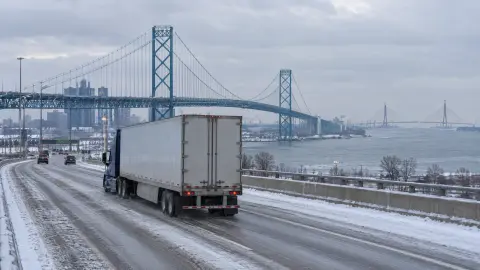
Every northbound load out of Kentucky and every southbound load out of Dayton funnels onto the same river crossing in Cincinnati. I-71 and I-75 share the Brent Spence Bridge, and on May 8, 2026 Ohio and Kentucky broke ground on the companion bridge that KYTC expects to carry that traffic once it opens in 2031. On the Ohio side, ODOT's Thru the Valley work is widening and rebuilding I-75 from SR 126 to just south of I-275, with construction running from summer 2021 to a fall 2031 finish. A Cincinnati driver's day is shaped by those two work zones, by the CVG cargo ramps in Hebron, and by the intermodal gates at Queensgate, Gest Street and Sharonville.
We recruit drivers for carriers in this market and we are paid per placed driver. You tell us the lane, the schedule, the truck and the yard. We find the driver who lives on the right side of the river for it, verify the record, and present only people who have said yes to that exact job. You pay half when the driver starts and the rest after the retention window in the agreement. No retainer, no job-board spend. If the seat does not fill, you do not pay us.
In Cincinnati the river is a hiring line: tell a driver which bank the truck is parked on before you tell him the pay.
Freight in Cincinnati: what moves, and where
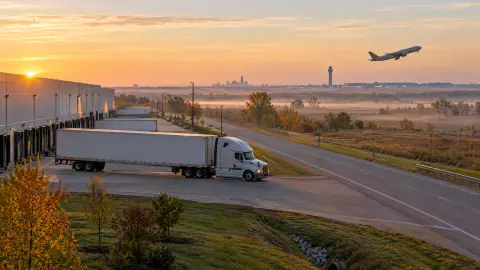
Cincinnati freight is river, air, rail and interstate stacked inside a few miles. The Ports of Cincinnati and Northern Kentucky cover 226.5 miles of the Ohio and Licking rivers with more than 70 active terminals moving an estimated 48 million tons a year, and that barge tonnage meets trucks on both banks. In Hebron, CVG handled 2.1 million tons of cargo in 2023, sixth among North American cargo airports. Amazon's primary U.S. Air Hub sits on more than 600 acres there and DHL runs its Americas super hub on the same field. That cargo moves on trucks at night: linehaul out of the hub, shuttles to sort buildings, dedicated runs that are back in the yard by morning.
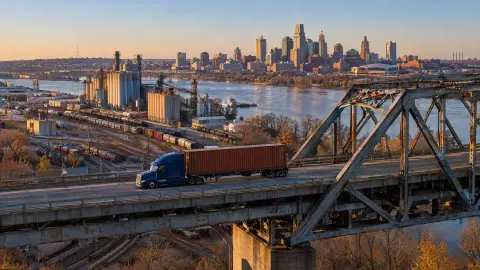
Rail is the other anchor. CSX runs Queensgate Yard and the Queensgate intermodal terminal at 2149 Western Avenue in 45214. Norfolk Southern runs two ramps, Gest Street at 1276 West 8th Street in the West End and Sharonville at 3155 East Sharon Road. Since February 16, 2026 NS has accepted outbound ingates only at Sharonville while it expands that terminal, with the expansion scheduled to finish in late 2026, so container drayage in this market now orbits the 45241 ZIP, which is also the second-densest carrier ZIP in the metro with 63 trucking families. Follow I-75 north and the fleets stack up through Springdale in 45246 (25 families), West Chester in 45069 (47) and Mason in 45040, the densest carrier ZIP in the region at 91 families. Past Monroe is Middletown, midway between Cincinnati and Dayton, where Cleveland-Cliffs runs an integrated mill shipping hot-rolled, cold-rolled and aluminized steel to automotive, appliance and distribution customers. Blue Ash and 45249 (39 families) sit off I-71 to the northeast.
The shippers headquartered here set the tone: Procter & Gamble downtown, Kroger on Vine Street, GE Aerospace's world headquarters in Evendale where the company has built jet engines since the late 1940s, Cintas running its route-based uniform business from its Mason headquarters. Consumer goods, grocery, aerospace parts and daily service routes, almost all of it regional. Columbus, Louisville, Indianapolis and Dayton are each a day's turn. The FMCSA census counts 3,086 active carrier registrations running 45,815 trucks: 2,518 with one to nine trucks, 410 families with 10 to 49, 133 families with 50 or more. The middle band is where the recruiting pressure is.
- I-75
- The spine of the metro from Covington through Sharonville, West Chester and Monroe to Middletown. ODOT's Thru the Valley rebuild between SR 126 and I-275 runs from summer 2021 to fall 2031, so lane shifts and weekend closures north of downtown are part of the job.
- I-71
- Splits from I-75 downtown, runs through the Lytle Tunnel and out past Blue Ash and Mason toward Columbus; south of the river it shares the Brent Spence Bridge with I-75 toward Louisville. Placarded loads may not use the tunnel or the bridge.
- I-275
- The beltway and the hazmat detour. The 2013 KYTC and FMCSA regulation that restricted I-71/75 north of I-275 in Kentucky sends placarded trucks around on I-275, and the loop is also how CVG linehaul reaches I-75 and I-71 without touching downtown Cincinnati or Covington.
- I-74
- West to Indianapolis from the I-75 junction north of downtown. FHWA's route log puts 19.73 miles of I-74 in Ohio, 3.45 of them shared with I-275, serving Cincinnati, Dent and Harrison before the Indiana line. It runs through Ohio and Indiana only, so it is the one interstate out of Cincinnati that never touches Kentucky or the river.
- Brent Spence Bridge Corridor
- I-71 and I-75 cross the Ohio River on one double-deck bridge. The companion bridge broke ground on May 8, 2026, and KYTC expects it to open in 2031 with the approach work substantially complete by 2033. Covington is down to one entrance ramp per direction, and the Cincinnati ramps to Second Street from eastbound US 50, southbound I-75 and northbound I-71 have moved to a temporary ramp.
- CVG cargo (Hebron, KY)
- Off I-275 on the Kentucky side. Amazon's Air Hub and DHL's Americas hub mean night linehaul, drop-and-hook at the sort, and home-by-morning schedules that compete directly with Ohio-side daytime work for the same drivers.
Where the 10-plus-truck fleets sit, by ZIP: 45040 (91), 45241 (63), 45069 (47), 45249 (39), 45246 (25).
Hiring drivers in Cincinnati: what we actually see
The driver pool here lives in three clusters: Butler and Warren County drivers north along I-75 and I-71, from Fairfield and Hamilton over to Mason and Lebanon; Northern Kentucky drivers within reach of the CVG ramps and the I-275 loop; Clermont County drivers east around Batavia and Milford. The river is a hiring line. An Ohio-side driver with a home-daily seat in West Chester will not take a CVG night shift that means crossing the Brent Spence work zone twice a day, and a Hebron driver will not commute to a Monroe yard for the same reason. Ask a Cincinnati driver what matters and the first answer is where the truck is parked, the second is the start time, and pay is third.
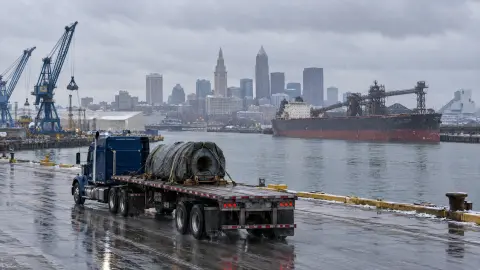
Seats that fill fast are home-daily regional runs out of the I-75 corridor: dedicated grocery and consumer-goods loads, drayage out of Sharonville and Queensgate for a driver who already lives in 45241 or 45246, steel out of Middletown for a flatbed driver who sleeps at home. Seats that fill slowly are over-the-road with a vague weekend promise, any job that lists Cincinnati but starts in Monroe or Hebron, and night linehaul that does not say whether the driver sleeps at home or in a hotel. Hazmat seats sit open longer than carriers expect, because the driver has to plan around the I-275 detour and a TSA threat assessment that TSA itself says to start sixty days ahead.
What carriers get wrong here is the address. A posting that says Cincinnati when the terminal is in Monroe loses the Northern Kentucky applicants on the first call and burns the Ohio-side ones who learn the start is 4 a.m. at a Kentucky sort. We put the exact yard, the ZIP, the gate time and the real home-time pattern into the submission before the driver hears the pay, because a driver promised weekends who gets Saturday afternoons is one we would be replacing in ninety days. Word about forced dispatch or slow settlements moves up this corridor fast.
What drivers in Cincinnati are paid
BLS puts the median annual wage for heavy and tractor-trailer truck drivers in the Cincinnati, OH-KY-IN metro area at $60,590, with a mean of $63,170 (Occupational Employment and Wage Statistics, May 2025).
BLS puts the 2025 median for heavy and tractor-trailer drivers in the Cincinnati metro at $60,590 a year, with a mean of $63,170. The mean sitting above the median tells you there is a tail of higher-earning seats pulling the average up: night linehaul out of CVG, team runs, and flatbed steel out of Middletown. The typical regional home-daily driver in West Chester or Sharonville is at or near the median. Those figures cover the whole metro, both sides of the river.
What a carrier should publish is the way the number is built, not a slogan. State the rate per mile and the realistic weekly mile range, the stop pay, when detention starts, and whether the figure includes Kentucky-side runs. Home-daily drivers compare weekly checks, so give the weekly number and the annualized one. If your seat lands under the $60,590 median, say what the trade is: a 7 a.m. start in Mason, a dry van, no touch freight. Drivers accept a lower number for a specific schedule far more often than a vague higher one.
- $60,590
- median annual wage, Cincinnati metro
- $63,170
- mean annual wage, May 2025 (BLS OEWS 53-3032)
Rules that shape Cincinnati seats
No placarded hazmat on the Brent Spence Bridge or in the Lytle Tunnel
KYTC and FMCSA companion regulations effective July 15, 2013 designate I-71/75 north of I-275 in Kentucky, including the Brent Spence Bridge, a restricted hazardous materials route. The signed detour puts placarded trucks on I-275, which also keeps them off I-71 through the Lytle Tunnel in Cincinnati. source ↗
Ohio weight limits: 20,000 single, 34,000 tandem, 80,000 gross
Ohio Revised Code 5577.04 caps vehicles on the interstate system at 20,000 pounds on a single axle, 34,000 on a tandem, and 80,000 pounds gross vehicle weight. Bridge-formula spacing applies to consecutive axles. Steel out of Middletown and bulk off the river terminals are the loads that get scaled. source ↗
Kentucky KYU weight-distance tax at 60,000 pounds
Any carrier running vehicles with a combined licensed weight of 60,000 pounds or more on Kentucky roads must hold a KYU number and file quarterly weight-distance tax reports under KRS 138.660. That covers every CVG linehaul and every load that crosses the river, so an Ohio carrier adding Kentucky lanes needs it before the first dispatch. source ↗
Hamilton County snow emergency levels
The Hamilton County Sheriff declares Level 1, 2 and 3 snow emergencies. Level 1 means hazardous roads with blowing and drifting snow, Level 2 means icy spots and low visibility on all or certain county roads, and Level 3 means extremely hazardous conditions. Declarations are county by county, so a run from Mason to Covington can cross more than one. source ↗
Spring thaw load reductions on Ohio county roads
Ohio Revised Code 5577.07 lets county commissioners reduce the legal load limit on county roads other than state highways during thaws and excessive moisture, by as much as fifty percent, with signs posted at least a day ahead. Rural last-mile runs in Butler, Warren and Clermont counties can hit posted roads in late winter. source ↗
Ohio BMV Clearinghouse check and CDL downgrade
Ohio BMV checks the FMCSA Drug and Alcohol Clearinghouse before issuing, renewing, replacing or upgrading a CDL, and since November 18, 2024 it downgrades the CDL of any driver in prohibited status until the return-to-duty process is complete. Hazmat applicants must clear a TSA threat assessment first, and new CDL holders must show ELDT completion before skills testing. source ↗
The Cincinnati calendar
Winter is the hiring season that matters. 4, with a January normal low of 23 degrees. A Hamilton County Level 3 declaration means extremely hazardous roads, so a carrier's weather policy has to be written down before December.
In our own recruiting, applications for CVG night work thin out from October into December while the parcel hubs are busiest, then loosen in January and February when drivers who took holiday seats start looking for daylight. Spring brings the construction season on I-75 and the Brent Spence approaches, and commute complaints rise with it.
How pay-per-driver works for a Cincinnati carrier
An intake call maps your lanes, equipment, pay and home time for Cincinnati; if we can't guarantee you enough driver volume, we say so on that call. Our recruiters interview every driver by phone and verify CDL, endorsements, experience and work history against your requirements, then send complete submission packets through Onboard, our own placement platform. You pay per placed driver — half when the driver starts, half after the first 14 days — and recruiting for Cincinnati runs from our Romeoville, IL office, 290 miles away. The model in full is on Pay Per Driver; why the first 48 hours decide most hires is on speed to hire.
Who this fits in Cincinnati — and who it doesn't
The census counts 410 operators running 10 to 49 trucks in the Cincinnati area and 133 with 50 or more.
This works for the 410 carrier families running 10 to 49 trucks and the 133 running 50 or more along I-75 and I-71, especially those with a yard in Sharonville, West Chester, Monroe or Mason and a defined regional lane. Dedicated grocery and consumer-goods fleets. Drayage operators pulling from Sharonville and Queensgate who need drivers already living near the gates.
Flatbed carriers hauling steel out of Middletown. CVG linehaul contractors who can state the sort times and whether the driver sleeps at home. If you can tell us the ZIP the truck parks in and the schedule, we can fill it.
Who we turn down: We turn down the one-to-nine-truck operations offering a 1099 lease-purchase instead of a W-2 seat, because that pool of 2,518 small carriers is where drivers here get burned and they know it. We turn down carriers that will not say which side of the river the start point is on. We turn down forced-dispatch OTR dressed up as regional with a vague weekend promise. And we turn down any carrier that wants a hazmat driver to run the Brent Spence Bridge or the Lytle Tunnel to save twenty minutes, or that runs Kentucky lanes without a KYU number.
How we think about drivers who stay: why drivers quit, and how to fix each reason. Selling to trucking companies rather than hiring drivers? That's a different service — Marketing for Trucking.
Our numbers
No third party audited these. They're our own operating numbers — the claims we make publicly about our own shop, and the standard you should hold us to on a call.
- 100+
- drivers our operation places per month
- 3,000+
- lifetime CDL hires
- 50+
- carrier partners
- 24 hrs
- to first drivers for a new carrier
More carrier feedback, in the carriers' own words: results.
Questions Cincinnati carriers ask us
Staffing and recruiting are not the same purchase — ask any agency these, then compare who does the work and when the money changes hands.
What does it cost to fill a seat at our Sharonville or Monroe terminal?
We are paid per placed driver, not per month or per applicant. We agree a flat fee for the seat before we start, based on the lane, the schedule and the endorsements. You pay half when the driver starts and the rest after the driver has stayed through the retention window written into the agreement. There is no retainer, no job-board budget and no charge for candidates you interview and decline. We only get paid in full when a driver is in your truck and still there weeks later.
Where are your recruiters? Do you have anyone in Cincinnati?
No. We have no Cincinnati office and no recruiters based in Ohio or Northern Kentucky. Our nearest office is Romeoville, Illinois, about 290 miles away; headquarters is in Mundelein, Illinois, with offices in Lancaster, Texas, and North Miami, Florida. We recruit for this market by phone, video and text, the same way drivers here already job-hunt. What we bring is the geography: which ZIP the truck parks in, which side of the river the driver lives on, and what the Brent Spence work zone does to a commute. We will not claim a local yard we do not have.
Our drivers pull CVG air freight and river-terminal loads. What paperwork do they need?
There is no border crossing in this market, so no FAST card. CVG runs customs around the clock, but the badge a driver needs at the Amazon or DHL ramps comes through your contract with the hub, so we ask you for that process and set expectations on the first call. For river terminals, some ask for a TWIC and some do not, so we confirm with the specific terminal before we screen for it. If the load crosses into Kentucky at 60,000 pounds or more, the carrier needs a KYU number. If the load is placarded, the driver needs to know the I-275 detour around the bridge and the Lytle Tunnel.
We run night linehaul out of Hebron and a day shuttle in West Chester. Which is harder to fill than over-the-road?
The West Chester day shuttle fills first. A home-daily dedicated DC run on the Ohio side of I-75 is the seat Cincinnati drivers want, and we will have candidates from 45069 or 45246 within the week. The Hebron night linehaul draws from a narrower pool: Northern Kentucky drivers and a few Ohio-side drivers willing to cross the river against traffic. Over-the-road is the slowest seat in this market, because a driver who can sleep in his own bed every night on an I-75 regional run has little reason to consider it unless the pay and the home-time pattern are both specific and both true.
Which endorsements do Cincinnati carriers actually need, and how do you check them?
Hazmat comes up for chemical and fuel loads, and a hazmat driver here has to know the I-275 routing rule. Tanker usually goes with it. Doubles come up for parcel linehaul out of CVG if your contract runs pups. TWIC is rare and terminal-specific. We pull the MVR and PSP, read the endorsements off the Ohio or Kentucky CDL itself, and confirm the TSA threat assessment is current, since it runs five years and TSA asks for sixty days lead time. We do not submit a driver who still has to earn the endorsement unless you have said you will wait.
How do drug testing and Clearinghouse work for a driver who lives in Fairfield or Florence?
Before the driver can start, you run a full pre-employment query in the FMCSA Clearinghouse, and the driver must grant electronic consent inside the Clearinghouse for that query to return results. We make sure the driver is registered and has consented before we send the file, because an unregistered driver costs you a week. Ohio BMV has downgraded CDLs for prohibited status since November 2024, so we also confirm the license is still a CDL. You then schedule the DOT pre-employment test at a collection site near the driver's home, Butler County or Boone County as the case may be, and we chase the driver to the appointment. Annual limited queries on current drivers stay on your side.
Drivers in Cincinnati: browse current CDL-A jobs or get matched to a carrier — free for drivers.
Sources
- Brent Spence Bridge Corridor project timeline (ODOT/KYTC): groundbreaking May 8, 2026
- KYTC release, March 16, 2026: companion bridge to open in 2031, approach work by 2033, Covington and Second Street ramp changes
- ODOT I-75 Thru the Valley project page: SR 126 to just south of I-275, Summer 2021 to Fall 2031
- ODOT Hamilton County bulletin: I-75 closures and restrictions (May 2026)
- CVG Airport: Air Cargo (2.1 million tons in 2023, 6th in North America, Amazon and DHL hubs, 24/7 customs)
- Amazon: Welcome to the Amazon Air Hub (Hebron, KY, over 600 acres)
- Port of Greater Cincinnati Development Authority: Ports of Cincinnati and Northern Kentucky (226.5 miles, 70+ terminals, 48 million tons)
- CSX Ohio state fact sheet (Cincinnati Queensgate Yard)
- Ohio Rail Development Commission: Ohio's Intermodal Railroad Terminals (Queensgate, Gest Street and Sharonville addresses)
- Norfolk Southern: Operational changes, Cincinnati OH (effective February 16; outbound ingates at Sharonville only; expansion late 2026)
- City of Covington: 2013 KYTC/FMCSA hazmat restriction on I-71/75 north of I-275, the Brent Spence Bridge and the Lytle Tunnel detour
- FHWA Interstate route log, Table 1 (I-74: Ohio 19.73 miles, 3.45 on I-275; Indiana 151.26 miles)
- Ohio Revised Code 5577.04 (axle and gross weight limits)
- Ohio Revised Code 5577.07 (county load reductions during thaw)
- Kentucky Transportation Cabinet: Commercial Motor Vehicle Credentials (KYU, 60,000 lbs, KRS 138.660)
- Hamilton County Sheriff: Snow emergency level details
- NWS Wilmington OH: Cincinnati climate normals (index)
- NWS Wilmington OH: December normals for Cincinnati (4.1 inches snow)
- NWS Wilmington OH: January normals for Cincinnati (7.7 inches snow, 23.16 normal low)
- NWS Wilmington OH: February normals for Cincinnati (6.7 inches snow)
- NWS Wilmington OH: March normals for Cincinnati (3.4 inches snow)
- Ohio BMV: Driver license and CDL classes (Clearinghouse downgrade from November 18, 2024; hazmat TSA; ELDT)
- TSA: Hazmat endorsement threat assessment (five-year fee, 60-day lead time)
- FMCSA Drug and Alcohol Clearinghouse: Queries FAQ
- BLS OEWS series OEUM001714000000053303213: Cincinnati OH-KY-IN, heavy and tractor-trailer truck drivers, annual median wage, 2025 ($60,590)
- BLS OEWS series OEUM001714000000053303204: Cincinnati OH-KY-IN, heavy and tractor-trailer truck drivers, annual mean wage, 2025 ($63,170)
- Cleveland-Cliffs: Middletown Works (integrated mill midway between Cincinnati and Dayton)
- P&G: Cincinnati headquarters
- The Kroger Co.: Our Business (headquartered in Cincinnati, 1014 Vine Street)
- GE Aerospace: the Evendale complex (world headquarters and engine production)
- Cintas: Mason, Ohio corporate headquarters
1 FMCSA Company Census (2026-09-26): active carriers based in Cincinnati, Sharonville, West Chester, Fairfield, Hamilton, Monroe, Blue Ash, Norwood, Batavia, Milford, Harrison, Mason, Lebanon, Springdale, Evendale; MCS-150 filed in the last 24 months; 1–20,000 trucks; fewer than 10 buses. 10+ truck counts merge registrations sharing an address or D-U-N-S number. Totals and the 1–9 band count active USDOT registrations; fleet sizes are self-reported on the MCS-150, so read them as a scale, not a headcount.
Wages: U.S. Bureau of Labor Statistics, OEWS May 2025, occupation 53-3032, series OEUM001714000000053303213 (median) and OEUM001714000000053303204 (mean).
Written by
Andrius Pletniovas — Founder, CDL Agency
Andrius Pletniovas (Andrius Digital) is the founder of CDL Agency, a truck-driver recruiting and marketing company that has placed 3,000+ CDL drivers for 50+ carriers across the U.S. He writes about driver recruiting, retention, and the trucking market from running the agency every day.
More about Andrius →Official personal website →