FMCSA's carrier census lists 2,252 active carriers based in the Kansas City area — 1,996 with one to nine trucks, 191 operators running 10 to 49, and 59 with 50 or more — roughly 19,561 power units between them. 1
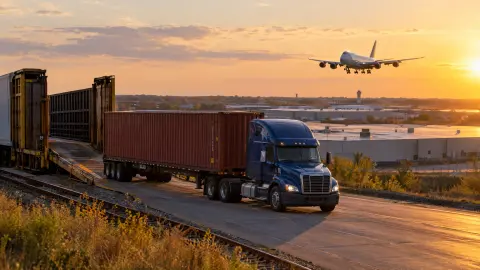
Every container that comes off the BNSF ramp at 32880 W. 191st in Edgerton, Kansas needs a tractor, and the drivers who pull those tractors live on both sides of the state line. That is a normal Kansas City day. A driver clocks in on one side of the line, pulls a box or a load of truck parts on the other, and comes home across the river. The Ford plant in Claycomo, the Edgerton ramp and the industrial ground along the Missouri River east of downtown all push freight through the same handful of interchanges, so a carrier here is really recruiting for a commute pattern, not a city name.
Pay-per-driver recruiting means we get paid when a seat is filled, not when a résumé is sent. For a Kansas City carrier that changes what we ask before we start: the yard address, the lane the truck actually runs, the home-time rhythm and the pay sheet you will defend on the phone. Then we work the market from Illinois by phone and video, screen hard, and you pay for the driver who shows up to orientation. You do not pay for the noise.
In Kansas City the first question is never pay; it is which side of the river the yard sits on, and we answer it before we dial.
Freight in Kansas City: what moves, and where
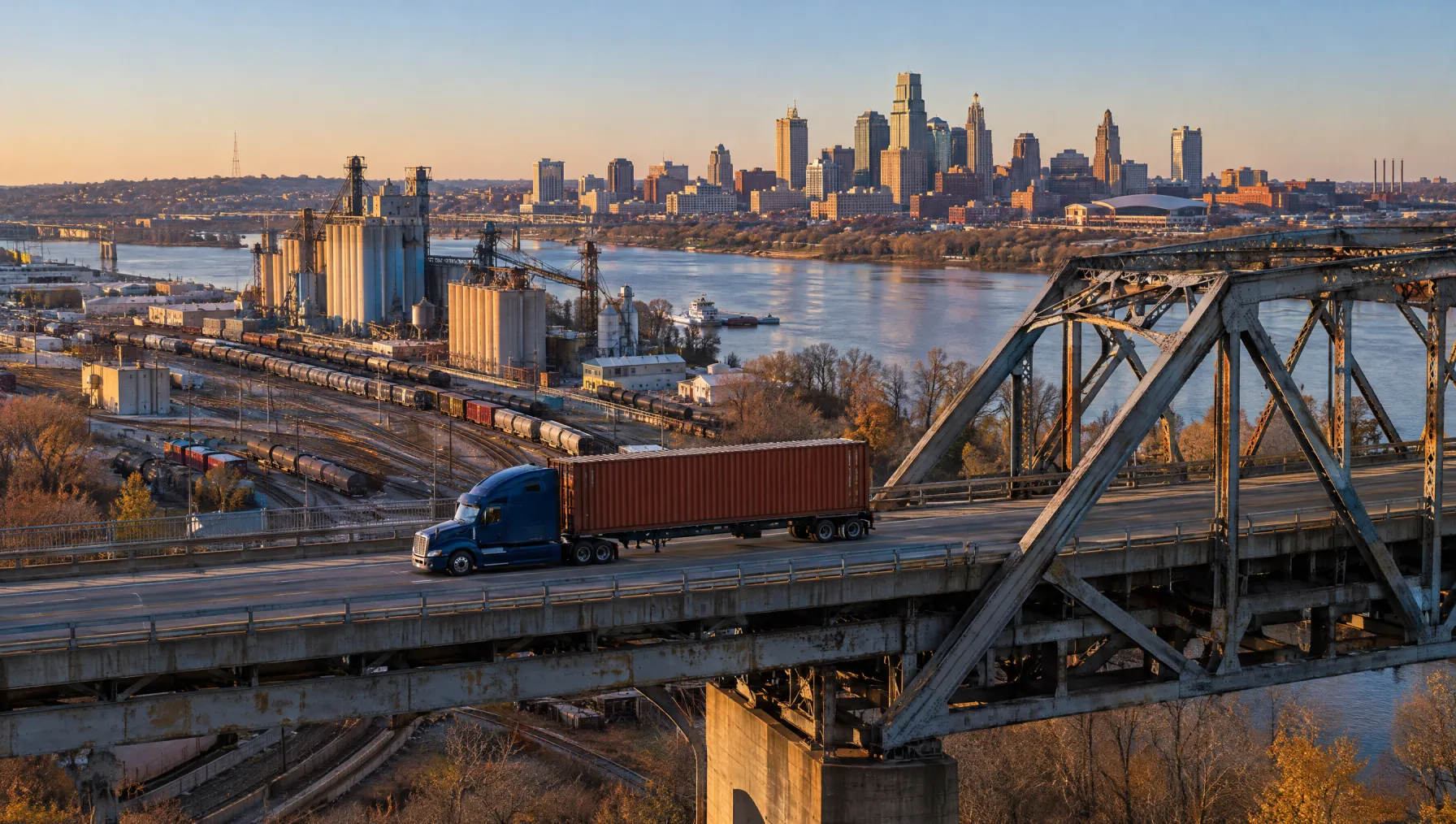
Kansas City's freight story starts with rail. MoDOT's Kansas City District Freight Plan calls the region the largest rail hub in the nation by tonnage, and the trucking market lives off that. BNSF lists its Logistics Park Kansas City Intermodal Facility at 32880 W. 191st in Edgerton, Kansas, on the south-west edge of the metro. KDOT's I-35 corridor study expected that ramp to generate 7,000 truck trips a day when fully developed, with most of them heading north on I-35 toward the I-435 loop and the state line, so that is where much of the metro's drayage begins and ends. On the Missouri side, the Port Authority of Kansas City holds a 415-acre former steel mill site it calls the Missouri River Terminal, where the Blue River meets the Missouri in Jackson County. Port KC describes it as a planned intermodal container rail terminal and river port with freight transload capability, direct access to five Class I railroads and a planned interchange onto I-435. It is still in planning, not operating, so we read it as a sign of where the east-side freight district is heading. The 64120 zip inside Kansas City already holds more carrier families than any other zip in our count: 25.
The second pillar is manufacturing. Ford's Kansas City Assembly Plant in Claycomo builds the F-150, the Transit and the E-Transit on a 1,269-acre site that has run since 1951, with roughly 9,205 employees as of June 2026 by Ford's own count. A plant that size means a steady stream of inbound parts trailers and outbound car haulers, and BNSF runs a separate Kansas City Vehicle Facility at 301 S. 51st St. in Kansas City, Kansas for automotive traffic. Car-haul, parts shuttle and dedicated plant work all grow out of that.
The fleets sit in a ring. Kansas City's 64108 zip holds 13 carrier families. Grandview, the 64030 zip on the I-49 side of the metro, holds 12. Across the river, North Kansas City in 64116 holds 11 and Riverside in 64150 holds 9. Beyond those five zips the registrations spread east along I-70 through Independence and Blue Springs, south through Lee's Summit, Belton and Harrisonville, and north through Liberty and Gladstone. In total the FMCSA census shows 2,252 active registrations and 19,561 trucks based in these towns, 1,996 of them one-to-nine-truck operations. The lanes point every direction. I-70 runs east through Columbia to Wentzville and St. Louis, where MoDOT's Improve I-70 program is adding a third lane each way and the Blue Springs-to-Odessa segment is under construction through late 2028. I-35 runs south-west to the Edgerton ramp and north-east out of the Northland, I-29 runs north through St. Joseph, and I-49 runs south toward Joplin. Regional work with a predictable reset is the natural product of that geography.
- I-70
- The east-west spine from the downtown loop through Independence and Blue Springs toward Columbia and St. Louis. MoDOT has the Blue Springs-to-Odessa widening under construction from September 2025 through late 2028 as part of Improve I-70, so drivers on this lane live in work zones for the next couple of years.
- I-35
- KDOT's I-35 corridor study says the majority of trucks from the BNSF intermodal facility near Edgerton and Gardner use I-35, and it projected 7,000 truck trips a day from the ramp when fully developed, most of them northbound. Drayage drivers ride I-35 in both directions every shift, and it is the freeway that carries them into downtown Kansas City, Missouri.
- I-29
- The northbound road out of the Northland, which MoDOT's Northwest District maintains through St. Joseph in Buchanan County. The North Kansas City and Riverside yards in the 64116 and 64150 zips sit on the Northland side, and I-29 lets those drivers head north without touching the downtown loop.
- I-49
- MoDOT upgraded 180 miles of US 71 south of Kansas City to interstate standards and unveiled it as I-49 in December 2012. It runs south through Cass County toward Joplin and the Arkansas line. Grandview's 64030 zip holds 12 carrier families on that side of the metro, and a driver living in Belton or Harrisonville will take an I-49 yard over a river crossing almost every time.
- I-435 loop
- The beltway. KDOT's I-35 study notes that the I-435 loop gives truck traffic a way around the downtown constrictions and that intermodal trucks from Edgerton distribute onto the freeway system at I-435. Port KC's planned Missouri River Terminal is being designed around a new I-435 interchange, which tells you where east-side truck traffic is going.
Where the 10-plus-truck fleets sit, by ZIP: 64120 (25), 64108 (13), 64030 (12), 64116 (11), 64150 (9).
Hiring drivers in Kansas City: what we actually see
Kansas City recruiting starts with a map. The first thing a driver wants to know is which side of the river and which side of the state line the yard sits on. A driver in Blue Springs will not commute to Riverside for a 5 a.m. start, and a driver in Liberty will not cross the river to reach Grandview. We ask every carrier for the exact yard address and shift start before we write an ad, because a Kansas City driver decides on the commute before he asks about pay. The second question is the lane. Drivers here have pulled containers, auto parts and dry van long enough to know what each kind of work does to a week, and they want the honest version.
The seats that fill fastest are home-daily with a clear per-move or hourly sheet: drayage to the Edgerton ramp, parts shuttle around the Claycomo plant, local routes out of the warehouses along the river. Regional runs with a weekly reset fill next, in rough order of how predictable the reset really is. Pure over-the-road is the slow seat. The 59 carrier families with 50 or more trucks based here, plus every national fleet holding a registration in the metro, chase the same OTR drivers with bigger budgets, and a 20-truck carrier posting a generic OTR ad into that crowd gets nothing back.
What carriers get wrong is treating Kansas City as one labor pool. It is at least four: Northland, east along I-70, south along I-49, and the Kansas side. A Kansas license holder in Overland Park is still a Kansas City driver, but the carrier has to be ready for both states' paperwork and has to say out loud which yard the job reports to. The other mistake is quoting a pay range only the highest-earning driver on the board actually makes. Drivers here talk to each other across the river, and a number that does not survive the first paycheck ends the relationship and poisons the next ad.
What drivers in Kansas City are paid
BLS puts the median annual wage for heavy and tractor-trailer truck drivers in the Kansas City, MO-KS metro area at $60,170, with a mean of $61,850 (Occupational Employment and Wage Statistics, May 2025).
The Bureau of Labor Statistics puts the 2025 annual median for heavy and tractor-trailer drivers in the Kansas City, MO-KS metro at $60,170, with the mean at $61,850. Two numbers that close together describe a middle-heavy market: many local, drayage and regional seats clustered near the median and a modest tail of higher earners nudging the mean up. The median is the reference point a driver carries in his head whether or not he has read the table.
For a home-daily drayage or shuttle seat, publish the real weekly figure a mid-board driver earns and show how it is built, per move, per hour or per mile. For regional or OTR, you are competing with the larger fleets, and a package that merely matches the median will not move a driver out of a seat he already has. Do not publish the highest figure on the board as typical.
Publish the median driver's real number and the path to the better one.
- $60,170
- median annual wage, Kansas City metro
- $61,850
- mean annual wage, May 2025 (BLS OEWS 53-3032)
Rules that shape Kansas City seats
Missouri legal weights
Missouri statute caps a vehicle or combination at 20,000 pounds on a single axle, 34,000 on a tandem and 80,000 gross. The harvest grain and milk-and-livestock tolerances in the same section apply only on highways other than the interstate system, so I-70, I-35, I-29, I-49 and I-435 run at the base limits. source ↗
Harvest-season grain tolerance
During harvest Missouri allows a vehicle hauling grain or grain coproducts up to 10 percent over the maximum weights on highways other than the interstates, and milk and livestock haulers up to 85,500 pounds gross off the interstates. Hopper and livestock drivers out of the metro must know the tolerance ends the moment they merge onto an interstate. source ↗
Two states, one paperwork stack
A Missouri-based carrier working both sides of the state line needs IRP apportioned plates, an IFTA license and UCR through MoDOT Motor Carrier Services; a carrier staying inside Missouri needs Missouri Operating Authority instead. Oversize or overweight loads need a MoDOT permit before they move. source ↗
Winter road status and work zones
MoDOT's Traveler Information Map publishes winter road conditions from Closed through Covered and Partly Covered to Clear, along with work zones and incidents. KC Scout, a joint KDOT and MoDOT operation, covers metro freeway traffic with cameras, message signs and incident alerts. Dispatchers check both before a winter shift, and the Improve I-70 work zones east of Blue Springs are a daily factor through late 2028. source ↗
The Kansas City calendar
The hiring calendar follows the freight. Fall brings harvest, and Missouri's statutory grain tolerance pulls hopper drivers toward farm work off the interstates during the harvest weeks, which thins the pool for everything else. Fourth-quarter retail volume runs through the Edgerton ramp and the warehouses that feed off it, and drayage demand follows.
Winter is the hard stretch. m. start quit in January.
Spring is the easiest time to fill a seat, as construction season reopens the I-70 work zones and drivers who tried OTR over the winter come home looking for regional work.
How pay-per-driver works for a Kansas City carrier
An intake call maps your lanes, equipment, pay and home time for Kansas City; if we can't guarantee you enough driver volume, we say so on that call. Our recruiters interview every driver by phone and verify CDL, endorsements, experience and work history against your requirements, then send complete submission packets through Onboard, our own placement platform. You pay per placed driver — half when the driver starts, half after the first 14 days — and recruiting for Kansas City runs from our Romeoville, IL office, 480 miles away. The model in full is on Pay Per Driver; why the first 48 hours decide most hires is on speed to hire.
Who this fits in Kansas City — and who it doesn't
The census counts 191 operators running 10 to 49 trucks in the Kansas City area and 59 with 50 or more.
This works for the 191 carrier families in the 10-to-49-truck band and a good share of the 59 in the 50-plus band, provided the job is specific. A Grandview carrier with eight drayage seats to the Edgerton ramp and a published per-move sheet is an ideal fit. So is a Northland carrier feeding the Claycomo plant on a dedicated schedule, or an I-70 regional fleet out of Independence or Blue Springs with a real weekly reset.
They share a yard address, a defined lane, a pay sheet that survives the first check, and an owner or dispatcher who returns our call the day a driver is ready to interview.
Who we turn down: We turn down most of the 1,996 one-to-nine-truck registrations in the metro, not because they are small but because a two-truck carrier usually cannot absorb a placement fee or hold a driver through a slow month. We turn down lease-purchase programs dressed up as driver jobs, any carrier that wants to post Kansas City without naming the yard, and any carrier that asks us to advertise a pay figure the mid-board driver does not actually earn.
How we think about drivers who stay: why drivers quit, and how to fix each reason. Selling to trucking companies rather than hiring drivers? That's a different service — Marketing for Trucking.
Our numbers
No third party audited these. They're our own operating numbers — the claims we make publicly about our own shop, and the standard you should hold us to on a call.
- 100+
- drivers our operation places per month
- 3,000+
- lifetime CDL hires
- 50+
- carrier partners
- 24 hrs
- to first drivers for a new carrier
More carrier feedback, in the carriers' own words: results.
Questions Kansas City carriers ask us
Staffing and recruiting are not the same purchase — ask any agency these, then compare who does the work and when the money changes hands.
What does it cost to fill a drayage seat running to the BNSF ramp in Edgerton, and when do we pay?
You pay a flat fee per placed driver, and nothing for sourcing, screening or interviews that do not end in a hire. The fee splits in two: half when the driver starts, and the balance after the driver clears the retention period written into the agreement. If the driver leaves inside that window, the second half is not owed. For an Edgerton drayage seat, our work is finding a driver whose home sits on the right side of I-35 for your start time, verifying the CDL and record, and walking him through your per-move sheet so the first check matches what he heard.
Does anyone at CDL Agency actually sit in Kansas City?
No. Our nearest office is Romeoville, Illinois, about 480 miles east of Kansas City, and we have no office, yard or recruiters stationed in the metro. Kansas City recruiting runs by phone and video from Illinois. What we bring is the FMCSA census for the metro, the BLS pay table, and the habit of asking for the exact yard address and start time before we write an ad. If a carrier wants us at the yard for an orientation day, we schedule it and drive down. We would rather say that plainly than pretend to a local address we do not have.
How many Kansas City carriers are competing for the same drivers my Independence yard needs?
As of September 2026 the FMCSA census shows 2,252 active carrier registrations based in Kansas City and its Missouri-side suburbs, running 19,561 trucks. Of those, 1,996 are one-to-nine-truck operations, 191 carrier families run 10 to 49 trucks and 59 run 50 or more. A mid-size carrier in Independence is therefore bidding against a long tail of small fleets paying per load and a short list of large fleets with real recruiting budgets. An unspecific ad gets lost in that. A specific one, with the yard, the lane and the pay sheet, stands out because so few of the 2,252 bother to write one.
I run 18 trucks out of Grandview. Does pay-per-driver recruiting fit a fleet my size, or only the big I-70 carriers?
It fits your size well. The 191 carrier families in the 10-to-49-truck band are the fleets we work with most in Kansas City, because one placement is a meaningful share of the fleet and the owner is close enough to the drivers to keep promises. The 59 fleets with 50 or more trucks here usually have an in-house recruiter and a sign-on budget; we help them on hard seats, like a new dedicated lane, rather than on steady volume. For an 18-truck Grandview carrier on the I-49 side, the fit comes down to whether you can name the yard, the lane and the real pay, and start a driver within a week of saying yes.
Should we lease on owner-operators for the Edgerton container work, or hire company drivers?
In Kansas City the answer turns on who carries the empty miles. Drayage to the Edgerton ramp and shuttle work around the Claycomo plant are short, repetitive moves where a company driver on an hourly or per-move sheet usually stays longer than an owner-operator watching fuel and wait time eat the settlement. Regional dry van and flatbed out of the I-70 towns is where lease-on owner-operators make sense, because the miles are there and a settlement can carry a truck payment. We recruit both, but we will not recruit for a lease-purchase program presented as a job, and we tell owner-operators the real deadhead and detention picture on the first call.
The BLS median for Kansas City is $60,170. Where should a Blue Springs regional carrier set pay against that?
Start from the two numbers the Bureau of Labor Statistics publishes for the Kansas City, MO-KS metro for 2025: a $60,170 median and a $61,850 mean. A Blue Springs regional seat with a weekly reset competes with the larger fleets that keep registrations in the metro, so a package at or below the median will not pull a driver out of a seat he already has. We do not invent a target number for you. We ask that you publish the figure a mid-board driver actually earned last quarter, show how it is built, and let us put it in front of drivers who want the I-70 lane and the reset you offer. A real number above the median wins more often than a bigger number nobody earns.
Drivers in Kansas City: browse current CDL-A jobs or get matched to a carrier — free for drivers.
Sources
- BNSF facility listings: Logistics Park Kansas City Intermodal Facility, Edgerton KS; Kansas City Vehicle Facility
- KDOT 5-County Regional Transportation Study, I-35 Corridor: BNSF intermodal truck trips, I-35 and I-435 routing
- MoDOT Kansas City District Freight Plan: largest rail hub in the nation by tonnage, I-70 capacity priority, interstate network
- Ford Kansas City Assembly Plant (Claycomo, MO): vehicles, acreage, employment
- Port KC: Missouri River Terminal, 415 acres, planned intermodal and river port, I-435 interchange
- MoDOT Improve I-70: Blue Springs to Wentzville third lane; Blue Springs to Odessa segment, construction September 2025 through late 2028
- MoDOT I-49 History in Missouri: US 71 upgraded over 180 miles south of Kansas City, unveiled December 2012
- MoDOT Northwest District: I-29 bridge rehabilitation in St. Joseph, Buchanan County
- Missouri Revised Statutes 304.180: axle and gross weight limits, harvest grain and milk/livestock tolerances
- MoDOT Motor Carrier Services: IRP, IFTA, UCR, Missouri Operating Authority, OS/OW permits
- MoDOT Traveler Information Map: winter road conditions, work zones, incidents
- KC Scout: Kansas City metro freeway traffic, operated by KDOT and MoDOT
- NWS Kansas City/Pleasant Hill forecast office
- NWS Kansas City winter weather statistics
1 FMCSA Company Census (2026-09-26): active carriers based in Kansas City, Independence, Riverside, North Kansas City, Grandview, Lee's Summit, Blue Springs, Liberty, Raytown, Belton, Harrisonville, Gladstone; MCS-150 filed in the last 24 months; 1–20,000 trucks; fewer than 10 buses. 10+ truck counts merge registrations sharing an address or D-U-N-S number. Totals and the 1–9 band count active USDOT registrations; fleet sizes are self-reported on the MCS-150, so read them as a scale, not a headcount.
Wages: U.S. Bureau of Labor Statistics, OEWS May 2025, occupation 53-3032, series OEUM002814000000053303213 (median) and OEUM002814000000053303204 (mean).
Written by
Andrius Pletniovas — Founder, CDL Agency
Andrius Pletniovas (Andrius Digital) is the founder of CDL Agency, a truck-driver recruiting and marketing company that has placed 3,000+ CDL drivers for 50+ carriers across the U.S. He writes about driver recruiting, retention, and the trucking market from running the agency every day.
More about Andrius →Official personal website →