FMCSA's carrier census lists 3,856 active carriers based in the Detroit area — 3,267 with one to nine trucks, 402 operators running 10 to 49, and 155 with 50 or more — roughly 84,123 power units between them. 1
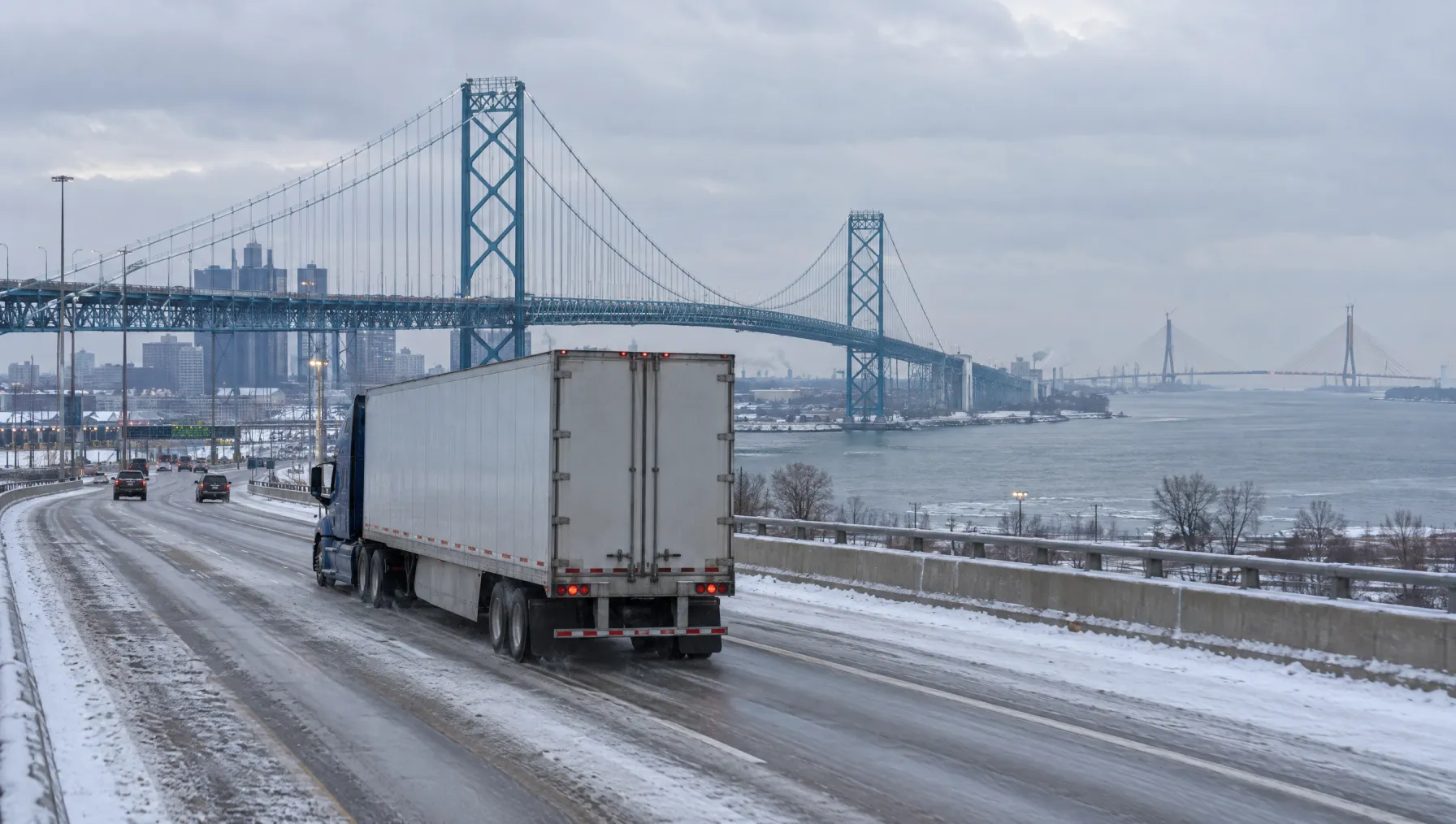
Every weekday morning the trucks queued at the Ambassador Bridge, and since late July 2026 at the new Gordie Howe International Bridge, are carrying the same thing: parts for an assembly line that will run out of them by the afternoon shift. More trucks enter the United States at Detroit than at any other port on the Canadian border, and the plants that traffic feeds sit in Dearborn, Warren, Sterling Heights, Wayne and the city itself, along with the suppliers that serve them. The schedule belongs to the plant, and the carrier and the driver work backward from it.
Pay-per-driver recruiting fits that rhythm. A Detroit carrier does not need a retainer that bills the same in a plant down week as it does when the lines run Saturday overtime. It needs seats filled when they open, by drivers who already understand what a tightly timed parts lane or a Windsor crossing asks of them, and it needs to pay only when one of those drivers actually starts. We screen, check documents and follow up from Illinois by phone and video, and our fee is tied to a start date.
In Detroit the assembly line sets the hiring calendar; a recruiter who does not know which plants are down this week is guessing.
Freight in Detroit: what moves, and where
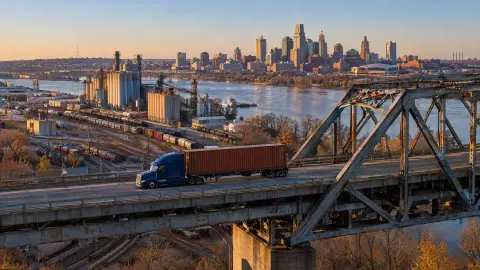
Detroit is the busiest truck gateway on the U.S.-Canada border. Bureau of Transportation Statistics border crossing data counted 1,132,114 inbound trucks at the Detroit port in 2025, ahead of Port Huron at 1,060,776 and Buffalo-Niagara Falls at 865,370. Until this summer the truck bridge was the Ambassador Bridge, a private crossing that still bars Class 1 explosives, Division 6.2 infectious substances and Class 7 radioactive loads, and that since October 29, 2024 has taken Class 3 flammables and Class 8 corrosives with 24 hours' notice and an escort at no more than 20 mph. The Gordie Howe International Bridge opened to traffic on July 27, 2026. It connects I-75 directly to Ontario Highway 401 with six lanes and 36 U.S. primary inspection lanes, charges a standard commercial toll of $12 Canadian or $8.75 U.S. per axle, and was designed to carry all nine classes of dangerous goods. The Detroit-Windsor Tunnel takes no placarded vehicles at all.
Inland, the freight is the auto supply chain. Ford builds the F-150 and Raptor at the Dearborn Truck Plant in Dearborn and the Ranger and Bronco at Michigan Assembly in Wayne. Stellantis runs the Ram 1500 out of Sterling Heights Assembly on Van Dyke, the Grand Wagoneer out of Warren Truck on Mound Road and the Grand Cherokee out of the Detroit Assembly Complex on St. Jean. GM's Factory ZERO in Detroit-Hamtramck is the dedicated plant for the Silverado EV, Sierra EV, Escalade IQ and Hummer EV, and GM has said Orion Assembly adds gas-powered full-size SUVs and light-duty pickups in early 2027. Around each plant sits a ring of suppliers and sequencing centers, which is why the FMCSA fleet families cluster where they do: 49 in 48126 in Dearborn, 49 in 48174 in Romulus around the airport, 32 in 48150 in Livonia, 30 in 48180 in Taylor on the Downriver side of I-75, and 24 in 48393 in Wixom at the west end of I-96.
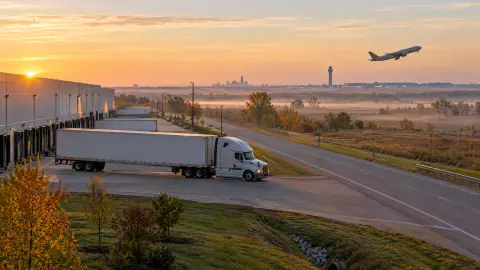
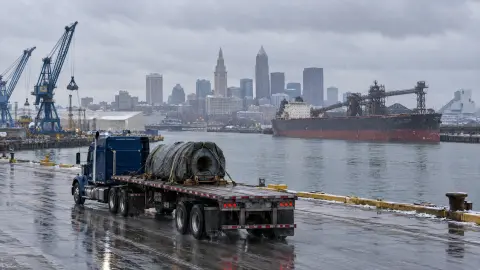
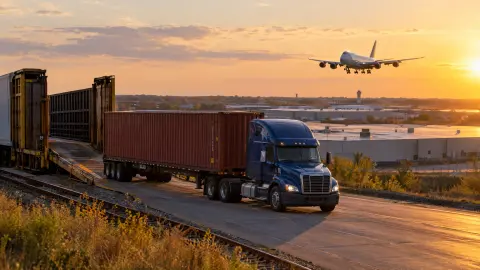
Three more systems share the same roads. Detroit Metropolitan Airport in Romulus handled 354,581,419 pounds of cargo in 2025 by the airport authority's count, feeding the expedite cluster along I-94. Norfolk Southern's Livernois Intermodal Facility in Southwest Detroit is being upgraded with a $67 million federal CRISI grant, matched by $45 million from Norfolk Southern, MDOT and the City of Detroit for a $112 million project that adds track, repaves the yard and replaces diesel cranes. CN's Detroit intermodal terminal on 8 Mile Road in Ferndale opens its gates at 5 a.m. on weekdays. On the river, the Port of Detroit's 29 terminals in Detroit, River Rouge and Ecorse handle steel, aluminum, cement and project cargo, with the port authority's own terminal in Delray. That steel becomes flatbed and Conestoga work for fleets Downriver and in southwest Detroit.
- I-75
- The spine from Downriver past the Rouge and downtown to Troy and Pontiac, and now the direct approach to the Gordie Howe bridge, so Canada-bound trucks mix with plant traffic south of downtown.
- I-94
- The airport and east-side corridor. MDOT's Restore I-94 project is rebuilding the freeway between I-275 and Michigan Avenue, part of $353 million of work along almost 13 miles, with many ramp closures that touch every expedite run out of Romulus.
- I-96
- The west leg to Livonia, Novi and Wixom, the dock-door suburbs where many 10-to-49 truck fleets park, and the route to Lansing and Grand Rapids for work that stays off the border.
- I-275
- The western bypass from I-75 in Monroe County past the airport to Canton and Livonia. Many Romulus-based drivers start and end their day on it, and it is the shared detour whenever an I-94 ramp closes.
- Ambassador Bridge / Gordie Howe crossing to Windsor
- Two bridges and a tunnel, one set of CBP rules. Hazmat and oversize loads sort between crossings by class and permit, a FAST card shortens the wait, and a driver who has done the crossing is worth more here.
Where the 10-plus-truck fleets sit, by ZIP: 48126 (49), 48174 (49), 48150 (32), 48180 (30), 48393 (24).
Hiring drivers in Detroit: what we actually see
The Detroit driver pool is shaped by the plants. Many experienced local drivers have run a dedicated parts lane at some point, and they ask the questions experience teaches: which plant, which delivery window, drop-and-hook or live unload at a sequencing center, and what happens to the paycheck in a down week. Drivers from Dearborn, Taylor, Lincoln Park and Melvindale will take a Downriver or Romulus start without hesitation. Ask the same driver to report to Auburn Hills or Wixom at 5 a.m. and the commute becomes the deal-breaker, because this metro is wide and I-94 is under reconstruction. We screen home ZIP against yard ZIP before anything else.
Home-daily dedicated auto seats with a predictable window fill fastest here, often from referrals. Cross-border seats fill slower because the pool is smaller: the driver needs documents that get them into Canada and back, a record that clears CBP and ideally a FAST card, and carriers that demand all three plus two years of border experience are fishing in a very small pond. Flatbed and steel work out of Delray and Downriver draws an older driver who is particular about tarping and pay per load. Regional and OTR seats based here are the slowest, because a Detroit driver with a clean record can find local work and does not need to leave home.
What carriers here get wrong is treating the market as one pool. They post a generic Class A ad, get airport expedite applicants for a Sterling Heights dedicated run, and conclude there are no drivers. The other mistake is timing. When a plant announces downtime, dedicated drivers start calling that same week, and a carrier with steady non-automotive freight can hire well for about a month. When the lines run Saturdays, those drivers stop answering. We watch the plant calendar, and we tell a carrier when the week they want to hire is the wrong week.
What drivers in Detroit are paid
BLS puts the median annual wage for heavy and tractor-trailer truck drivers in the Detroit-Warren-Dearborn, MI metro area at $59,120, with a mean of $58,070 (Occupational Employment and Wage Statistics, May 2025).
BLS puts the 2025 median wage for heavy and tractor-trailer drivers in the Detroit-Warren-Dearborn metro at $59,120 and the mean at $58,070. A median a little above the mean says the middle of this market is thick: many steady, home-daily dedicated and local seats earning close to the same number, with a tail of lower-paid yard, airport and entry-level work pulling the average down rather than a few high OTR earners pulling it up. For a carrier here the headline figure persuades less than the structure behind it.
Publish what the seat pays in a normal week and in a plant down week, say whether it is hourly, per stop or per mile, and state the weekly guarantee if there is one. A carrier paying at the median with a real floor will out-hire one advertising more with no floor.
- $59,120
- median annual wage, Detroit-Warren-Dearborn metro
- $58,070
- mean annual wage, May 2025 (BLS OEWS 53-3032)
Rules that shape Detroit seats
Spring weight restrictions (frost laws) on seasonal routes
MDOT and county agencies impose spring weight restrictions when frost leaves the roadbed. In 2026 they took effect February 17 on state trunklines from the Ohio and Indiana borders north to Ludington, were lifted March 9 on trunklines south of a line running along I-94, US-23, I-96 and M-59, which covers most of metro Detroit, and ended statewide May 15. On routes marked seasonal on the MDOT Truck Operators Map, legal axle weights drop 25 percent on concrete and 35 percent on asphalt and some vehicles are held to 35 mph. All-season routes, marked green and gold, keep full weights. source ↗
Michigan's 164,000-pound, 11-axle weight law
Michigan regulates axle loads rather than gross weight and allows up to eleven axles, so a properly spaced Michigan combination can gross 164,000 pounds where a federal-weight-law truck grosses 80,000 on five. Steel and aggregate here move on these heavy trains, and a driver new to Michigan multi-axle trailers needs training time before a steel seat. source ↗
Ambassador Bridge hazardous materials classes and escort
The bridge company's crossing guide bars Class 1 explosives, Division 6.2 infectious substances and Class 7 radioactive material; Classes 2, 3, 4, 5, 6.1, 8 and 9 may cross. Since October 29, 2024, Class 3 and Class 8 loads must call the escort team at least 24 hours ahead, stage at the duty-free lot on arrival, and cross under escort with four-way flashers at no more than 20 mph. source ↗
Detroit-Windsor Tunnel: no placarded vehicles
Michigan's entries in the FMCSA National Hazardous Materials Route Registry restrict all classes in the Windsor Tunnel from Jefferson Avenue to Canada and prohibit all placarded vehicles, and restrict placarded loads on the M-10 Lodge Freeway downtown. Any placarded run to Windsor is a bridge run, and the driver needs to know that at dispatch. source ↗
The Detroit calendar
Detroit's hiring calendar is set by the plants and the snow. When an assembly plant takes a shutdown or changeover week, its dedicated drivers come onto the market for a few weeks, and carriers with non-automotive freight hire well then. When the plants run overtime, those drivers vanish.
Winter is the other filter. 9 inches. In 2026 MDOT's spring weight restrictions started February 17, came off the Detroit-area trunklines March 9 and ended statewide May 15, so a seat that runs north to Flint or Lansing feels them longer than one that stays inside the metro.
Drivers who do not want a January bridge queue or reduced loads on seasonal routes stop answering ads around Thanksgiving. In our experience fall is when applications are thinnest and the plants run hardest, so we tell Detroit carriers to open seats in late summer.
How pay-per-driver works for a Detroit carrier
An intake call maps your lanes, equipment, pay and home time for Detroit; if we can't guarantee you enough driver volume, we say so on that call. Our recruiters interview every driver by phone and verify CDL, endorsements, experience and work history against your requirements, then send complete submission packets through Onboard, our own placement platform. You pay per placed driver — half when the driver starts, half after the first 14 days — and recruiting for Detroit runs from our Mundelein, IL office, 300 miles away. The model in full is on Pay Per Driver; why the first 48 hours decide most hires is on speed to hire.
Who this fits in Detroit — and who it doesn't
The census counts 402 operators running 10 to 49 trucks in the Detroit area and 155 with 50 or more.
This works for the 402 fleet families in the 10-to-49 truck band and the 155 in the 50-plus band that run dedicated, cross-border, intermodal or airport expedite work out of the Dearborn, Romulus, Livonia, Taylor and Wixom clusters and need a few seats filled by a date, not a retainer that bills through a down week. It also fits expedite fleets at the airport adding company drivers, and steel and flatbed carriers Downriver that need drivers trained on Michigan multi-axle trailers. The common thread is a real dispatcher, a defined lane and a pay sheet we can read to a driver on the phone.
Who we turn down: We turn down most of the 3,267 one-to-nine truck registrations in this metro unless the owner is a working carrier with a dispatcher, insurance in force and a seat that pays every week. We turn down carriers whose authority is under a year old or whose safety record would scare the drivers we call, carriers that want FAST-card drivers but will not pay for bridge wait time, and anyone recruiting into a lease-purchase program we would not sign ourselves.
How we think about drivers who stay: why drivers quit, and how to fix each reason. Selling to trucking companies rather than hiring drivers? That's a different service — Marketing for Trucking.
Our numbers
No third party audited these. They're our own operating numbers — the claims we make publicly about our own shop, and the standard you should hold us to on a call.
- 100+
- drivers our operation places per month
- 3,000+
- lifetime CDL hires
- 50+
- carrier partners
- 24 hrs
- to first drivers for a new carrier
More carrier feedback, in the carriers' own words: results.
Questions Detroit carriers ask us
Staffing and recruiting are not the same purchase — ask any agency these, then compare who does the work and when the money changes hands.
What does it cost to fill a dedicated seat running Sterling Heights to a Windsor supplier, and when do we pay?
We charge a flat fee per placed driver, agreed before we start, and nothing for the search itself. You pay half when the driver starts and the other half after the retention window we agree on, usually 30 days, has passed with the driver still in the seat. If the driver leaves before that, the second half is never billed. For a cross-border run like Sterling Heights to Windsor the fee is the same as a local seat; we simply front-load the document and record checks so a driver who cannot clear CBP never reaches your orientation.
Do you have recruiters in Detroit, or anyone we could meet at a Romulus or Dearborn yard?
No. Our nearest office is our headquarters at 1280 Townline Road in Mundelein, Illinois, about 300 miles west of Detroit, and our other offices are in Romeoville, Illinois, Lancaster, Texas and North Miami, Florida. We have no Detroit office, yard or walk-in location, and we will not pretend to. Detroit recruiting runs by phone, text and video from Mundelein, which is how most drivers prefer to be screened anyway. If a carrier wants one of us in the room for an orientation, we will drive over on I-94, and we say that up front.
We run 18 trucks out of Livonia. Does pay-per-driver recruiting work for a fleet our size, or is it built for the 50-plus fleets along I-75?
It works better for you than for them. A 10-to-49 truck fleet in Livonia or Wixom competes for the same drivers as the large dedicated carriers but cannot carry an in-house recruiter or a monthly retainer through a slow quarter, so paying only when a driver starts matches your cash flow. The 50-plus fleets here tend to use us for overflow and hard seats such as cross-border or steel, because their own recruiters are tied up with turnover on the big dedicated accounts. For an 18-truck fleet we usually fill one to three seats at a time, and the owner talks to the driver.
Most of the airport expedite fleets in Romulus run on owner-operators. Can you recruit lease-on operators, or only company drivers?
Both, but as different searches. A company driver for a straight truck or tractor at the airport is a pay, schedule and home-time conversation. A lease-on owner-operator is a revenue, deadhead, fuel and settlement conversation, and in Romulus the operators ask hard questions about load frequency because expedite volume swings with the plants. We recruit owner-operators for carriers that publish their settlement terms and let us read them to the operator. We do not recruit into lease-purchase programs where the carrier owns the truck and the driver carries the risk, because those drivers leave within months.
The BLS median for Detroit is $59,120. Do we have to beat it to hire for a dedicated Dearborn parts lane?
Not necessarily, and we will not invent a number for you. The 2025 BLS median for the metro is $59,120 and the mean is $58,070, and a dedicated Dearborn lane with a predictable window and daily home time is one of the more wanted seats in the region. What drivers compare is the structure: hourly or per stop, what the guarantee is, and what the check looks like in a Ford down week. A seat at the median with a real weekly floor and a fixed start time fills faster than one advertised above the median with no floor. We read your pay sheet against the drivers we are already talking to before we post anything.
Our tractors run out of Taylor to Windsor and Toledo all winter. How do you screen for drivers who can handle January on the Ambassador Bridge approach and the spring weight restrictions?
We ask directly, because Detroit winters sort drivers quickly. NWS Detroit normals put January at 14.0 inches of snow and February at 12.5, and a bridge approach in a snow squall with a stopped queue of trucks is a specific kind of patience. We ask whether the driver has run a Michigan winter in a tractor, how they handle a stopped plaza queue, whether they hold a FAST card or have crossed before, and whether they understand that MDOT's spring weight restrictions, which ran from February 17 to March 9 on the Detroit-area trunklines in 2026 and to May 15 farther north, cut legal axle weights on seasonal routes and change the load plan. A driver from Taylor with two winters on I-75 answers those in a sentence.
Drivers in Detroit: browse current CDL-A jobs or get matched to a carrier — free for drivers.
Sources
- BTS Border Crossing Entry Data, Detroit port, Trucks, 2025 (data.bts.gov API)
- Gordie Howe International Bridge: Celebrating the Gordie Howe International Bridge (July 24, 2026; opening to traffic Monday, July 27, 2026)
- Gordie Howe International Bridge news releases
- Gordie Howe International Bridge commercial amenities (I-75 to Highway 401, six lanes, 36 U.S. primary inspection lanes)
- Gordie Howe International Bridge specialized loads (all nine classes of dangerous goods, oversize, overweight)
- Gordie Howe International Bridge toll rates announcement ($12 CAD / $8.75 USD per axle commercial)
- Ambassador Bridge hazardous materials crossing guide (updated October 2024)
- Ambassador Bridge Class 3 and Class 8 procedure starting 10-29-2024 (24-hour notice, escort, 20 mph)
- FMCSA National Hazardous Materials Route Registry, Michigan state responses (Windsor Tunnel, M-10 Lodge Freeway, Ambassador Bridge)
- MDOT Hazardous Material Route Registry Study for the Ambassador Bridge (November 2023)
- CBP Free and Secure Trade (FAST) program for commercial vehicles
- MDOT: Annual spring weight restrictions begin Tuesday, Feb. 17 (Feb. 12, 2026)
- MDOT: Annual spring weight restrictions changing Monday, March 9 (March 5, 2026; lifted south of the I-94/US-23/I-96/M-59 line)
- MDOT: Lifting all remaining spring weight restrictions Friday, May 15 (May 13, 2026)
- MDOT: Michigan's Truck-Weight Law and Truck-User Fees (164,000 lb, 11 axles)
- MDOT Truckers page (Truck Operators Map, restrictions, permits)
- MDOT: Restore I-94 project, I-275 to US-12 Michigan Avenue, $353 million along almost 13 miles (Feb. 12, 2026)
- Michigan Infrastructure Office: $67 million CRISI grant for Livernois Intermodal Facility, $45 million match, $112 million total (Oct. 30, 2024)
- CN intermodal terminals (Detroit terminal, 923 East 8-Mile Road, Ferndale, MI; Mon-Fri 05:00-21:00)
- Detroit/Wayne County Port Authority: terminal leasing and cargo capabilities (29 terminals; Detroit, River Rouge, Ecorse; Delray terminal)
- Ford Dearborn Truck Plant (current products: Ford F-150, Raptor)
- Ford Michigan Assembly Plant, Wayne, MI (current products: Ford Ranger, Ford Bronco)
- Stellantis Warren Truck Assembly Plant fact sheet (21500 Mound Road; Jeep Grand Wagoneer)
- Stellantis Sterling Heights Assembly Plant fact sheet (38111 Van Dyke; Ram 1500)
- Stellantis Detroit Assembly Complex - Mack fact sheet (4000 St. Jean Avenue; Jeep Grand Cherokee)
- GM: $4 billion U.S. plant investment, Orion Assembly early 2027 and Factory ZERO EV lineup (June 2025)
- Wayne County Airport Authority: DTW Aviation Statistics Report, December 2025 (CY2025 total cargo 354,581,419 lb)
- NWS Detroit/Pontiac: Detroit January climate records and normals
- NWS Detroit/Pontiac: Detroit February climate records and normals
- NWS Detroit/Pontiac: Detroit December climate records and normals
- NWS Detroit/Pontiac: Detroit monthly snowfall by season, 2000-2001 through 2020-2021
1 FMCSA Company Census (2026-09-26): active carriers based in Detroit, Warren, Dearborn, Romulus, Taylor, Livonia, Sterling Heights, Auburn Hills, Pontiac, Troy, Southfield, Novi, Wixom, Belleville, Canton, Melvindale, Lincoln Park; MCS-150 filed in the last 24 months; 1–20,000 trucks; fewer than 10 buses. 10+ truck counts merge registrations sharing an address or D-U-N-S number. Totals and the 1–9 band count active USDOT registrations; fleet sizes are self-reported on the MCS-150, so read them as a scale, not a headcount.
Wages: U.S. Bureau of Labor Statistics, OEWS May 2025, occupation 53-3032, series OEUM001982000000053303213 (median) and OEUM001982000000053303204 (mean).
Written by
Andrius Pletniovas — Founder, CDL Agency
Andrius Pletniovas (Andrius Digital) is the founder of CDL Agency, a truck-driver recruiting and marketing company that has placed 3,000+ CDL drivers for 50+ carriers across the U.S. He writes about driver recruiting, retention, and the trucking market from running the agency every day.
More about Andrius →Official personal website →