FMCSA's carrier census lists 2,965 active carriers based in the Milwaukee area — 2,634 with one to nine trucks, 248 operators running 10 to 49, and 72 with 50 or more — roughly 22,937 power units between them. 1
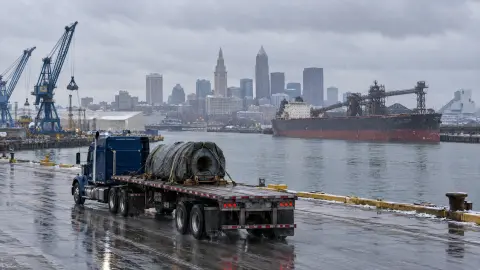
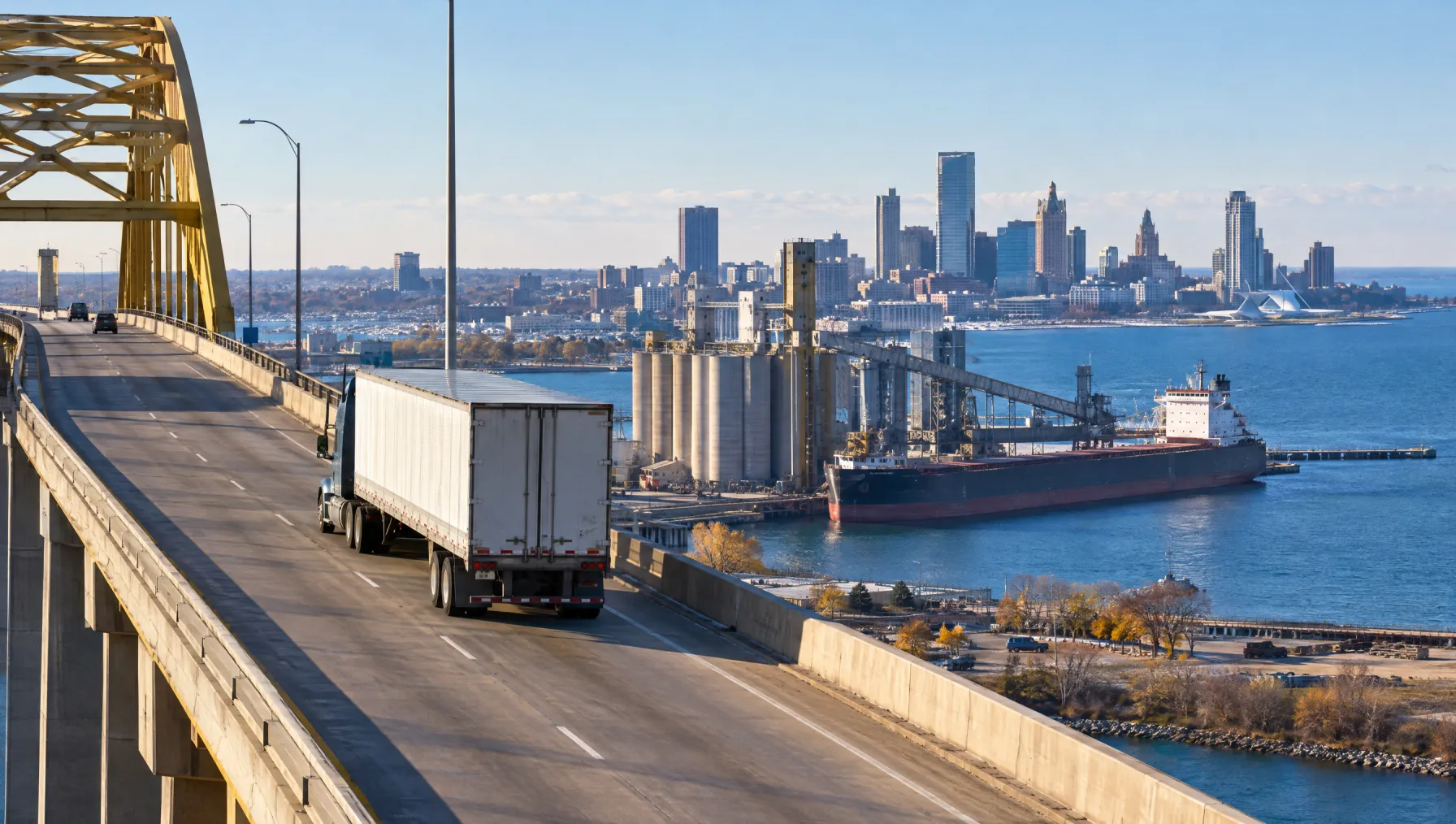
The DeLong Company's bulk export terminal at Port Milwaukee loads grain and feed onto ocean-going vessels and river barges, and every ton of it arrives by truck or by train from farms and plants across the state. That is Milwaukee freight in one picture: a harbor, a brewery, a machine shop and a dairy cooler, tied together by I-94 and I-43. The metro's carriers are not chasing containers. They haul beer out of the Molson Coors brewery on State Street, engines out of Menomonee Falls, generators out of Generac's Wisconsin plants and cheese to every grocery distribution center within a day's drive.
Pay-per-driver recruiting means a Milwaukee carrier pays us when a driver we found starts, not before. We take the lane, the equipment and the home time as they really are, source drivers from Oak Creek to Kenosha and out through Waukesha County, screen them by phone, and hand over people who know what they are signing up for. Our nearest office is our headquarters in Mundelein, Illinois, about 60 miles south on I-94, so we work this market by phone and by driving up to your yard, not from a storefront in Milwaukee.
A Racine driver reads a Milwaukee offer with a Bolingbrook offer open in the other tab, so we write yours to survive that comparison.
Freight in Milwaukee: what moves, and where
Start at the water. Port Milwaukee sits on Jones Island at the mouth of the harbor, and WisDOT's own port profile says I-94 and I-794 lead directly into it, with the interstate less than five minutes from the main terminals, truck scales on the port and rail service from both Union Pacific and CPKC. WisDOT's freight committee put the port's cargo at 2.2 million tons for 2023, second in the state behind Superior, with fertilizer components, Portland cement, chemicals and salt at the top of the list. Since the summer of 2023 the island has also had a bulk agricultural export terminal run by The DeLong Company, a project of more than $40 million that loads vessels of 8,000 to 22,000 metric tons for Northern Europe, the Mediterranean, North Africa and the Middle East. DeLong added two silos to it in early 2026, and the grain and feed it ships arrive by truck or train, which is work for hopper and tanker fleets across southern Wisconsin. Just west of the harbor, Rockwell Automation keeps its global headquarters at 1201 South Second Street. Up the Menomonee Valley, Molson Coors' Milwaukee Brewery at 4000 West State Street turns out 5.7 million barrels a year across 42 brands, which means reefer and dry van outbound every day of the week. Harley-Davidson is headquartered at 3700 West Juneau Avenue and builds engines at its Powertrain Operations plant on Pilgrim Road in Menomonee Falls, where Kohl's also keeps its corporate headquarters in ZIP 53051, one of the five ZIPs with the most fleets in the metro.
The fleets themselves cluster south and west. Oak Creek's 53154 has more carrier families of ten or more trucks than any other ZIP in the metro, with New Berlin's 53151 and Menomonee Falls' 53051 next. That is the I-94 and I-41 ring around the city, where industrial parks sit between the airport and the county line. Generac is headquartered on Highway 59 in Waukesha, builds generators in Oshkosh and Beaver Dam, and in January 2026 announced a new commercial and industrial plant in Sussex that is due to open in the fourth quarter of 2026 with more than 100 manufacturing jobs. Down the lakeshore, Racine County is changing shape. InSinkErator is headquartered in Racine and lists a Mount Pleasant address on International Drive in 53177, and Microsoft is building its Fairwater AI datacenter on 315 acres in Mount Pleasant, three buildings with 1.2 million square feet under roof, which is a construction freight stream of its own into Racine County. Kenosha's 53142 rounds out the top five, and Snap-on has been headquartered in Kenosha since 1930. The Kenosha and Pleasant Prairie belt is where Milwaukee freight becomes Chicago freight; Wisconsin's northbound scale on I-94 at milepost 349 sits a quarter mile inside the state line.
What Milwaukee does not have is a Union Pacific intermodal terminal. UP's nearest ramps are Global 2, Global 4 and Yard Center, all in the Chicago area, so container drayage from here means a run down I-94 and back. Behind all of it is the state's farm economy. Wisconsin made 3.64 billion pounds of cheese in 2025, a quarter of the nation's output, from about 5,000 dairy farms and 1.27 million cows, and it grows more than 60 percent of the country's cranberries. Milk, cheese and finished food move through this metro to Chicago, Minneapolis and the East Coast on reefers, while the farm-to-plant leg runs on straight trucks and tankers that rarely see an interstate.
- I-94 (south to Kenosha and Chicago)
- The spine of the market, from the Oak Creek industrial parks past Racine and Kenosha to the state line, with Wisconsin's northbound scale at milepost 349. Every Chicago run and every Illinois recruiter's offer rides this road.
- I-94 East-West (Marquette Interchange to Waukesha)
- West out of downtown toward Waukesha and Madison. WisDOT is rebuilding the segment between 70th Street and 16th Street and resurfacing the Marquette Interchange, so expect lane shifts and ramp closures while that work runs.
- I-43 (north to Green Bay, southwest to Beloit)
- North along the lake to Sheboygan and Green Bay, southwest toward Beloit. WisDOT is rehabilitating the bridges between North Halyard Street and West Capitol Drive, which slows the north side at shift change.
- I-41 / US-45 (Menomonee Falls to the Fox Valley)
- Through Menomonee Falls and Germantown to Oshkosh, Appleton and Green Bay. It is one of two interstate corridors that carry Wisconsin's agricultural weight exemptions, which matters if you haul grain, feed or milk.
- I-794 and the Hoan Bridge
- The truck route onto Jones Island and the port; WisDOT calls I-794 an important freight route to and from Port Milwaukee and counted 42,500 vehicles a day at the Hoan in 2022, 3.7 percent of them trucks. WisDOT is planning maintenance on the Hoan from the Milwaukee River to Carferry Drive and studying what replaces the Lake Interchange's 28 original 1970s bridge units; the Hoan's main span is not on the table, the ramps are.
Where the 10-plus-truck fleets sit, by ZIP: 53154 (24), 53151 (19), 53051 (19), 53142 (15), 53177 (13).
Hiring drivers in Milwaukee: what we actually see
The driver pool here lives in a ring, not a dot. Someone in Oak Creek or Cudahy can reach any yard on the south side in twenty minutes, but a driver in Waukesha or Sussex will not take a 5 a.m. start in Kenosha, and a Racine driver treats Pleasant Prairie and Oak Creek as equal commutes. So the first question we ask a carrier is not how many trucks. It is which gate, which start time, and which side of the Milwaukee River. The second question is the lane. Drivers here have usually run Chicago, Minneapolis or the Fox Valley for years, and they want to know whether your version of regional means home every night, home every other night, or out Monday and back Friday. Vague answers lose them to the next call.
The seats that fill fast are daytime local and dedicated regional with a set schedule: brewery and food runs, dedicated retail loops, port and plant shuttles. What fills slow is the night shift to Chicago, anything that touches the Chicago ramps during rush hour, and open-board regional with some weekends. Flatbed with tarping for the machinery shippers is its own small pool, and tanker with endorsements for milk and chemicals is smaller still; expect two to three weeks of sourcing, not days. The thing carriers get wrong here is quoting against the shop next door. The driver is not comparing you to the fleet in New Berlin. He has a Bolingbrook or Elk Grove offer in his phone, because those carriers recruit across the state line every day, and he is weighing your weekly pay plus a shorter commute against their higher number plus well over an hour on I-94 each way. If your offer does not name the weekly number, the home time and the commute saving in the same breath, you lose by default.
We also tell carriers to stop screening for two years of over-the-road experience when the job is a daycab shuttle. Milwaukee has plenty of experienced local drivers who have never run long-haul and never will. Write the requirement for the job you actually have, and we can call the brewery veteran in West Allis who would never answer an OTR ad.
What drivers in Milwaukee are paid
BLS puts the median annual wage for heavy and tractor-trailer truck drivers in the Milwaukee-Waukesha, WI metro area at $59,580, with a mean of $60,080 (Occupational Employment and Wage Statistics, May 2025).
The BLS puts the 2025 annual median for heavy and tractor-trailer truck drivers in the Milwaukee-Waukesha metro at $59,580, with the mean at $60,080. Those two numbers are only $500 apart, and that tells you something useful: the pay distribution here is flat. There is no large tail of high-earning long-haul drivers pulling the average up, because this market is mostly local, LTL, dedicated and short regional work paid hourly or as a fixed weekly figure.
For a carrier that means two things. Publish a weekly number, not a cents-per-mile range, because the drivers you are competing for think in weeks. And remember the figure covers every Class A driver from a daycab brewery shuttle to an East Coast reefer run, so if your regional seat pays above that median, say so with a dollar figure and the hours behind it.
The comparison in the driver's head is a Chicago offer, and market rate is not a number.
- $59,580
- median annual wage, Milwaukee-Waukesha metro
- $60,080
- mean annual wage, May 2025 (BLS OEWS 53-3032)
Rules that shape Milwaukee seats
Wisconsin legal size and weight limits
Without a permit, Wisconsin allows 80,000 pounds gross, 20,000 on a single axle, 34,000 on tandems, 13 feet 6 inches tall, 8 feet 6 inches wide and 75 feet for a tractor-semitrailer. Class B highways carry 60 percent of Class A weight limits, which catches drivers on county roads around the dairy plants. source ↗
Spring thaw Class II postings
From early March into late April or early May, WisDOT posts about 1,400 miles of state highway as Class II and suspends most divisible-load multiple-trip permits above legal axle weights or 80,000 pounds. Travel on single-trip or annual non-divisible permits is not restricted in Milwaukee County or anywhere on the Interstate system, so this bites farm, forest and aggregate haulers in the counties around the metro, not the I-94 fleets. source ↗
Harvest-season weight allowance, August 1 to December 31
Wisconsin Statute 348.17 lets a vehicle registered for at least 50,000 pounds exceed weight limits by up to 15 percent when hauling corn, soybeans, potatoes, vegetables or cranberries from field to storage or processing. It does not apply on interstates other than the I-39 and I-41 corridors. source ↗
Kenosha scale on northbound I-94
Wisconsin's Kenosha Safety and Weight Enforcement Facility sits at I-94 milepost 349 in Pleasant Prairie, a quarter mile north of the Illinois line, checking northbound traffic. The southbound Racine facility at milepost 328 in Caledonia is listed as currently closed. Drivers coming up from Chicago should expect the Kenosha pull-in. source ↗
The Milwaukee calendar
Winter sets the calendar. 7 inches a year, and the lakeshore counties get lake-effect bands on top of system snow, like the Racine and Kenosha County event of November 9 and 10, 2025, and the blizzard of March 14 to 16, 2026. Driver applications climb in January once holiday pay has cleared, and carriers ready to hire then get the pick of people leaving December behind.
Spring brings the Class II thaw postings outside Milwaukee County and reopens the Seaway for the port's shipping season. From August 1 to December 31 the harvest weight allowance pulls farm-side drivers into grain and cranberry work, which thins the tanker and hopper pool for everyone else. Retail freight through the Kenosha and Pleasant Prairie warehouse belt builds from October through December, and that is when local daycab seats are hardest to keep filled.
How pay-per-driver works for a Milwaukee carrier
An intake call maps your lanes, equipment, pay and home time for Milwaukee; if we can't guarantee you enough driver volume, we say so on that call. Our recruiters interview every driver by phone and verify CDL, endorsements, experience and work history against your requirements, then send complete submission packets through Onboard, our own placement platform. You pay per placed driver — half when the driver starts, half after the first 14 days — and recruiting for Milwaukee runs from our Mundelein, IL office, 60 miles away. The model in full is on Pay Per Driver; why the first 48 hours decide most hires is on speed to hire.
Who this fits in Milwaukee — and who it doesn't
The census counts 248 operators running 10 to 49 trucks in the Milwaukee area and 72 with 50 or more.
This works for the 248 carrier families in the metro running 10 to 49 trucks: the New Berlin machinery hauler, the Oak Creek food distributor, the Menomonee Falls dedicated fleet that needs two or three drivers a quarter and cannot justify a full-time recruiter. It also works for the 72 families at 50 or more trucks who have a recruiter but need a second channel for the hard seats, usually nights, tanker, or anything that touches Chicago. The common thread is a real lane, a real start time and a real weekly number.
Tell us those three things on the first call and we can source for them.
Who we turn down: We turn down carriers who want to match the Chicago megacarriers' recruiting volume with a fraction of the pay and no home-time advantage, because the driver will take the Bolingbrook job and everyone's time is wasted. We also pass on lease-purchase programs dressed up as company jobs, fleets that will not tell us their lane before we call drivers, and anyone who asks for drivers on the lot by Monday. Recruiting here is a two-to-three-week job done honestly, not a staffing bench.
How we think about drivers who stay: why drivers quit, and how to fix each reason. Selling to trucking companies rather than hiring drivers? That's a different service — Marketing for Trucking.
Our numbers
No third party audited these. They're our own operating numbers — the claims we make publicly about our own shop, and the standard you should hold us to on a call.
- 100+
- drivers our operation places per month
- 3,000+
- lifetime CDL hires
- 50+
- carrier partners
- 24 hrs
- to first drivers for a new carrier
More carrier feedback, in the carriers' own words: results.
Questions Milwaukee carriers ask us
Staffing and recruiting are not the same purchase — ask any agency these, then compare who does the work and when the money changes hands.
What does it cost a Menomonee Falls fleet to hire through you, and when do we pay?
We charge a flat fee per placed driver, agreed in writing before we start calling. You pay half when the driver starts and the balance after the driver has stayed through the retention period we agree to up front. If the driver leaves inside that window, the second half is never billed. There is no retainer, no monthly subscription and no charge for candidates you interview but do not hire. For a 15-truck fleet in Menomonee Falls hiring three drivers a year, put that number next to the cost of one bad hire's onboarding and decide for yourself.
Do you have recruiters in Milwaukee, or are you working this market from somewhere else?
From somewhere else, and we would rather say so than pretend. Our nearest office is our headquarters at 1280 Townline Road in Mundelein, Illinois, about 60 miles south of downtown Milwaukee on I-94. We do not have a Milwaukee office, yard or walk-in location. Our recruiters work this market by phone, text and video with drivers, and we drive up to meet carriers at their yards when it helps close a hire. The Kenosha and Pleasant Prairie belt sits between the two cities, so the commute logic we use for Chicago's north suburbs carries straight up the lakeshore.
If I run Milwaukee to Minneapolis or Milwaukee to Chicago, what home time will drivers here expect?
Chicago is a same-day turn from anywhere in the metro, so drivers expect to sleep at home every night, and they expect you to say which end of the day the Chicago leg hits traffic. Minneapolis on I-94 is a long day, so the local expectation is either a relay with day-cab drivers meeting partway or a sleeper driver home every other night. Green Bay and the Fox Valley on I-41 are daily. East Coast reefer runs are the only lanes where out five and home two is accepted, and only with the weekly number to match. Define your lane in nights at home per week, not in adjectives.
Do you recruit Spanish-speaking drivers for Milwaukee's near south side, Racine and Kenosha?
Yes. We recruit in English and Spanish, and a driver from the near south side, Racine or Kenosha can do the first call in Spanish and ask about the lane, the pay and the equipment in the language he is most comfortable in. We do not treat bilingual recruiting as a separate product. It is the same screen, the same honesty about home time and the same quote against the Chicago offer the driver is already holding. If your dispatcher or safety manager speaks Spanish, tell us, because that is a real selling point for a driver's first ninety days.
How many carriers in the Milwaukee metro are competing for the same drivers I am?
As of September 26, 2026, the FMCSA census shows 2,965 active carrier registrations based in the Milwaukee, Waukesha, Racine and Kenosha cities we cover, running 22,937 trucks between them. Most are tiny: 2,634 have one to nine trucks. Merge registrations that share an address and you get 248 carrier families with 10 to 49 trucks and 72 with 50 or more. That is the local field. But the carrier that actually takes your driver is often not on that list, because the Chicago fleets recruit across the state line every day. You compete with a few hundred mid-size Wisconsin fleets and with Illinois on top, which is why the offer has to name a weekly number.
I run 20 trucks out of Oak Creek. Does this work as well for me as for a 100-truck fleet in Pleasant Prairie?
Usually better. A 20-truck fleet in Oak Creek hires two to four drivers a year, has no recruiter, and loses a week of the owner's time every time a seat opens. Paying per placed driver fits that rhythm, and a smaller fleet can promise a named dispatcher and an assigned truck, which drivers here value. A 100-truck fleet in Pleasant Prairie usually has a recruiter already; we are the second channel for the seats that recruiter cannot fill, the night Chicago run or the tanker position. Both work. The fleets we struggle with are the ones in either band whose lane and pay change depending on who answers the phone.
Drivers in Milwaukee: browse current CDL-A jobs or get matched to a carrier — free for drivers.
Sources
- WisDOT: Oversize/overweight permit requirements and Wisconsin legal limits
- WisDOT: Class II highways spring thaw weight restrictions
- WisDOT: Frozen road declaration
- WisDOT: Safety and Weight Enforcement Facility locations (Kenosha I-94 MP 349, Racine MP 328)
- Wisconsin Statute 348.17: Special or seasonal weight limitations
- Wisconsin Statute 348.15: Weight limitations
- WisDOT Southeast Region projects (I-94 East-West 70th to 16th, Marquette Interchange resurfacing, I-43 bridges Halyard to Capitol, Hoan Bridge maintenance)
- WisDOT: I-794 Lake Interchange Study
- WisDOT: I-794 Lake Interchange Study FAQ (freight route to Port Milwaukee, 2022 traffic counts, 28 original bridge units)
- WisDOT: Hoan Bridge (I-794) safety improvements project (bridge crosses the Port of Milwaukee)
- WisDOT: Economic Impact of Wisconsin's Commercial Ports, April 2024 (Port Milwaukee profile: Jones Island, I-94/I-794 access, truck scales, UP and CPKC rail)
- WisDOT Freight Advisory Committee minutes, April 21, 2026 (Port Milwaukee 2.2 million tons, top commodities, DeLong terminal)
- 511 Wisconsin trucker information
- NWS Milwaukee: 2025 annual climate report for Milwaukee (normal snowfall 48.7 in.)
- NWS Milwaukee/Sullivan: event summaries (lake effect snow, blizzards)
- Wisconsin DATCP: Wisconsin agricultural statistics
- Molson Coors: Milwaukee Brewery
- The DeLong Company: Exports (Milwaukee bulk agricultural export terminal)
- Microsoft: Fairwater AI datacenter, Mount Pleasant, Wisconsin
- Rockwell Automation Form 10-K (FY2025), SEC EDGAR
- Harley-Davidson Form 10-K (FY2025), SEC EDGAR
- Harley-Davidson: Factory tours (Powertrain Operations, Pilgrim Road, Menomonee Falls)
- Kohl's Corporation Form 10-K (FY2025), SEC EDGAR
- Generac Holdings Form 10-K (FY2025), SEC EDGAR
- Generac: Sussex, WI manufacturing expansion press release, January 5, 2026
- Snap-on: About
- InSinkErator: About us
- Union Pacific: intermodal terminal map (no Wisconsin terminal)
- Great Lakes St. Lawrence Seaway: opening and closing information
1 FMCSA Company Census (2026-09-26): active carriers based in Milwaukee, Oak Creek, Cudahy, West Allis, Menomonee Falls, Germantown, Waukesha, New Berlin, Pewaukee, Franklin, Butler, Sussex, Kenosha, Pleasant Prairie, Racine, Sturtevant, Mount Pleasant; MCS-150 filed in the last 24 months; 1–20,000 trucks; fewer than 10 buses. 10+ truck counts merge registrations sharing an address or D-U-N-S number. Totals and the 1–9 band count active USDOT registrations; fleet sizes are self-reported on the MCS-150, so read them as a scale, not a headcount.
Wages: U.S. Bureau of Labor Statistics, OEWS May 2025, occupation 53-3032, series OEUM003334000000053303213 (median) and OEUM003334000000053303204 (mean).
Written by
Andrius Pletniovas — Founder, CDL Agency
Andrius Pletniovas (Andrius Digital) is the founder of CDL Agency, a truck-driver recruiting and marketing company that has placed 3,000+ CDL drivers for 50+ carriers across the U.S. He writes about driver recruiting, retention, and the trucking market from running the agency every day.
More about Andrius →Official personal website →