FMCSA's carrier census lists 4,672 active carriers based in the Minneapolis area — 4,264 with one to nine trucks, 319 operators running 10 to 49, and 81 with 50 or more — roughly 26,590 power units between them. 1
The Twin Cities sit at the top of the navigable Mississippi. The Saint Paul Port Authority owns four public river terminals in the Port of St. Paul, and its terminal pages list what moves across those docks: corn and soybeans, fertilizer, salt, cement, steel coils, rebar and scrap metal. A few miles away, BNSF's St. Paul Intermodal Facility on Pierce Butler Route runs its gate around the clock. The retail side of the metro is anchored by Target's two corporate campuses in Minneapolis and Brooklyn Park. Bulk, boxes and groceries, all in one metro, each with its own kind of driver.
For a carrier here, pay-per-driver recruiting means you stop paying for job-board clicks and start paying for a person who shows up at your Eagan or Shakopee yard with a clean MVR and a realistic idea of what January looks like. We charge per placed driver, not per month and not per applicant. If we cannot find someone who fits your lanes and your equipment, you owe us nothing. So we are not trying to get a warm body through orientation. We are trying to find someone who is still driving for you when the spring load restrictions come off.
In the Twin Cities the driver is not choosing between you and another carrier. He is choosing between you and a grocery fleet with a heated shop.
Freight in Minneapolis: what moves, and where
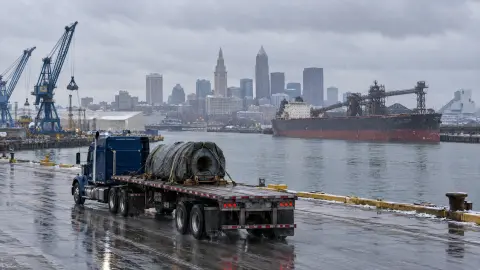
Start with the river. The Port of St. Paul is a bulk and project-cargo port. Barge Terminal One sits on Childs Road near Warner Road and US-10 and handles fertilizer, salt, aggregate, cement, scrap metal, feed additives and asphalt. Southport Terminal is on Barge Channel Road near Concord Avenue and US-52, with recyclable metals, project cargo, rebar, steel coils, fertilizer, grain, feed ingredients and salt on its list. Red Rock Terminal is on Red Rock Road near Maxwell Avenue and I-494, with corn, soybeans, fertilizer, cement, scrap, asphalt and rebar moving through it. Barge Terminal Two, on State Street near Plato Boulevard and US-52, does barge cleaning and repair rather than cargo. The truck work that feeds those docks is hopper, tanker, flatbed and end-dump work. MnDOT's Statewide Ports and Waterways Plan describes the winter shutdown of the state's river ports and notes that shippers with storage take extra barge shipments in season and draw them down through the non-shipping months. That stockpile leaves the terminals by truck, which is why bulk fleets here stay busy after the barges stop.
The rail side is quieter but constant. BNSF lists its St. Paul Intermodal Facility at 1701 Pierce Butler Route, open 24 hours, seven days a week, with flip hours around the clock. That is the BNSF drayage ramp for the metro, and the drivers we talk to who work it want to live close, in St. Paul, Roseville, Fridley and the north suburbs. Then there is the freight that never touches a barge or a railcar. Target's locations page puts its two corporate campuses in Minneapolis and Brooklyn Park and counts 66 supply chain facilities nationally, and C.H. Robinson's North America global headquarters is at 14701 Charlson Road in Eden Prairie. Between the retailer, the broker and the food companies based here, a large share of the trucks counted in this market belong to private fleets or dedicated contracts that never post a job on an open board.
The for-hire carriers that do hire outside sit in a ring. The heaviest clusters of 10-plus-truck fleets are in 55379 Shakopee, 55121 Eagan, 55449 Blaine, 55044 Lakeville and 55337 Burnsville. That is the south and southwest edge along US-169, I-35W and I-494, plus the Blaine pocket to the north, with Rogers and Maple Grove carrying the northwest on the I-94 side. A driver in Lakeville will not take a yard in Rogers, and a driver in Blaine will not cross the Minnesota River to Shakopee every morning. The I-494/I-694 loop is the commute boundary that matters, and I-494 itself is under construction between Edina and Richfield, with E-ZPass lanes being added from Hwy 100 to I-35W through fall 2026 and a second project from I-35W to Hwy 77 anticipated for 2027 through fall 2030.
- I-94
- The main line west toward Fargo and east into Wisconsin. Placarded hazmat cannot use the Lowry Hill Tunnel near downtown Minneapolis, and MnDOT and FHWA are running the Rethinking I-94 environmental review of the Minneapolis to St. Paul segment, with alternatives from no build to a reconfigured freeway still on the table.
- I-35W / I-35E
- The twin spines through the south suburbs to Burnsville and Lakeville. MnDOT has I-35W between Cliff Road and the I-35 split in Burnsville reduced to two lanes each direction for pavement and bridge work through fall 2026.
- I-494 / I-694 loop
- The beltway around both cities. It crosses the river beside the Red Rock terminal in St. Paul, and E-ZPass lane construction between Edina and Richfield runs through fall 2026, with a second project from I-35W to Hwy 77 anticipated for 2027 to 2030.
- US-52
- The St. Paul river road past Southport and Barge Terminal Two on the east side of the river. Bulk and ag fleets in Inver Grove Heights and the south river towns work this corridor to reach the docks.
- US-169
- The west-side north-south route through Shakopee, Eden Prairie and Bloomington, where MnDOT rebuilt the 169 and I-494 interchange and repaved 169 into Shakopee in 2024. The Shakopee ZIP has the deepest fleet cluster in the metro, and 169 is how those drivers reach I-494.
Where the 10-plus-truck fleets sit, by ZIP: 55379 (29), 55121 (25), 55449 (23), 55044 (19), 55337 (19).
Hiring drivers in Minneapolis: what we actually see
The driver pool here splits by what a person will tolerate. The largest group wants to be home every night on a local or regional food, grocery or retail route, and will trade a few dollars for a company that keeps its yard plowed and its equipment heated. A smaller group grew up around farm trucks and will pull a hopper or tanker to the river terminals or run grain and fertilizer out to the Dakotas; they ask about tarping, loading waits and whether the truck has a good APU and a block heater. The OTR pool is the thinnest. A Minnesota driver who wants to run the country can sign with any national fleet, and most of those fleets have a terminal somewhere on the I-94 or I-35 line.
What drivers ask us first is not the cents per mile. It is where the yard is, what they pull, when they are home, and what happens when weather closes the road. MnDOT closes highways only in extreme blizzard and whiteout conditions and posts the closures on 511mn.org, but a driver stuck in Fergus Falls still wants to know whether the day is paid. Commute geography is the second filter. Eagan and Inver Grove Heights pull from St. Paul and the south river towns. Shakopee and Lakeville pull from the southwest and south. Rogers and Maple Grove pull from the northwest and the small towns up I-94 toward St. Cloud. A posting that says Twin Cities without a yard address wastes everyone's week.
The seats that fill fastest are daytime local and regional dry van and reefer with a fixed schedule and a yard inside the loop. The seats that fill slowest are night-shift intermodal, OTR with irregular home time and anything flatbed in winter. The mistake we see most from carriers here is competing on the wrong thing. The alternative for most of these drivers is a private or grocery fleet with a pension and a heated shop. You will not beat that on benefits. You beat it on schedule certainty, on equipment, and on being honest about winter before the driver finds out the hard way.
What drivers in Minneapolis are paid
BLS puts the median annual wage for heavy and tractor-trailer truck drivers in the Minneapolis-St. Paul-Bloomington, MN-WI metro area at $64,200, with a mean of $66,500 (Occupational Employment and Wage Statistics, May 2025).
The Bureau of Labor Statistics puts the 2025 annual median for heavy and tractor-trailer drivers in the Minneapolis-St. Paul-Bloomington metro at $64,200, with a mean of $66,500. The gap between the two is small, which tells you the market is not carried by a thin layer of very high earners.
It is a broad middle of local and regional drivers on private, grocery and retail fleets, with OTR and bulk work pulling the mean up a little. For a for-hire carrier, that median is the number a driver already has in his head when he calls. Publish a real annual figure and show how it is built: the hourly or mileage rate, average weekly hours or miles, detention and layover, and whether winter downtime is paid.
A posting far above the median with no math reads as a trap to a Minnesota driver. A posting at the median with a fixed schedule and a yard inside the loop will beat a bigger number on an irregular OTR board.
- $64,200
- median annual wage, Minneapolis-St. Paul-Bloomington metro
- $66,500
- mean annual wage, May 2025 (BLS OEWS 53-3032)
Rules that shape Minneapolis seats
No placarded hazmat through the Lowry Hill Tunnel on I-94
MnDOT's 2026 Commercial Vehicle Resource Book states that vehicles required to be marked or placarded for hazardous materials may not use the Lowry Hill Tunnel on I-94 near downtown Minneapolis, and that a prohibited-vehicle route around the tunnel is provided. Tanker and chemical drivers running between the north and west metro and St. Paul plan around it. source ↗
Spring load restrictions and the winter 10 percent increase
Minnesota Statute 169.826 raises weight limits by ten percent between dates the commissioner sets for each freezing-index zone each winter, and MnDOT then imposes spring load restrictions when the frost comes out. For the Metro zone the 2025-2026 winter increase ran from December 16, 2025 to March 3, 2026, and the spring restriction ran from March 3 to April 20, 2026. Every start and end date comes with at least three days notice on MnDOT's load limits site. source ↗
80,000 pounds gross and 10-ton routes by default
Minnesota Statute 169.824 caps gross weight at 80,000 pounds on all streets and highways. MnDOT's resource book adds that all paved routes are 10-ton routes unless posted lower, with 20,000 pounds on a single axle and 34,000 on a tandem group, while unpaved routes default to 9-ton. Grain and fertilizer drivers working county roads to the river terminals watch the postings. source ↗
Oversize loads stay off Twin Cities freeways at rush hour
The permit travel hours table in MnDOT's 2026 resource book bars permitted loads wider than 14 feet 6 inches or longer than 110 feet from the Twin Cities metro from 6:00 to 8:30 a.m. and 3:30 to 6:00 p.m. on weekdays, and requires loads over 16 feet wide to move between midnight and 5:00 a.m. Monday through Friday in the seven-county metro. Flatbed and heavy-haul carriers build their day around those windows. source ↗
Blizzard closures are real and gated
MnDOT closes state highways only in extreme blizzard and whiteout conditions, using barricades, flashing lights or gates across the roadway, and posts closures on 511mn.org. Drivers who ignore a closure device risk a fine. Carriers running west on I-94 or south on I-35 in winter should spell out their closure pay policy before the first storm. source ↗
The Minneapolis calendar
The hiring calendar follows the frost. 2. Drivers get cautious about changing jobs in November and stay put through February; nobody wants to learn a new yard and new lanes in the dark at ten below.
Supply loosens in March and April, which is also when the Metro zone spring load restriction hits the paved routes and bulk fleets slow down. Summer is the easiest hiring window and the busiest for the river and for construction aggregate. Fall brings harvest hoppers, the pre-holiday push into the retail and grocery networks, and the stockpiling of barge cargo ahead of the winter port shutdown that MnDOT's ports plan describes.
If you need a seat filled for winter, post it in September.
How pay-per-driver works for a Minneapolis carrier
An intake call maps your lanes, equipment, pay and home time for Minneapolis; if we can't guarantee you enough driver volume, we say so on that call. Our recruiters interview every driver by phone and verify CDL, endorsements, experience and work history against your requirements, then send complete submission packets through Onboard, our own placement platform. You pay per placed driver — half when the driver starts, half after the first 14 days — and recruiting for Minneapolis runs from our Mundelein, IL office, 380 miles away. The model in full is on Pay Per Driver; why the first 48 hours decide most hires is on speed to hire.
Who this fits in Minneapolis — and who it doesn't
The census counts 319 operators running 10 to 49 trucks in the Minneapolis area and 81 with 50 or more.
This works for the 319 fleets in the 10 to 49 truck band and the 81 in the 50-plus band that actually hire from outside: the regional reefer and dry van carriers in Eagan, Burnsville and Lakeville running food and consumer lanes to Chicago, Des Moines and Fargo; the bulk carriers in Shakopee and Inver Grove Heights pulling hoppers and tankers to the river terminals and out to the Dakotas; and the intermodal and dedicated operators working the BNSF ramp in St. Paul. The common thread is a fixed yard address, a written winter policy, equipment with working heat and an APU, and a schedule that can be stated in one sentence.
If you can tell us the lane and the home time without hedging, we can fill the seat.
Who we turn down: We turn down carriers with no yard in the metro who want Minnesota addresses on a national OTR board, because those drivers already have that option with a bigger name. We turn down fleets that will not put the winter policy in writing, because the first storm ends the placement. We turn down anyone who wants us to recruit owner-operators out of the 4,264 one-to-nine-truck carriers with promises of freight we cannot verify. And we do not place drivers into trucks without a block heater and a working bunk heater. Here that is the difference between a driver who stays and one who quits in January.
How we think about drivers who stay: why drivers quit, and how to fix each reason. Selling to trucking companies rather than hiring drivers? That's a different service — Marketing for Trucking.
Our numbers
No third party audited these. They're our own operating numbers — the claims we make publicly about our own shop, and the standard you should hold us to on a call.
- 100+
- drivers our operation places per month
- 3,000+
- lifetime CDL hires
- 50+
- carrier partners
- 24 hrs
- to first drivers for a new carrier
More carrier feedback, in the carriers' own words: results.
Questions Minneapolis carriers ask us
Staffing and recruiting are not the same purchase — ask any agency these, then compare who does the work and when the money changes hands.
What does CDL Agency charge to fill a seat at our Eagan or Shakopee yard?
We charge a flat fee per placed driver, nothing per month and nothing per applicant. You pay half when the driver starts and the other half after the retention period we agree on in writing, so if the driver walks in the first weeks you are not paying the full fee for someone who did not stay. There is no charge for searching, screening or presenting candidates you do not hire. The fee is the same whether the seat is a regional reefer run out of Eagan, a hopper feeding the Red Rock terminal, or a drayage seat at the BNSF ramp in St. Paul. We tell you the number before we start.
Where are your recruiters, and do you have anyone in Minneapolis?
No. Our nearest office is our headquarters at 1280 Townline Road in Mundelein, Illinois, about 380 miles from Minneapolis. We have no office, yard or recruiters in the Twin Cities, and we will not pretend otherwise. Minneapolis recruiting runs by phone, text and video with our team in Illinois, and the carrier does the in-person interview, road test and orientation at its own yard. What we bring is a process built for Midwest regional and bulk fleets and a screen that treats winter tolerance and commute geography as hard filters.
When is it hardest to hire drivers in the Twin Cities, and when does it get easier?
Hardest from mid-November through February. The Minnesota State Climatology Office's normals put the heaviest snow in December and January, and drivers with a plowed yard and working heat do not move in the dark months. It eases in March and April as the frost comes out, which is also when MnDOT's spring load restrictions slow the bulk fleets and free up hopper and tanker drivers. Summer is the easiest window, with the river open and construction freight moving. If you need a seat covered for winter, post it in September and have the winter policy written before the first storm.
Do drivers who live in the south metro want local, regional or OTR work?
Mostly local and regional. The south metro pool around Burnsville, Lakeville and Eagan skews toward drivers who want to be home nightly or on a fixed weekly schedule, running grocery, food and retail lanes to Chicago, Des Moines and Fargo. Bulk drivers in Shakopee and Inver Grove Heights will take longer hopper and tanker runs to the Dakotas if the equipment is right and loading waits are paid. OTR is the thinnest pool here, because a Minnesota driver who wants the open road can sign with any national fleet on I-94 or I-35 and does not need a small carrier to do it.
What should we know about intermodal and drayage seats at the BNSF ramp on Pierce Butler Route?
BNSF lists its St. Paul Intermodal Facility at 1701 Pierce Butler Route with a gate open 24 hours a day, seven days a week, and flip hours around the clock. That makes night and weekend drayage possible, and it makes those shifts the hardest to fill. Drivers who work the ramp ask about chassis availability, how long the gate queue runs on a Monday morning, whether the carrier pays for time waiting on a box, and whether they will be routed through the Lowry Hill Tunnel with anything placarded, which MnDOT's resource book prohibits. Carriers that pay detention and keep a day shift for seniority hold their ramp drivers.
Is there border or port paperwork a driver needs to run out of the Twin Cities?
There is no seaport and no international crossing in the metro, so most local and regional drivers need nothing beyond a CDL, medical card and any hazmat endorsement the freight requires. The Port of St. Paul is a bulk barge port handling grain, fertilizer, salt, steel coils and scrap, not a container seaport. Carriers that run low-risk shipments across the northern border can enroll drivers in CBP's FAST program, which requires every link in the supply chain, from manufacturer to carrier to driver to importer, to be CTPAT certified. For hazmat, the real local rule is the Lowry Hill Tunnel ban on I-94.
Drivers in Minneapolis: browse current CDL-A jobs or get matched to a carrier — free for drivers.
Sources
- Saint Paul Port Authority: Saint Paul River Terminals
- BNSF Railway facility listings (St. Paul Intermodal Facility)
- MnDOT Minnesota Commercial Vehicle Resource Book 2026 (PDF)
- MnDOT Minnesota Commercial Vehicle Resource Book index
- MnDOT seasonal load limits (spring load restrictions and winter load increases)
- Minnesota Statutes 169.824 gross weight limits
- Minnesota Statutes 169.826 seasonal weight increases
- MnDOT winter road closures
- Minnesota DNR State Climatology Office: Twin Cities 1991-2020 normals
- MnDOT I-494 Edina, Bloomington and Richfield project
- MnDOT I-35W in Burnsville project
- MnDOT Rethinking I-94
- MnDOT Hwy 169 / I-494 interchange design-build project (Bloomington, Edina, Eden Prairie)
- MnDOT construction projects completed in 2024 (Hwy 169 Jordan to Shakopee)
- MnDOT Statewide Ports and Waterways Plan (PDF)
- Target Corporation: Our locations
- C.H. Robinson: Contact us (global headquarters)
- U.S. Customs and Border Protection: FAST program
1 FMCSA Company Census (2026-09-26): active carriers based in Minneapolis, Saint Paul, St. Paul, Bloomington, Eagan, Burnsville, Inver Grove Heights, Rogers, Maple Grove, Brooklyn Park, Shakopee, Lakeville, Roseville, Fridley, Blaine, Coon Rapids, Plymouth, Eden Prairie; MCS-150 filed in the last 24 months; 1–20,000 trucks; fewer than 10 buses. 10+ truck counts merge registrations sharing an address or D-U-N-S number. Totals and the 1–9 band count active USDOT registrations; fleet sizes are self-reported on the MCS-150, so read them as a scale, not a headcount.
Wages: U.S. Bureau of Labor Statistics, OEWS May 2025, occupation 53-3032, series OEUM003346000000053303213 (median) and OEUM003346000000053303204 (mean).
Written by
Andrius Pletniovas — Founder, CDL Agency
Andrius Pletniovas (Andrius Digital) is the founder of CDL Agency, a truck-driver recruiting and marketing company that has placed 3,000+ CDL drivers for 50+ carriers across the U.S. He writes about driver recruiting, retention, and the trucking market from running the agency every day.
More about Andrius →Official personal website →