FMCSA's carrier census lists 16,497 active carriers based in the Los Angeles area — 15,477 with one to nine trucks, 849 operators running 10 to 49, and 148 with 50 or more — roughly 87,881 power units between them. 1
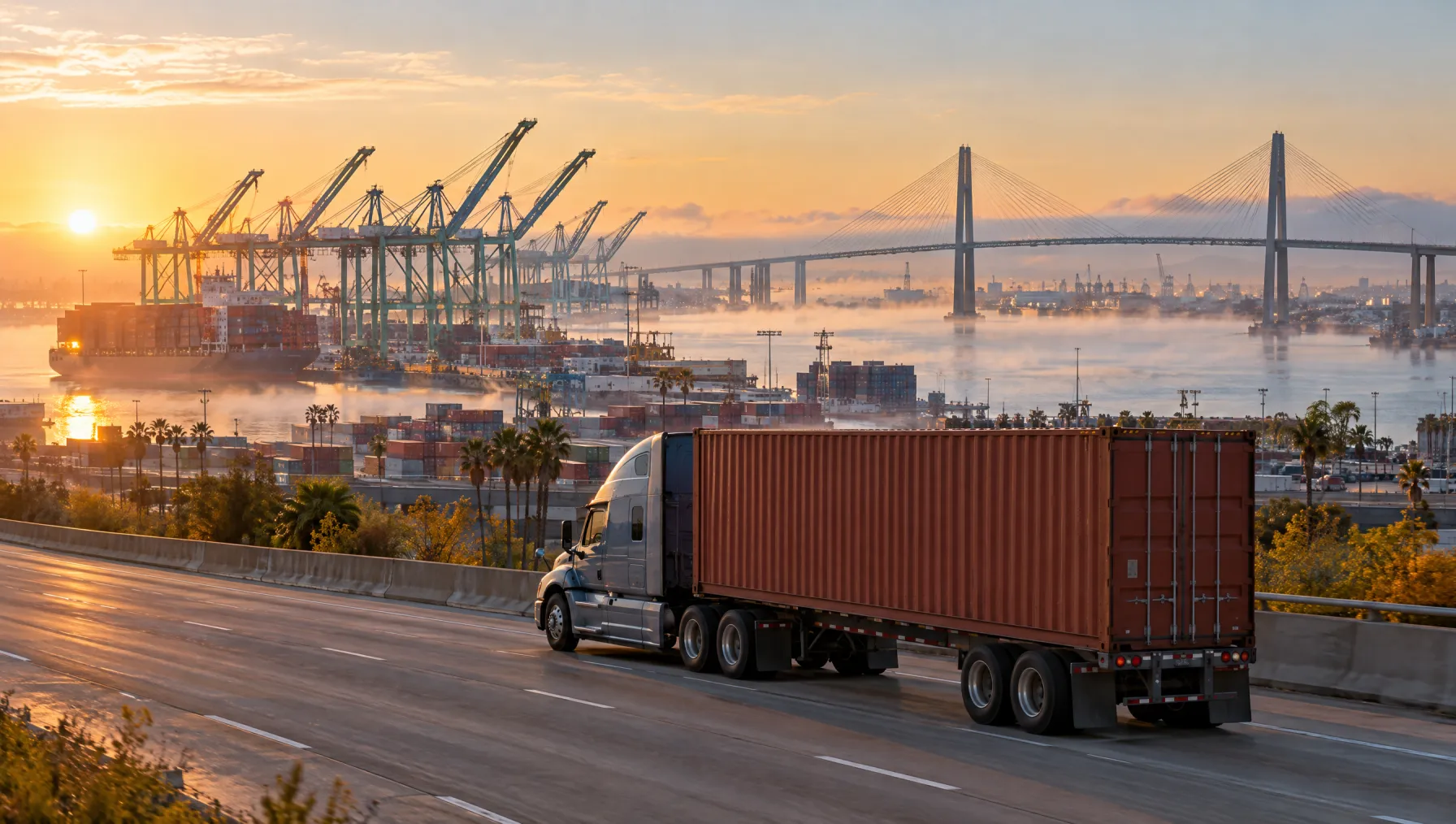
Freight in Los Angeles starts at the water. Containers come off ships at the Port of Los Angeles and the Port of Long Beach, roll up the 710 to the rail yards near the I-5 interchange or to the warehouses in Carson, Compton and Santa Fe Springs, then head east on the 10 and the 60 to Fontana, Ontario and Rialto, where the big distribution buildings sit. The basin works like one loading dock the size of a county, and the drivers who work it live along that same line, most of them on the Inland Empire end.
Pay-per-driver recruiting here means we get paid only when a driver you approved shows up in Fontana or Carson and starts pulling your freight. We do the sourcing, the calls, the Spanish-language screening and the paperwork chase. You carry no retainer and no monthly fee. If the seat is in Vernon and the driver lives in Riverside, we tell you before you both lose a week finding out the commute kills it. We would rather place one driver who stays than three who quit at the 60 and 15 interchange.
In Los Angeles the commute is the job offer. A seat in Carson and a driver in Riverside are two different markets, and the pay has to say so.
Freight in Los Angeles: what moves, and where
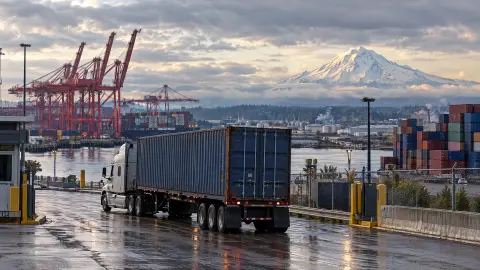
The Port of Los Angeles moved 10.2 million TEUs in 2025 across seven container terminals, with five on-dock railyards and 122 miles of track inside the port. Next door, the Port of Long Beach started construction on its Pier B On-Dock Rail Support Facility in 2024, on the port's own arithmetic that each on-dock train removes 750 truck trips. Until that yard is finished, trucks carry the load. All trucks entering the marine terminals must be on the Ports Drayage Truck Registry, and they pull containers through gates that PierPass keeps open on night and weekend OffPeak shifts at the twelve container terminals in the two ports, with a Traffic Mitigation Fee of $40.63 per TEU as of August 1, 2026. Near-dock, Union Pacific's ICTF at 2401 E. Sepulveda Blvd. in Long Beach runs 24 hours, and the Alameda Corridor's 60 miles of track carry about 32 trains a day between the harbor and the rail network near downtown. The Port of Los Angeles Clean Truck Program sets its own bar: new PDTR registrations must be model year 2014 or newer, nonexempt trucks pay a $10 per TEU Clean Truck Fund rate, and the stated target is a zero-emission truck fleet by 2035.
Follow the 710 north and the freight turns into rail and food. BNSF runs intermodal yards at 4000 E. Sheila Street in Los Angeles and 5600 E. 26th Street in Commerce, and Union Pacific has its LATC yard on North Mission Road plus the City of Industry terminal, which took over the Kansas City domestic container traffic from ICTF on September 3, 2025. Vernon, 5.2 square miles of industrial city southeast of downtown with more than 1,800 businesses and roughly 50,000 workers, is where the food, apparel, steel and logistics plants cluster. ZIP 90058, the Vernon City Hall ZIP, holds 44 carrier families, and ZIP 90670, the City Hall ZIP in Santa Fe Springs, holds another 43. These are the first-ring fleets: reefer, LTL, food distribution and shuttle work between the port and the rail heads.
Then the freight goes east. San Bernardino County's transportation authority notes that the I-10/I-15 interchange ranks as the tenth most critical truck bottleneck in the country in the American Transportation Research Institute's list, and the 60 climbs the Badlands between Moreno Valley and Beaumont on truck lanes that opened in May 2022. The two Fontana ZIPs, 92337 on the south side of the 10 and 92335 around Fontana City Hall, lead the whole metro in carrier families at 47 and 45, and ZIP 91761, the Ontario ZIP where the warehouses line Airport Drive, adds 41. BNSF's San Bernardino yard at 1535 W. 4th Street runs direct service to Chicago on the Southern Transcon, so a driver based in Rialto or Bloomington can shuttle boxes between the port, the rail ramp and a warehouse without leaving the basin. That is the geography a carrier is really hiring for: a driver who lives in the Inland Empire and does not want to cross the 57 twice a day.
- I-710 (Long Beach Freeway)
- The drayage spine from the Ports of Los Angeles and Long Beach to the railroad freight yards near the I-710/I-5 interchange. Heavy truck traffic all day, and a gate appointment decides whether the afternoon is one turn or two.
- I-10 (San Bernardino Freeway)
- The east-west freight artery across San Bernardino County to Redlands. SBCTA cites the I-10/I-15 interchange as the tenth most critical truck bottleneck in the country, and the yards on either side of it are where most Inland Empire shifts start and end.
- SR-60 (Pomona Freeway)
- The parallel route past City of Industry and Riverside toward Beaumont. RCTC's Route 60 Truck Lanes through the Badlands between Moreno Valley and Beaumont opened in May 2022 and took some of the sting out of the grade for loaded eastbound trucks.
- I-15 (Cajon Pass)
- The road to Barstow, Las Vegas and the desert warehouses. Caltrans posts chain controls over Cajon Pass in winter, and the National Weather Service's 2025 review for the region logged January Santa Ana gusts that toppled trucks in the northern Inland Empire, with a 76 mph gust in Ontario.
- I-405 (San Diego Freeway)
- Caltrans calls it the commuter corridor from the San Fernando Valley to the South Bay and Orange County, and the Sepulveda Pass repaving runs through winter 2029. A driver with a yard in Torrance or Gardena plans around it.
- I-5 (Grapevine / Tejon Pass)
- The only practical interstate north to the Central Valley. When forecasts put heavy snow at 4,500 feet or lower, Caltrans and CHP activate Operation Snowflake and can close northbound I-5 at Castaic, stranding regional drivers for a shift.
Where the 10-plus-truck fleets sit, by ZIP: 92337 (47), 92335 (45), 90058 (44), 90670 (43), 91761 (41).
Hiring drivers in Los Angeles: what we actually see
The drivers who work this market mostly live in the Inland Empire: Fontana, Rialto, Bloomington, Ontario, Riverside, Corona, Chino and Pomona. Many started in port drayage as owner-operators or on a lease and have had enough of waiting at terminal gates for a per-container rate. When they call us they ask four things in a predictable order. Is the truck 2010 or newer and legal under the CARB Truck and Bus rule. Is this a W-2 seat or a 1099 arrangement, because AB 5 has been law since January 1, 2020 and they have heard every version of the owner-operator story. Where exactly is the yard. And what shift. A carrier in Carson or Wilmington that answers all four in the first call can fill a seat with a Riverside driver. A carrier that hedges on any of them loses that driver to a Fontana fleet that pays a little less and sits ten minutes from his house.
The seats that fill fast here are local and regional dedicated runs with a fixed start time and a known yard, especially day shifts out of the 92335, 92337 and 91761 ZIPs. Reefer shuttle work between Vernon food plants and Inland Empire distribution centers fills if the pay is posted as a weekly number. Night OffPeak drayage fills with experienced port drivers who already hold a TWIC and drive a truck that is on the Drayage Truck Registry; it does not fill with people new to the harbor, because the learning curve on gate appointments and chassis is real. The seats that sit are OTR out of Southern California, where every national fleet staging freight here is bidding for the same driver, and anything that asks a South Bay driver to deadhead to Ontario before the clock starts.
What carriers get wrong here is treating Los Angeles as one hiring market. It is at least three: the harbor, the Vernon and Commerce ring, and the Inland Empire, with the 57 and the 605 as the practical dividing lines. The second mistake is posting an annual salary instead of a shift, a yard address and a weekly gross. The third is screening only in English. A large share of the drivers we talk to here prefer Spanish for the first call, and the carrier who makes them switch languages to explain their endorsements has lost rapport before the drug screen is scheduled.
What drivers in Los Angeles are paid
BLS puts the median annual wage for heavy and tractor-trailer truck drivers in the Los Angeles-Long Beach-Anaheim, CA metro area at $60,340, with a mean of $61,230 (Occupational Employment and Wage Statistics, May 2025).
The Bureau of Labor Statistics puts the 2025 median for heavy and tractor-trailer truck drivers in the Los Angeles-Long Beach-Anaheim metro at $60,340, with a mean of $61,230. Those two numbers sit close together, which tells you the market is mostly employee drivers earning similar money: port shuttle, local P&D, LTL city work and regional dedicated runs. Owner-operators pulling drayage on a per-container rate are not in this data at all, and a driver leaving that world for a W-2 seat will measure your offer against what his truck used to gross, not against the median.
Drivers also know the figure covers a region where rent in Fontana and rent in Torrance are not the same, so an annual number means little to them. What a carrier should publish is the weekly gross for the actual shift, how it is built (hourly, per stop, per load or mileage), the yard address, the start time, and whether the truck goes home. A posting that lists only an annual salary gets scrolled past.
, gets a reply from the right driver.
- $60,340
- median annual wage, Los Angeles-Long Beach-Anaheim metro
- $61,230
- mean annual wage, May 2025 (BLS OEWS 53-3032)
Rules that shape Los Angeles seats
CARB Truck and Bus Regulation: 2010 or newer engines
Since January 1, 2023, diesel trucks over 14,000 lbs GVWR operating in California must have a 2010 or newer engine, and the DMV denies registration to trucks that do not comply. Drivers here ask about the engine year before they ask about the pay. source ↗
Clean Truck Check: report, pay, test
Heavy-duty vehicles over 14,000 lbs GVWR on California roads, including out-of-state trucks, must be reported in CARB's CTC-VIS system, pay an annual compliance fee ($31.18 for 2025), and submit passing emissions tests from a credentialed tester before each compliance deadline. Missed payments or deadlines can trigger a DMV registration hold. source ↗
Five-minute idling limit
California limits idling of on-road commercial diesel vehicles to five minutes, and sleeper berth trucks have been covered since January 2008. The minimum first-offense civil penalty is $300 and later violations run $1,000 to $10,000. Drivers waiting on port gates and warehouse docks live with this every shift. source ↗
Port access: Drayage Truck Registry and TWIC
All trucks entering Port of Los Angeles marine terminals must be on the Ports Drayage Truck Registry, and new registrations must be model year 2014 or newer. The driver needs a TSA Transportation Worker Identification Credential, which costs $124 for a new applicant, is valid for five years, and should be applied for at least 60 days ahead. source ↗
Chain controls over Cajon Pass and Tejon Pass
Caltrans lists Interstate 15 over Cajon Pass and Interstate 5 over Tejon Pass among the routes where chain controls are posted. When controls are up, heavy-duty commercial vehicles must mount chains with no exemption for snow tires, and a trailer with brakes needs chains on at least one axle. source ↗
California Legal routes and the 40-foot KPRA limit
Caltrans separates STAA trucks (53-foot trailers, interstates and signed routes only) from California Legal trucks (65 feet overall) and caps kingpin-to-rear-axle at 40 feet on two-axle semitrailers and 38 feet on single-axle semitrailers. Many surface streets in Vernon, Commerce and the Inland Empire are not STAA routes, so route planning is part of the job. source ↗
The Los Angeles calendar
The hiring calendar in Los Angeles tracks the ships. 0 million TEUs, and August, at 958,355, while May was the slowest at 716,619. Summer is when port and Inland Empire warehouse carriers open seats at the same time, so a dedicated shift out of Fontana draws the most applicants and the most competition then.
Volume eased through the fall and a driver who was patient in August will take a call in November. Weather matters at the edges. The National Weather Service's 2025 review for the region logged repeated Santa Ana wind events in January that toppled trucks in the northern Inland Empire, and a few times a winter Caltrans and CHP close I-5 over the Grapevine under Operation Snowflake.
Neither shuts the basin down, but both strand regional drivers for a shift, and carriers that pay for that lost day keep those drivers. LA-based fleets do not lose drivers to a harvest or a hurricane season the way Gulf and Midwest carriers do, so the seasonal swing here is in demand, not in driver supply.
How pay-per-driver works for a Los Angeles carrier
An intake call maps your lanes, equipment, pay and home time for Los Angeles; if we can't guarantee you enough driver volume, we say so on that call. Our recruiters interview every driver by phone and verify CDL, endorsements, experience and work history against your requirements, then send complete submission packets through Onboard, our own placement platform. You pay per placed driver — half when the driver starts, half after the first 14 days — and recruiting for Los Angeles runs from our Lancaster, TX office, 1,440 miles away. The model in full is on Pay Per Driver; why the first 48 hours decide most hires is on speed to hire.
Who this fits in Los Angeles — and who it doesn't
The census counts 849 operators running 10 to 49 trucks in the Los Angeles area and 148 with 50 or more.
This works for the 849 carrier families running 10 to 49 trucks out of Fontana, Ontario, Santa Fe Springs, Vernon and Carson that need two to six drivers a quarter and do not have a recruiter on payroll. It works for the 148 families at 50 trucks and up that have a recruiter but cannot cover a sudden opening on a night drayage shift or a new dedicated account in Rialto. It works for food and reefer fleets in Vernon and Commerce that need bilingual screening done properly.
It works for any carrier here that can state the yard, the shift, the truck year and the weekly gross in one sentence, because that is what we put in front of the driver on the first call.
Who we turn down: We turn down carriers that want us to recruit drivers into a lease-purchase or 1099 arrangement they have not had a California employment attorney sign off on, because AB 5 is not something we can talk a driver around. We turn down fleets running pre-2010 engines, since the driver will ask and we will not lie. We turn down anyone who wants OTR drivers at a rate the national fleets staging in Ontario beat on day one. And we turn down the single-truck owner-operator looking for a driver, because our fee does not work for one seat at that scale.
How we think about drivers who stay: why drivers quit, and how to fix each reason. Selling to trucking companies rather than hiring drivers? That's a different service — Marketing for Trucking.
Our numbers
No third party audited these. They're our own operating numbers — the claims we make publicly about our own shop, and the standard you should hold us to on a call.
- 100+
- drivers our operation places per month
- 3,000+
- lifetime CDL hires
- 50+
- carrier partners
- 24 hrs
- to first drivers for a new carrier
More carrier feedback, in the carriers' own words: results.
Questions Los Angeles carriers ask us
Staffing and recruiting are not the same purchase — ask any agency these, then compare who does the work and when the money changes hands.
What does CDL Agency charge to place a driver with a carrier in Fontana or Carson?
One flat fee per driver who starts, and nothing else. There is no retainer, no monthly subscription and no charge for candidates you interview and pass on. We invoice half when you accept the driver and half when the driver starts, so you never pay in full for someone who signs an offer and then takes a Fontana shift closer to home. If the driver leaves inside the guarantee window, we replace him at no additional fee. A night OffPeak drayage driver with an active TWIC costs more to find than a day-shift local driver out of Ontario, and we quote that before we start calling.
Where are your recruiters? Do you have anyone in Los Angeles or the Inland Empire?
No. Our nearest office is in Lancaster, Texas, in the Dallas area, about 1,440 miles from Los Angeles. Our headquarters is in Mundelein, Illinois, with other offices in Romeoville, Illinois and North Miami, Florida. We have no yard, no walk-in location and no staff sitting in Southern California, and we will not pretend otherwise. Los Angeles work runs by phone, text and video. Our recruiters know the 710, the 10 and the 60 the way a dispatcher does, because that is what every call is about, but the drug screen, road test and orientation happen at your yard or at a clinic near where the driver lives.
How do you handle the drug test, Clearinghouse query and paperwork for a driver who lives in Riverside and will work out of your Vernon yard?
We collect the application, the ten-year employment history, the medical card and the CDL copy before you see the file, and we get the driver registered in the FMCSA Drug and Alcohol Clearinghouse so he can give electronic consent for your pre-employment full query the day you ask. For the DOT drug screen we book a collection site near the driver, usually in Riverside or Ontario, rather than asking him to drive to Vernon unpaid. The MVR, PSP and previous-employer checks run in parallel. You get a single folder with every document, and we chase the former employers who do not answer, which in this market is often a drayage company that no longer exists.
What home time do drivers expect on lanes that run from the ports into the Inland Empire?
Home every night, and most of them mean it as a hard condition. The port-to-warehouse shuttle, the Vernon reefer run and the rail-ramp dray out of San Bernardino are all day trips, so a driver who takes a local seat here expects to sleep in Fontana or Rialto and will quit a job that turns into surprise layovers. Regional lanes to Phoenix, Las Vegas or the Central Valley sell as home two or three nights a week plus the weekend, and drivers accept that if the schedule is fixed. OTR out of Southern California is a different conversation: the driver is comparing you with every national fleet that stages in Ontario, and home time has to be stated in days per month.
A lot of our Santa Fe Springs drivers are Spanish speakers. Can you recruit and screen in Spanish?
Yes, and in this market we would be useless if we could not. A large share of the drivers who call us about Los Angeles seats prefer Spanish for the first conversation, and we run the whole screen in Spanish when the driver asks: the application, the employment history, the endorsement questions, the explanation of your pay structure and shift. What we do not do is translate promises you have not made. If a driver asks whether the seat is W-2 or 1099, or whether the truck is 2010 or newer, we give him the answer you gave us, in the language he asked in. A recruiter who guesses on those points creates a quit in week two.
How many carriers am I competing with for the same drivers around the 10 and the 15?
The FMCSA census as of September 26, 2026 shows 16,497 active carrier registrations based in the Los Angeles and Inland Empire cities we track, running 87,881 trucks between them. Of those, 15,477 are fleets of one to nine trucks, 849 carrier families run 10 to 49, and 148 run 50 or more. The five ZIPs with the most carriers are 92337 and 92335 in Fontana, 90058 in Vernon, 90670 in Santa Fe Springs and 91761 in Ontario. Fontana's two top ZIPs alone hold 47 and 45 carrier families, so a driver living there has dozens of yards within a short drive. A vague posting disappears there, and a specific one, with the yard, the shift, the engine year and the weekly gross, is how a mid-size fleet beats the big logos.
Drivers in Los Angeles: browse current CDL-A jobs or get matched to a carrier — free for drivers.
Sources
- Port of Los Angeles, Facts and Figures (2025 TEUs, seven terminals, five on-dock railyards, 122 miles of rail)
- Port of Los Angeles, Historical TEU Statistics 2025 (monthly volumes)
- Port of Los Angeles, Clean Truck Program (PDTR requirement, 2014+ model year, $10 per TEU Clean Truck Fund rate, 2035 goal)
- Port of Long Beach, The Green Port Through the Years (750 truck trips per on-dock train; Pier B construction start 2024)
- PierPass, TMF increase to $40.63 per TEU effective August 1, 2026 and OffPeak program
- Alameda Corridor Transportation Authority (60 miles of track, 32 daily trains)
- Union Pacific, ICTF Intermodal Terminal, Long Beach (address, 24-hour operation)
- Union Pacific, domestic containers to KCIT move from ICTF to City of Industry (Sept. 3, 2025)
- Union Pacific, Los Angeles area intermodal terminals (LATC North Mission Road, City of Industry, ICTF)
- BNSF, Facility Listings (Los Angeles, Commerce, San Bernardino intermodal addresses)
- BNSF Rail Talk, San Bernardino and the Southern Transcon (direct service to Chicago)
- Caltrans, I-710 and Florence Interchange project (truck traffic between the ports and freight yards near I-710/I-5)
- San Bernardino County Transportation Authority, I-10 Corridor Project (I-10/I-15 interchange ATRI bottleneck ranking)
- Riverside County Transportation Commission, 2023 Briefing Book (Route 60 Truck Lanes, Badlands, opened May 2022)
- Caltrans District 7, Sepulveda Pass (I-405) Pavement Rehabilitation Project
- Caltrans, Operation Snowflake (I-5 Grapevine closures, 4,500-foot snow threshold, Castaic)
- Caltrans, Truck Chain Requirements (Cajon Pass, Tejon Pass)
- Caltrans, Quick Guide: Truck Lengths and Routes (STAA vs California Legal, KPRA)
- CARB, Truck and Bus Regulation
- CARB, Clean Truck Check Overview Fact Sheet
- CARB, commercial diesel idling restrictions (five-minute limit, penalties)
- TSA, Transportation Worker Identification Credential (TWIC)
- California Labor and Workforce Development Agency, AB 5 employment status
- FMCSA Drug and Alcohol Clearinghouse FAQ (registration, consent, queries)
- National Weather Service glossary, Santa Ana wind
- National Weather Service San Diego, 2025 Weather Year in Review (January Santa Ana events, trucks toppled, 76 mph gust in Ontario)
- City of Vernon, About Vernon (5.2 square miles, 1,800+ businesses, about 50,000 employees, industries)
- City of Vernon, City Hall facility listing (4305 S. Santa Fe Ave., Vernon, CA 90058)
- City of Fontana, South Fontana Air Filter Distribution (ZIP 92337, residents south of I-10)
- City of Fontana, City Hall (16860 Valencia Avenue, Fontana, CA 92335)
- City of Santa Fe Springs (City Hall, 11710 E. Telegraph Road, Santa Fe Springs, CA 90670)
- City of Ontario, Properties for Lease report, September 2024 (warehouse listings on Airport Drive, Ontario 91761)
1 FMCSA Company Census (2026-09-26): active carriers based in Los Angeles, Long Beach, Carson, Wilmington, Compton, Santa Fe Springs, Commerce, Vernon, City of Industry, Fontana, Ontario, Rancho Cucamonga, Rialto, Bloomington, Riverside, Corona, Chino, Pomona, Gardena, Torrance, Montebello, Pico Rivera; MCS-150 filed in the last 24 months; 1–20,000 trucks; fewer than 10 buses. 10+ truck counts merge registrations sharing an address or D-U-N-S number. Totals and the 1–9 band count active USDOT registrations; fleet sizes are self-reported on the MCS-150, so read them as a scale, not a headcount.
Wages: U.S. Bureau of Labor Statistics, OEWS May 2025, occupation 53-3032, series OEUM003108000000053303213 (median) and OEUM003108000000053303204 (mean).
Written by
Andrius Pletniovas — Founder, CDL Agency
Andrius Pletniovas (Andrius Digital) is the founder of CDL Agency, a truck-driver recruiting and marketing company that has placed 3,000+ CDL drivers for 50+ carriers across the U.S. He writes about driver recruiting, retention, and the trucking market from running the agency every day.
More about Andrius →Official personal website →