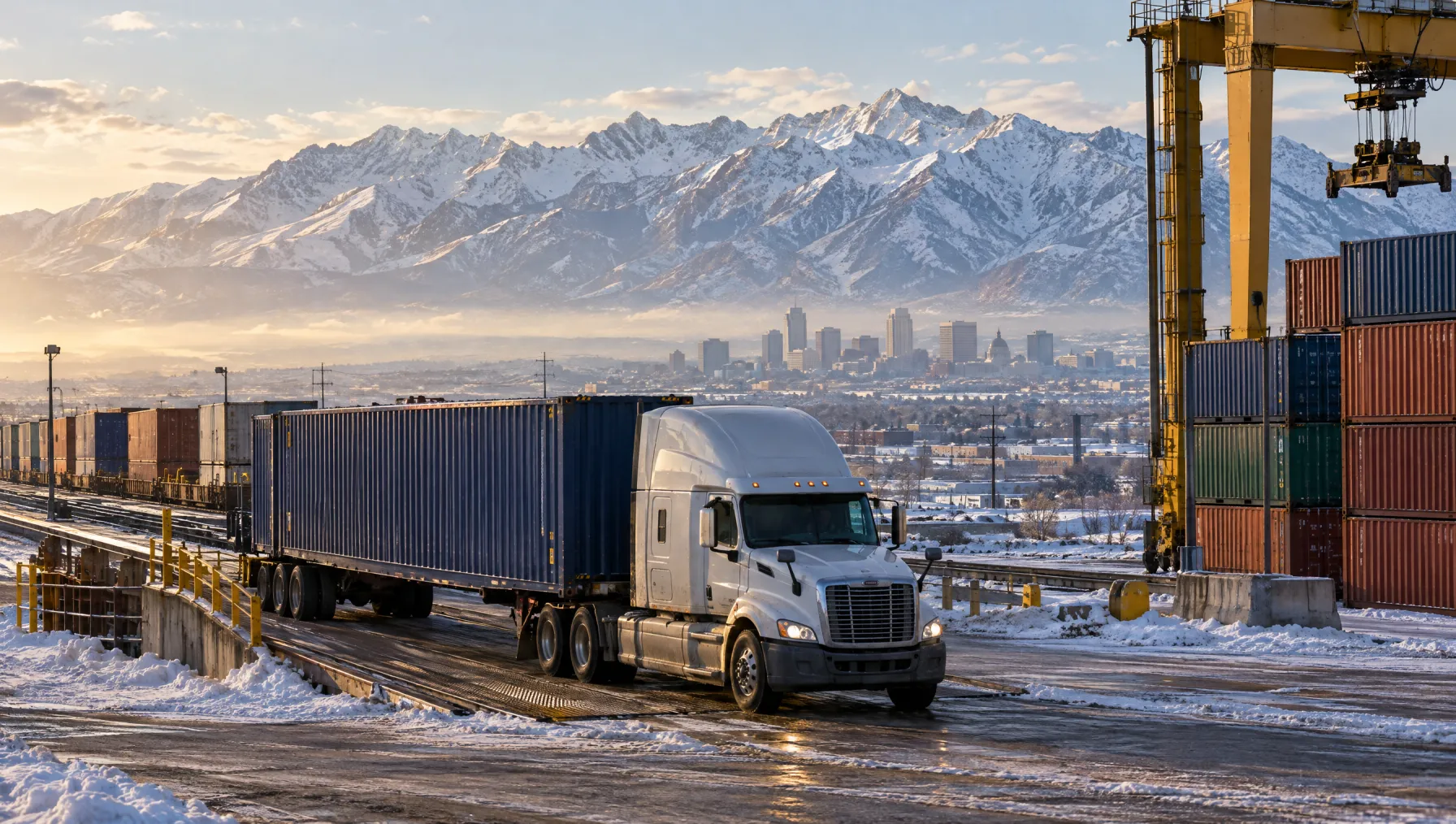
FMCSA's carrier census lists 3,576 active carriers based in the Salt Lake City area — 3,149 with one to nine trucks, 318 operators running 10 to 49, and 101 with 50 or more — roughly 37,727 power units between them. 1
The Union Pacific ramp at 1045 South 5500 West runs seven days, twenty-four hours, and the roadability lanes open at six in the morning. By the time the sun clears the Wasatch, containers that came over from the coast overnight are rolling east on I-80 or up and down I-15. That ramp, and the inland port land around it, is why so many fleets park on the west side of this valley. It is also why a Salt Lake carrier is never short of competition for a driver. A national fleet with a Salt Lake domicile can post a sign-on bonus on Monday and your strongest regional driver can be in their orientation by Thursday.
Pay-per-driver recruiting changes who carries that risk. We do not bill you for a job post or a month of sourcing. We bill you for a driver who shows up to your yard in West Valley City or Ogden, passes your road test, and starts. If the seat does not fill, you have paid us nothing. For a carrier here that is the whole point: you can compete against a megacarrier's Salt Lake terminal without funding a recruiting department before you know whether it works.
In Salt Lake the yard address is the recruiting pitch: a driver in Lehi will not report to Ogden, no matter what the bonus says.
Freight in Salt Lake City: what moves, and where
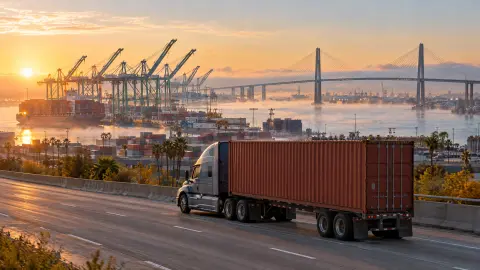
Salt Lake City is a transload market first and a destination market second. I-15 runs north to Idaho and south to Las Vegas; I-80 runs from the Wendover port of entry at the Nevada line, east through the valley and into the mountains toward the Echo port of entry at milepost 180, with the Wyoming line beyond it. Freight that comes off the water in California and is headed for the Rockies and the northern plains often changes hands here. The Union Pacific intermodal terminal on the west side handles containers and trailers on flatcar, gates with precision gating technology and dedicated lanes for UPGo app users, and never closes. The Utah Inland Port Authority's Northwest Quadrant project area sits on the same west side: sixteen thousand acres flanked by I-80, I-215 and I-15, with Salt Lake City International Airport's air cargo next door. That is where the new warehouses are and where the drayage work is.
The fleets sit where the freight is. The densest ZIP for carrier registrations in the metro is 84104, the same west-side ZIP as the UP ramp. Next come 84119 in West Valley City, 84401 in Ogden, and 84115 and 84107 along State Street in South Salt Lake and Murray. C.R. England, which has run dedicated, intermodal and over-the-road freight from here since 1920, keeps its headquarters at 4701 West 2100 South with more than four thousand drivers. Pride Transport is a Salt Lake family fleet with more than forty-five years on the road. Savage, which began in American Fork in 1946, runs trucking, rail and transload work. The authority's Tooele Valley project area, 584 acres in Tooele County reached by Burmester Road and I-80, is served by the Savage Tooele Railroad, a short line that opened in 2025, so the industrial footprint is stretching west along I-80 toward Tooele and Grantsville.
Industrial freight here is heavier than people expect. Rio Tinto's Kennecott operation, run from South Jordan, has mined Bingham Canyon since 1903 and operates one of only two copper smelters in the United States. Tooele Army Depot, about forty miles southwest of the city on 43,000 acres, moves ammunition by rail and truck and can outload 321 containers a day. North on I-15 in Davis County, HF Sinclair lists a refinery in Woods Cross and Big West Oil runs a locally operated refinery, so tanker and hazmat work lives in Woods Cross and the Davis County towns around it. Ogden and Clearfield form a second fleet cluster working I-15 toward the Perry port of entry; Lehi, American Fork, Provo and Orem form a third, mostly local and regional.
- I-15
- The spine of the market. Ogden to Provo is one commute shed on the map but three labor sheds in practice, and the Perry port of entry at milepost 358.8 is the first scale northbound.
- I-80 West
- Past the inland port and the airport, across the salt flats to the Wendover port of entry at milepost 3. UDOT lets eastbound oversize loads obtain their permit on arrival there instead of before entering the state.
- I-80 East
- Climbs out of the valley toward the Echo port of entry at milepost 180, the last UDOT scale before Wyoming. UDOT publishes a traction-law summary sheet with a map of the affected state routes, and this grade is the one drivers ask about before they sign.
- I-215
- The belt route that lets a west-side driver reach Murray, Midvale and the State Street fleets without crossing downtown. Local P&D and intermodal shuttles live on it all day.
- 5600 West / Northwest Quadrant
- The surface grid between I-80 and the UP ramp where inland port warehouses are rising. Drayage drivers run short turns here under Salt Lake City's two-minute idling limit.
Where the 10-plus-truck fleets sit, by ZIP: 84104 (66), 84119 (24), 84401 (24), 84115 (19), 84107 (17).
Hiring drivers in Salt Lake City: what we actually see
The driver pool here is steady and local. Most people we place in the Salt Lake market have lived along the Wasatch Front for years, often with family in the same county, and they are choosing between a handful of west-side terminals they can name. They ask three questions first: what is the home time, is the schedule real, and does the equipment start in January. The sign-on bonus comes fourth. A driver who has worked for a large carrier's Salt Lake domicile has usually seen a bonus claw back and a dispatch promise fall apart, and he is skeptical of both. Carriers that win here publish the real schedule, including the Saturday that sometimes happens, and keep it.
Commute geography matters more than in flatter markets. A driver in Lehi will not report to a yard in Ogden, and a driver in Layton will not report to Provo. I-15 looks like one metro, but it is three labor sheds: Weber and Davis County around Ogden, Clearfield and Layton; Salt Lake County from North Salt Lake to Draper; and Utah County from Lehi to Spanish Fork. A yard in West Valley City recruits from the middle shed and from Tooele, where the drive is easy. Local day-cab seats fill fastest when the pay is posted clearly. Regional seats with two nights out and weekends home fill next. Over-the-road seats with ten to fourteen days out are the slow ones, because the national fleets on the west side hire for the same lanes with bigger budgets.
What carriers get wrong here is the winter. They post a job in October without saying who chains the truck on I-80 or whether the driver runs the canyons under traction law. Drivers ask. They also underestimate the hazmat and tanker pool around the Davis County refineries: those drivers are few, they know each other, and they move for schedule, not for a few cents a mile.
What drivers in Salt Lake City are paid
BLS puts the median annual wage for heavy and tractor-trailer truck drivers in the Salt Lake City-Murray, UT metro area at $62,310, with a mean of $62,500 (Occupational Employment and Wage Statistics, May 2025).
The BLS puts the 2025 median for heavy and tractor-trailer drivers in the Salt Lake City-Murray metro at $62,310 and the mean at $62,500. Two numbers within two hundred dollars of each other tell you the distribution is flat: there are few outliers pulling the average up, which is what you see where a handful of large terminals running similar regional and dedicated freight set the scale. Local day-cab and intermodal work generally sits under the median.
Regional reefer and dedicated work with a national carrier generally sits at or above it. Tanker and hazmat around the Davis County refineries is its own pool. For a carrier posting a job here, publish a weekly range in dollars rather than a per-mile figure, and say what the median driver in the seat actually took home last year.
Drivers who have run for the big terminals already know the scale and will compare your number to it.
- $62,310
- median annual wage, Salt Lake City-Murray metro
- $62,500
- mean annual wage, May 2025 (BLS OEWS 53-3032)
Rules that shape Salt Lake City seats
Utah traction law for vehicles over 12,000 lbs GVWR
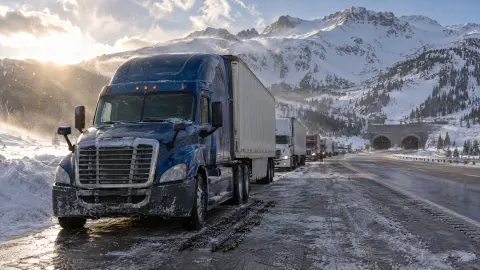
Utah's traction law takes effect when UDOT, UHP or a designated local law enforcement agency determines that road conditions warrant it, and it can be posted before a storm arrives. In Big and Little Cottonwood canyons, the strictest Class 3 routes, vehicles over 12,000 pounds GVWR without all-wheel drive must carry traction devices on all rear drive tires, and flashing beacons outside the canyons signal that the requirement is on. UDOT publishes a summary sheet and route map for the rest of the state highway system. source ↗
Salt Lake City two-minute idling limit
Salt Lake City's idle-free ordinance sets a two-minute limit on unnecessary idling on public property and private property open to the public, including parking lots. Exemptions cover the manufacturer's warm-up period for a turbocharged heavy-duty vehicle and auxiliary equipment such as a refrigeration unit, lift, crane or pump. The ordinance was updated in 2021 so the city issues one warning before fines. source ↗
Utah legal size limits
Legal dimensions on Utah highways are 14 feet high, 8 feet 6 inches wide, 53 feet for a semitrailer and 61 feet of combined trailer length on doubles, measured from the front of the lead trailer to the back of the rear trailer. source ↗
LCV authority and oversize permits at the border
A truck and trailer of 88 to 92 feet, a truck and two trailers of 92 to 95 feet, or a tractor with two or three trailers over 81 feet of cargo-carrying length needs LCV authority from UDOT's Motor Carrier Division and may run interstates and freeways only, with no more than one traveled mile off the route for food, fuel or a terminal. Oversize permits must be obtained before operating in Utah, except for loads entering at St. George on I-15, westbound at Echo on I-80 or eastbound at Wendover on I-80, where the permit can be handled on arrival. source ↗
Ports of entry on every exit from the valley
UDOT's Motor Carrier Division runs ports of entry at Perry on I-15 (milepost 358.8), Wendover on I-80 at the Nevada line (milepost 3), Echo on I-80 east of the valley (milepost 180) and Daniels on US-40 (milepost 22). A truck leaving the Wasatch Front in any direction crosses a scale before it leaves the state. source ↗
The Salt Lake City calendar
The hiring calendar here follows the mountains more than the retail calendar. In our experience the national terminals on the west side hire hardest in late summer and fall, when import freight moves east ahead of the holidays, and that is when the pool tightens. The first real snow on I-80 toward Echo, usually November, splits the market: drivers who do not want to chain look for local and I-15 regional seats, and carriers running east lose people.
Deep winter brings the inversions, about five to six multi-day episodes a winter by Utah DEQ's count, and the city's two-minute idling limit gets enforced at public docks. Spring is the easiest window. Applications climb in March and April as the canyons clear, construction hauling restarts, and drivers who ran over the road all winter come home looking for a home-daily seat.
How pay-per-driver works for a Salt Lake City carrier
An intake call maps your lanes, equipment, pay and home time for Salt Lake City; if we can't guarantee you enough driver volume, we say so on that call. Our recruiters interview every driver by phone and verify CDL, endorsements, experience and work history against your requirements, then send complete submission packets through Onboard, our own placement platform. You pay per placed driver — half when the driver starts, half after the first 14 days — and recruiting for Salt Lake City runs from our Lancaster, TX office, 1,250 miles away. The model in full is on Pay Per Driver; why the first 48 hours decide most hires is on speed to hire.
Who this fits in Salt Lake City — and who it doesn't
The census counts 318 operators running 10 to 49 trucks in the Salt Lake City area and 101 with 50 or more.
This works for the 318 fleets in the ten-to-forty-nine-truck band and the 101 at fifty trucks and up that already run defined lanes out of the valley and need a steady pipeline rather than a one-time push. A regional reefer or dry van carrier in West Valley City running Denver, Boise, Reno and Las Vegas turns. A drayage operator shuttling boxes off the UP ramp into the Northwest Quadrant warehouses.
A tanker fleet in Woods Cross or North Salt Lake that needs hazmat endorsements and can prove its schedule. An Ogden or Clearfield dedicated carrier working I-15. If you can tell us the yard address, the real home time and the weekly pay in dollars, we can fill the seat and stand behind it.
Who we turn down: We turn down carriers that list the job as Salt Lake City when the yard is in Tooele or Spanish Fork and will not say so, because the applications are wasted on people who will not make the drive. We turn down the three-truck fleets in the one-to-nine band that want one driver, once, with no plan for the next one. And we turn down anyone who wants us to advertise a pay figure the median driver in the seat did not earn last year. In this market the drivers already know the scale.
How we think about drivers who stay: why drivers quit, and how to fix each reason. Selling to trucking companies rather than hiring drivers? That's a different service — Marketing for Trucking.
Our numbers
No third party audited these. They're our own operating numbers — the claims we make publicly about our own shop, and the standard you should hold us to on a call.
- 100+
- drivers our operation places per month
- 3,000+
- lifetime CDL hires
- 50+
- carrier partners
- 24 hrs
- to first drivers for a new carrier
More carrier feedback, in the carriers' own words: results.
Questions Salt Lake City carriers ask us
Staffing and recruiting are not the same purchase — ask any agency these, then compare who does the work and when the money changes hands.
What does CDL Agency charge a Salt Lake City carrier to fill a seat on the west side?
A per-driver placement fee, quoted for your engagement, not a retainer and not a per-post fee. You pay half when the driver starts and the other half after the first fourteen days, once the driver is still on your dispatch board. Retention terms are set in the engagement itself, and we do not promise a blanket free replacement on a web page. Sourcing, screening and the interviews that do not turn into a hire cost you nothing. For a West Valley City or Ogden fleet competing against a national carrier's Salt Lake terminal, that means a real recruiting effort for a regional or drayage seat without funding a department first.
Where are your recruiters? Do you have anyone in the Salt Lake valley?
No. We have no office, yard or staff in Utah. Our nearest office is Lancaster, Texas, in the Dallas area, about 1,250 miles from Salt Lake City. Our other offices are Mundelein and Romeoville in Illinois and North Miami, Florida. Utah recruiting runs by phone, text and video from Texas and Illinois. Our recruiters know the three labor sheds along I-15, the UP ramp hours and the traction law, because that is what drivers ask about. If you need someone physically in your yard in 84104, we are not that company.
Why do drivers leave a Salt Lake carrier in the first ninety days, and how does the fourteen-day retention term work?
Two reasons come up most. The commute: a driver from Layton took a job in Draper because the pay looked good, and by week six the I-15 drive at shift change has worn him down. The schedule: a job sold as home daily turned into two nights out when a Denver load needed covering. We screen for both before we send a candidate, which is why we ask for the real yard address and the real schedule. Under the fourteen-day term, the second half of our fee is not due until the driver has been on your board for two weeks. What happens if he leaves inside that window is written into the engagement, not promised on this page. After that, retention comes down to keeping your word on home time.
When is it hardest to hire a driver in the Salt Lake market, and when is it easiest?
Hardest is October through December. In our experience the national terminals on the west side hire hardest ahead of the holidays, and the first snow on I-80 toward Echo pushes drivers who do not want to chain into the same local and I-15 regional seats everyone else is filling. January and February are slow for other reasons: inversions, cold starts, drivers staying put. Easiest is March through May, when the canyons clear, construction hauling restarts and drivers who ran over the road all winter come home to Utah County and Davis County looking for a seat that gets them home. Post in late February so you are first in line.
Do drivers who live along the Wasatch Front prefer local, regional or over-the-road work?
Local first, regional second, over the road a distant third. The drivers here are settled, often with family in the same county, and a home-daily day-cab seat in West Valley City or Murray draws the most applications of anything we post. Regional runs that keep a driver out two nights and home for the weekend, Denver and back, Boise and back, Las Vegas and back, fill well if the schedule is real. Over-the-road seats with ten to fourteen days out are the hard ones, because drivers who want that life usually already work for one of the large carriers headquartered or domiciled here. A small fleet beats them only on home time and on keeping promises.
What should I know about drayage and intermodal seats off the Union Pacific ramp at 5500 West?
The terminal runs seven days, twenty-four hours, but roadability runs six in the morning to ten-thirty at night, so a chassis problem late at night waits until morning. The gate uses precision gating technology with dedicated lanes for drivers on the UPGo app, and drivers who have not used the app lose time until they do. Appointments and chassis availability drive the day more than miles. A drayage driver might run six to eight short turns between the ramp and the Northwest Quadrant warehouses, with the two-minute city idling limit at every public dock. Drivers who know this work want to be paid by the move or by the hour, not by the mile. Post the pay that way and you will hear from them.
Drivers in Salt Lake City: browse current CDL-A jobs or get matched to a carrier — free for drivers.
Sources
- Union Pacific, Salt Lake City Intermodal Terminal (address, hours, gate technology)
- Utah Inland Port Authority, Northwest Quadrant project area
- Utah Inland Port Authority, Tooele Valley project area
- UDOT Cottonwood Canyons, Utah traction law
- UDOT, Utah traction law summary sheet and route map
- UDOT Motor Carrier Division, legal height, width and length
- UDOT Motor Carrier Division, oversize/overweight provisions and LCV authority
- UDOT Motor Carrier Division, ports of entry
- Salt Lake City, Idle Free Ordinance
- Salt Lake City, air quality and winter inversions
- Utah DEQ, winter inversions
- U.S. Army, Tooele Army Depot
- Rio Tinto, Kennecott operations
- C.R. England, About Us (headquarters, fleet)
- Pride Transport (Salt Lake City family fleet)
- Savage Companies, company history
- HF Sinclair, refining facilities (Woods Cross, UT)
- Big West Oil, locally operated refinery in Davis County
- BLS OEWS, heavy and tractor-trailer truck drivers, Salt Lake City-Murray annual median wage series
- BLS OEWS, heavy and tractor-trailer truck drivers, Salt Lake City-Murray annual mean wage series
1 FMCSA Company Census (2026-09-26): active carriers based in Salt Lake City, West Valley City, West Jordan, South Jordan, Murray, Midvale, Sandy, Draper, Ogden, Clearfield, Layton, Farmington, North Salt Lake, Woods Cross, Bountiful, Tooele, Grantsville, Lehi, American Fork, Spanish Fork, Provo, Orem; MCS-150 filed in the last 24 months; 1–20,000 trucks; fewer than 10 buses. 10+ truck counts merge registrations sharing an address or D-U-N-S number. Totals and the 1–9 band count active USDOT registrations; fleet sizes are self-reported on the MCS-150, so read them as a scale, not a headcount.
Wages: U.S. Bureau of Labor Statistics, OEWS May 2025, occupation 53-3032, series OEUM004162000000053303213 (median) and OEUM004162000000053303204 (mean).
Written by
Andrius Pletniovas — Founder, CDL Agency
Andrius Pletniovas (Andrius Digital) is the founder of CDL Agency, a truck-driver recruiting and marketing company that has placed 3,000+ CDL drivers for 50+ carriers across the U.S. He writes about driver recruiting, retention, and the trucking market from running the agency every day.
More about Andrius →Official personal website →